

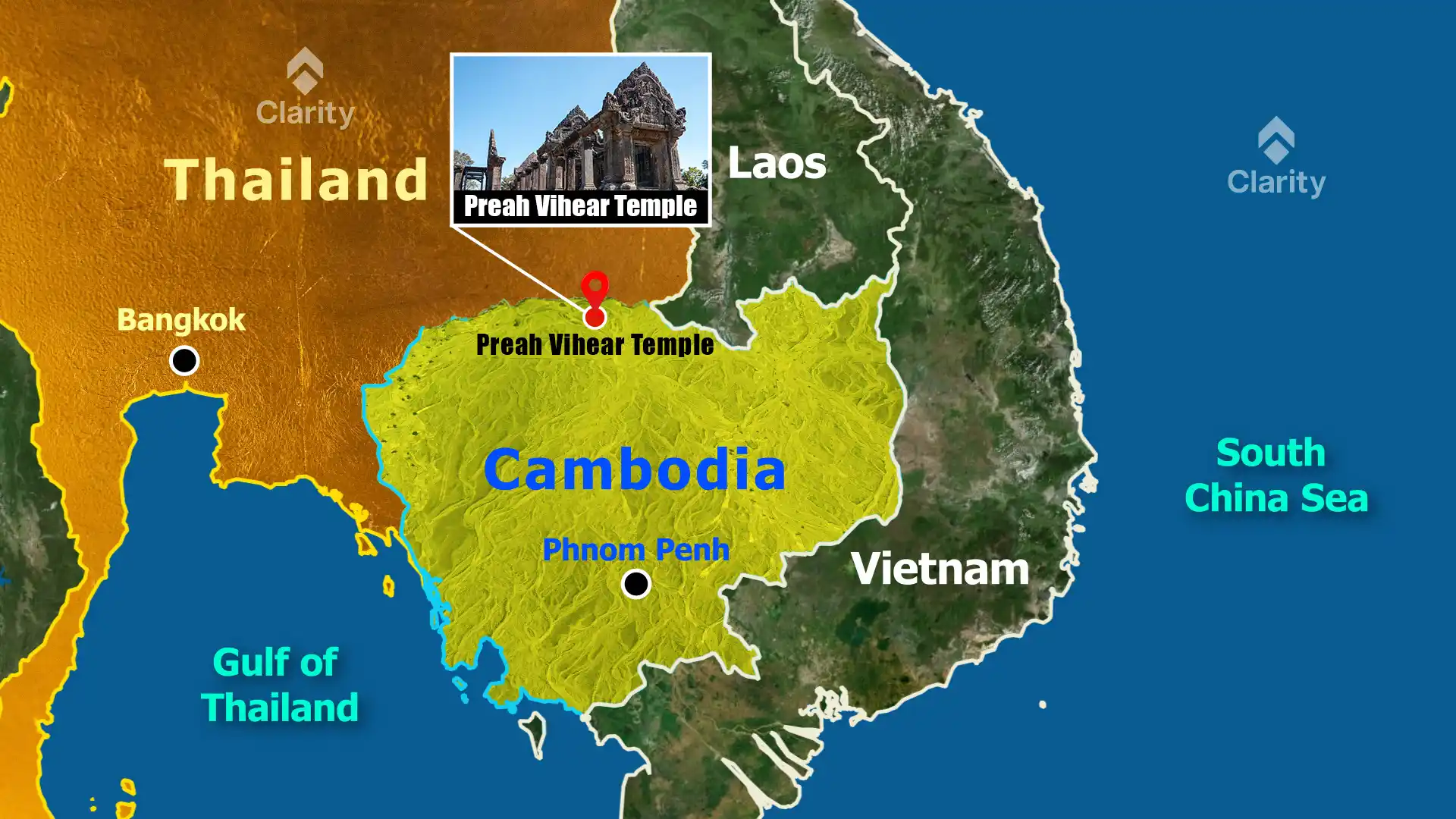
Why in news?
Fighting erupted again along the Cambodia–Thailand border near the Preah Vihear Temple, causing damage to conservation facilities and raising fears for the safety of the ancient monument. India and UNESCO have urged both countries to protect the site, which is recognised as a UNESCO World Heritage property and part of our shared human heritage.
Background
Preah Vihear is a Hindu temple dedicated to Lord Shiva. It was built in the 11th and 12th centuries by Khmer kings Suryavarman I and II. The temple sits atop a 525‑metre‑high cliff in the Dângrêk Mountains, offering sweeping views of the plains below. Unlike most Khmer temples oriented east–west, Preah Vihear is aligned along a north–south axis to follow the ridge line.
After colonial borders were drawn between French Indochina and Siam (now Cambodia and Thailand), the temple’s location became disputed. In 1962 the International Court of Justice (ICJ) ruled that the temple belongs to Cambodia. Tensions flared again when UNESCO listed Preah Vihear as a World Heritage Site in 2008, prompting clashes between Cambodian and Thai forces. In 2013 the ICJ reaffirmed that Cambodia has sovereignty over the temple and surrounding areas.
Recent clashes
- Damage to heritage: In early December 2025, artillery fire and airstrikes damaged buildings used to conserve artefacts and manuscripts near the temple complex. There were reports of civilian casualties and forced evacuations.
- International appeals: India’s Ministry of External Affairs described Preah Vihear as a shared heritage site and called on both sides to exercise restraint. UNESCO urged adherence to the 1954 Hague Convention on protecting cultural property during armed conflict and offered technical assistance.
- Disputed border: The latest clashes stem from differing interpretations of the border demarcation around the cliff. Both countries deploy troops near the site, and any incident risks escalation.
Architecture and significance
- Temple layout: The complex consists of a series of five sanctuaries linked by long causeways and staircases. Intricate stone carvings depict scenes from Hindu mythology. The main sanctuary houses a linga (symbol of Shiva) and originally held royal inscriptions.
- Cultural fusion: Though a Hindu shrine, the temple reflects a blend of Khmer and Hindu art and demonstrates the political and spiritual power of the Khmer Empire at its height.
- Symbol of identity: For Cambodians, the temple is a source of national pride. For Thais, it recalls ancient ties to the Khmer civilisation. This shared heritage underscores why its protection is important for both peoples.
Way forward
Peaceful dialogue, joint conservation efforts and adherence to international rulings are essential to safeguarding Preah Vihear. Cultural sites should never become collateral damage in political disputes. Ensuring the safety of local communities and preserving the temple’s integrity will benefit both nations and the world.
Conclusion
The recent violence near Preah Vihear highlights how historical grievances can threaten cultural treasures. Protecting the temple requires respect for law, cooperation and recognition that heritage belongs to humanity as a whole.
Source: NOA