

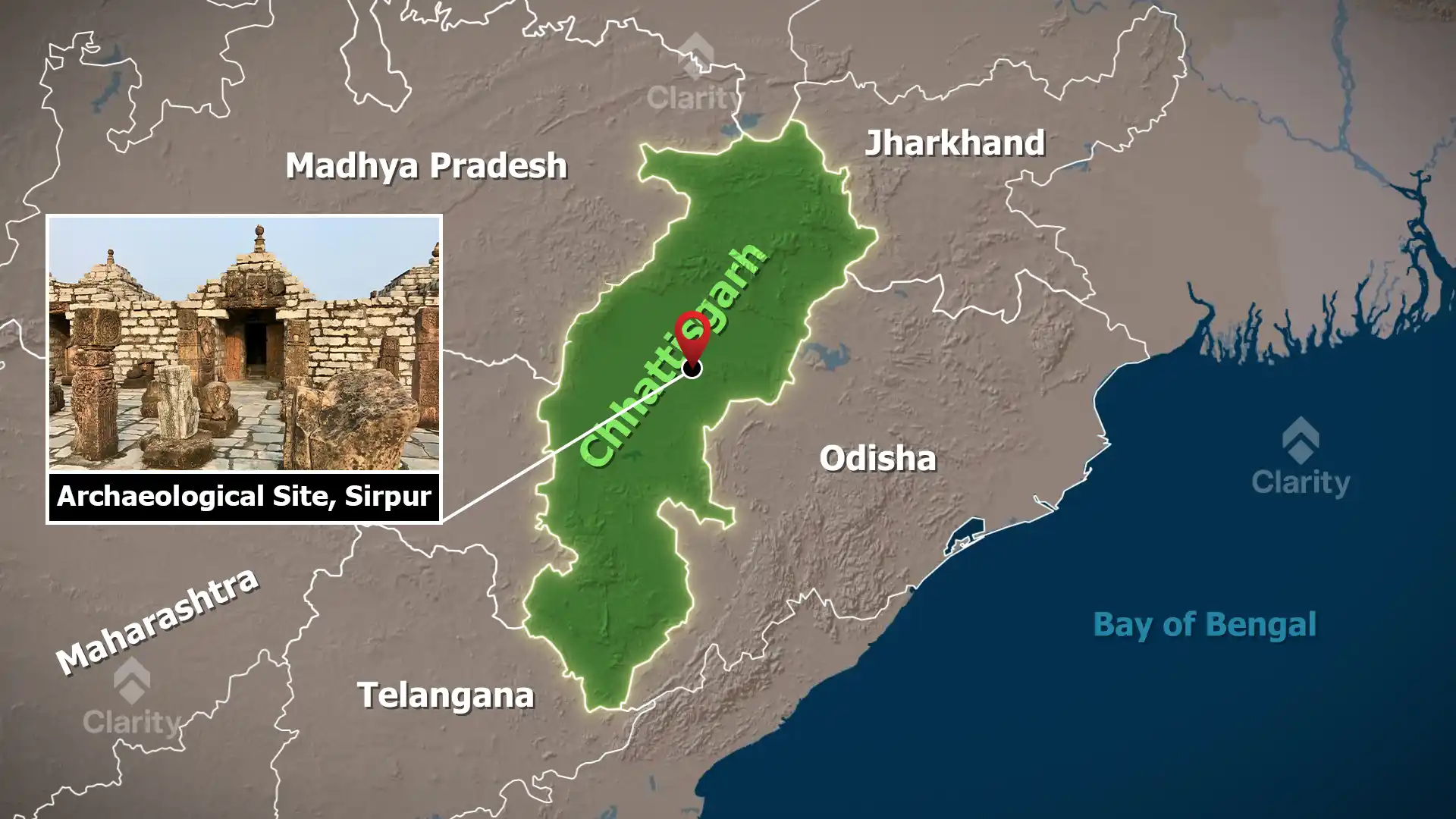
Why in news?
The Government of Chhattisgarh has announced plans to develop the ancient town of Sirpur so that it can be proposed for inclusion on UNESCO’s World Heritage List. The initiative will upgrade visitor infrastructure, restore monuments and showcase digital reconstructions to highlight Sirpur’s unique multi‑religious heritage.
Background
Sirpur is located on the banks of the Mahanadi River in today’s Mahasamund district of Chhattisgarh. Between the 5th and 12th centuries it flourished as the capital of the Dakshina Kosala kingdom under the Panduvanshi and later Somavamshi dynasties. Archaeological excavations, first undertaken by B.P.L. Bhowmik in the 1950s and continued by the Archaeological Survey of India, have revealed a cosmopolitan urban centre with Hindu, Buddhist and Jain monuments. These include:
- Lakshmana Temple: A 7th‑century brick temple dedicated to Vishnu, notable for its curvilinear tower, finely carved entrance and sanctum built entirely of bricks.
- Surang Tila complex: A stepped platform rising about 8 metres with a cluster of shrines arranged in the Panchayatana style (a central shrine surrounded by four smaller ones). It reflects sophisticated engineering and is thought to have been built in the 8th century.
- Buddhist viharas and stupas: Monastic complexes such as the 8th‑century Anand Prabhu Kudi Vihar and twin monolithic stupas indicate that Sirpur was a major seat of Buddhism. Inscriptions record visits by Chinese pilgrim Xuanzang.
- Jain temples and market complex: Evidence of Jain worship includes sculptural panels, while a 6th‑century market complex with nine rooms (navaratna) illustrates the town’s role as a trading hub.
Planned improvements
- Visitor amenities: Authorities propose paved pathways, battery‑operated vehicles, clean drinking water points and accessible toilets to make the site more visitor‑friendly.
- Digital and interpretive aids: The plan includes creating 3D reconstructions of important monuments, installing interactive exhibits, and setting up interpretation centres + explaining the social and religious history of Sirpur.
- Heritage clusters and walks: Monuments will be grouped into thematic clusters with signboards and guided heritage walks to help visitors appreciate the site’s diversity. Local youths will be trained as guides to foster community participation.
Conclusion
Sirpur’s candidacy for the UNESCO World Heritage List underscores its importance as a melting pot of Hindu, Buddhist and Jain traditions. The proposed improvements aim to protect fragile structures, enhance visitor experience and highlight India’s pluralistic heritage on a global stage.