
Why in news?
The European Space Agency (ESA) has reported difficulties with its Proba‑3 solar‑eclipse mission after contact was lost with one of the two spacecraft in mid‑February 2026. The mission, launched in December 2024, relies on two satellites flying in precise formation to create artificial solar eclipses and study the Sun’s outer atmosphere.
Background
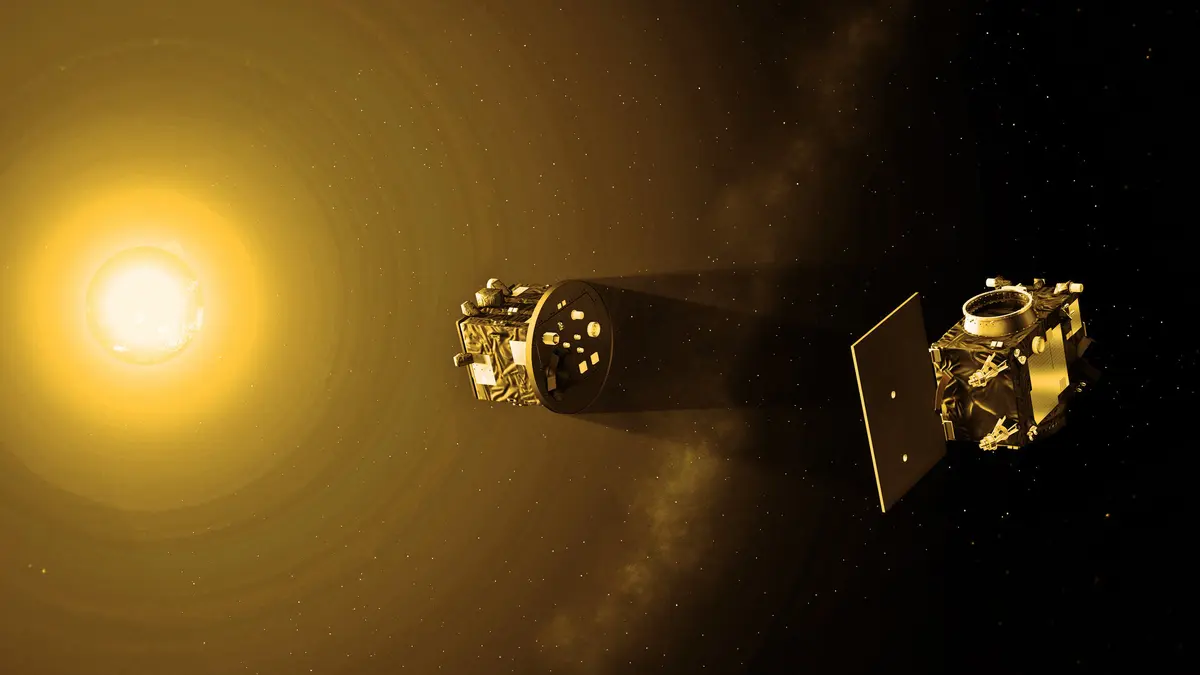
Proba‑3 is ESA’s first precision formation‑flying mission. It consists of two small satellites: the Occulter, which carries a disc to block the Sun’s bright photosphere, and the Coronagraph, which houses a telescope to observe the faint corona. The satellites were launched on 5 December 2024 aboard a PSLV‑XL rocket from Satish Dhawan Space Centre in India. When separated by about 150 metres at apogee (around 60,000 km from Earth), they act like a single giant instrument to simulate a total solar eclipse.
Technological innovations
- Formation flying: The mission demonstrates millimetre‑level relative positioning using a suite of sensors. These include cameras on the Occulter that track flashing LEDs on the Coronagraph, a shadow‑position sensor that keeps the coronagraph in the occulter’s shadow and a laser‑based Fine Lateral and Longitudinal Sensor capable of measuring distance with millimetre precision.
- Autonomous control: After ground controllers bring the two satellites close together, on‑board software manages navigation, guidance and control, minimising propellant use when the pair are far from Earth’s gravity.
- Science goals: By creating repeated artificial eclipses, scientists hope to answer why the Sun’s corona is significantly hotter than the surface, what accelerates the solar wind and how coronal mass ejections are triggered. The technique may also inform future missions, such as exoplanet hunters that use occulters to block starlight.
Current situation and significance
In May 2025 the two spacecraft successfully performed several hours of formation flying with millimetric precision. They captured their first artificial solar‑eclipse images in June 2025. However, according to a March 2026 update, the Coronagraph lost orientation following an anomaly on 14 February, causing its solar panels to point away from the Sun and draining its batteries. ESA teams are investigating the cause and exploring ways to bring the Occulter closer to assist recovery. The incident underscores the challenges of controlling multiple satellites in deep space and highlights the mission’s experimental nature.

