

Why in news?
The Union Ministry of Food Processing Industries released an update on the PM Formalisation of Micro Food Processing Enterprises (PMFME) scheme, showing substantial uptake by micro‑entrepreneurs and self‑help groups. As of 31 October 2025, the scheme has sanctioned more than 1.6 lakh loans and provided seed capital to over 3.6 lakh self‑help group members. Policymakers are highlighting these numbers as evidence of the scheme’s role in formalising India’s vast micro‑food sector.
Background
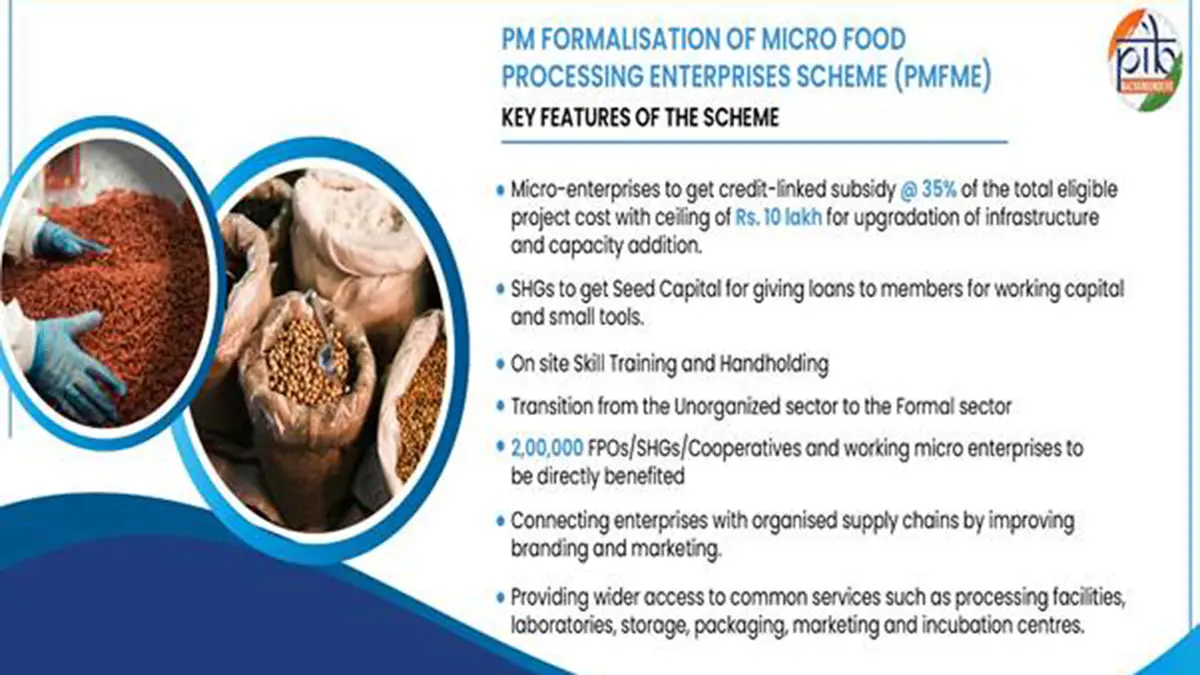
Launched in June 2020 as part of the Atmanirbhar Bharat package, the PMFME scheme aims to help tiny food processors become part of the formal economy. India has millions of home‑based food businesses – making snacks, pickles and grain products – that operate without registration or access to credit. The scheme adopts a One District One Product approach, identifying a special food product in each district and supporting entrepreneurs involved in its production. Assistance includes a credit‑linked subsidy of up to 35 percent of the project cost for individuals (maximum ₹10 lakh) and up to 50 percent for groups, along with training, common infrastructure and branding support.
Key achievements
- Loan sanctions: Banks have sanctioned 1,62,744 loans under the credit‑linked subsidy component. Beneficiaries use these funds to upgrade equipment, improve hygiene and comply with food safety standards.
- Support to self‑help groups: Seed capital has been provided to 3,65,935 members of self‑help groups, enabling them to start or expand micro‑food enterprises. Many of these members are women, contributing to economic empowerment.
- Funding released: The ministry has disbursed over ₹1,300 crore since the scheme’s inception. Funds cover subsidies, capacity building, common infrastructure such as processing centres and marketing support.
- ODOP promotion: Districts across India are developing value chains around local specialties like millet‑based products, jackfruit chips, pickles, jaggery and spices. This helps brand small enterprises and connect them to larger markets.
Challenges and way forward
- Awareness: Many micro‑entrepreneurs are still unaware of the scheme or find the application process daunting. Greater outreach through district industries centres and NGOs is needed.
- Market linkage: Beyond production, small producers need access to reliable supply chains, packaging and e‑commerce platforms to sell their goods at fair prices.
- Quality and compliance: Training in food safety, labelling and hygiene must accompany financial support so that products meet national and international standards.
Source: KNN India