

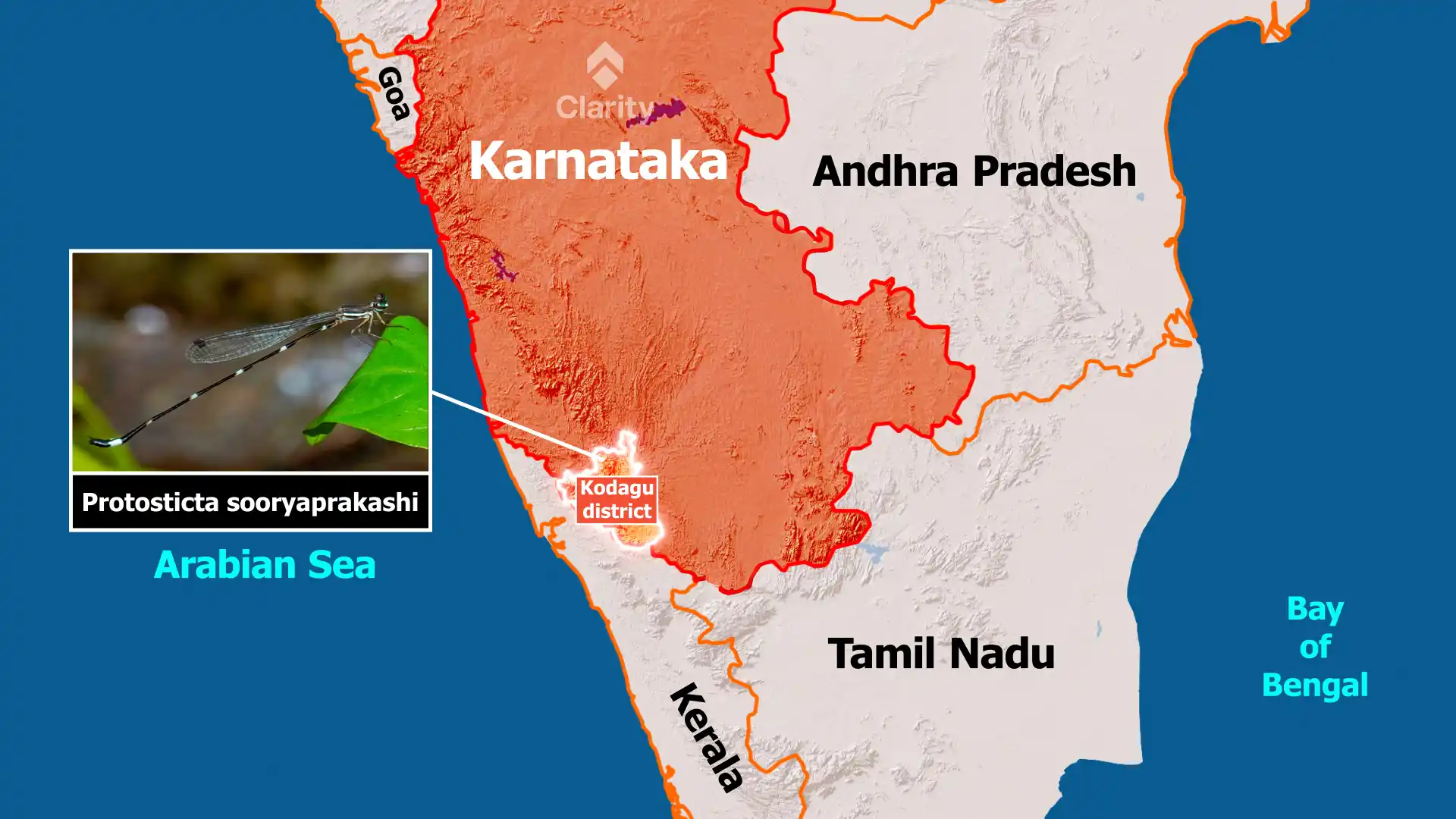
Why in news?
Researchers conducting biodiversity surveys in the Western Ghats have reported the discovery of a new species of damselfly. The insect, named Protosticta sooryaprakashi or the Kodagu Shadowdamsel, was identified along shaded streams in Karnataka’s Kodagu district and nearby highland forests. The finding underscores both the rich diversity of the Western Ghats and the need to protect its fragile freshwater habitats.
Background
Damselflies belong to the order Odonata and are close cousins of dragonflies. They are slender, weak fliers that favour shady areas near clean, fast‑flowing streams. During surveys along the Sampaje River and in the forests of Agumbe, researchers observed specimens that resembled the known species Protosticta sanguinostigma but were smaller and more delicate. Detailed morphological study, followed by DNA analysis, confirmed that the specimens represented a distinct species. The species was named in honour of Dr Sooryaprakash Shenoy, a noted botanist who championed biodiversity conservation in the region.
Key characteristics of the Kodagu Shadowdamsel
- Distinctive markings: Males have sky‑blue patches on the prothorax (the “neck” behind the head) and at the tip of the abdomen. The rest of the body is dark brown to black. Under a microscope, the reproductive organ of the male has tips shaped like a duck’s head – a feature that distinguishes it from close relatives.
- Size and appearance: It is among the thinnest members of its family, with a slender, delicate body and a wingspan of only a few centimetres. The colour of the body deepens or fades depending on the insect’s mood.
- Habitat: The species inhabits shaded riparian zones along small forest streams. Adults perch on vegetation close to water and exhibit a fluttering flight. They thrive only in pristine, low‑light environments, making them indicators of a healthy ecosystem.
- Behaviour: The damselfly is largely crepuscular; it is most active during dawn and dusk and spends daylight hours resting on plants. Unlike dragonflies, it avoids open sunny spaces.
- Ecological significance: The presence of this damselfly suggests that the riparian habitats of the Western Ghats still harbour many undiscovered species. Protecting these ecosystems is crucial for maintaining freshwater biodiversity.
Source: Research Matters