

Why in news?
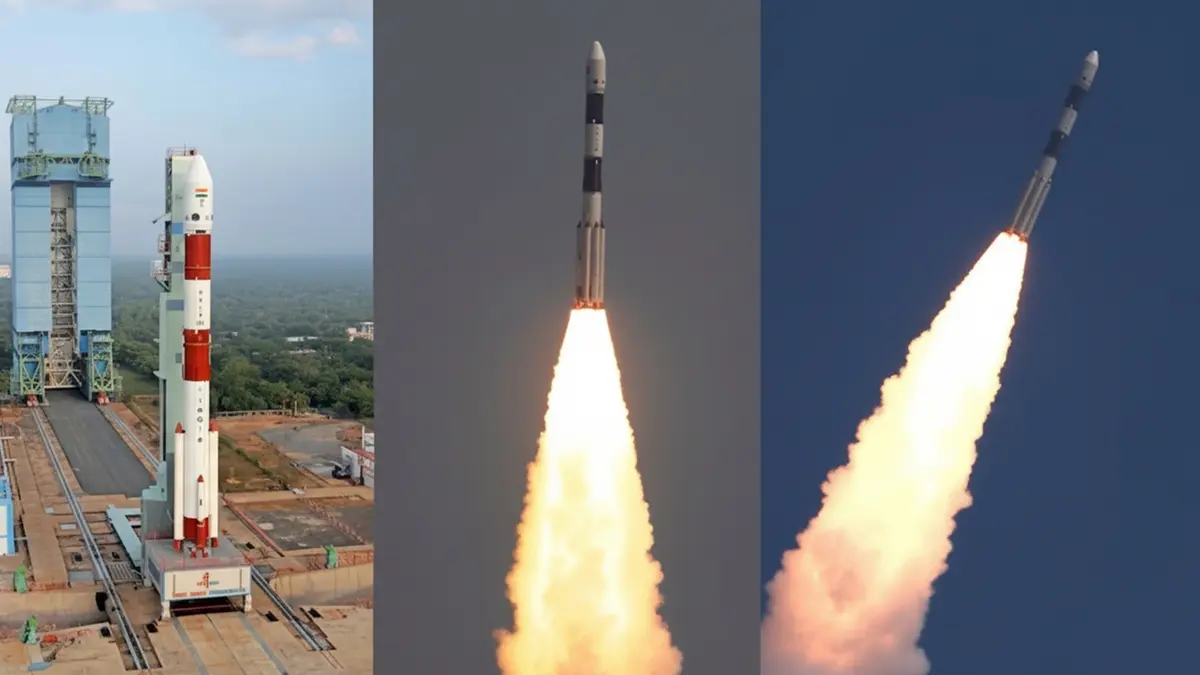
On 12 January 2026 India’s Polar Satellite Launch Vehicle (PSLV‑C62) lifted off from the Satish Dhawan Space Centre carrying the Earth‑observation satellite EOS‑N1 (also called Anvesha) and 15 co‑passenger satellites. Shortly after the third stage burn, the rocket deviated from its intended path and ISRO declared an anomaly, leaving the status of all satellites uncertain.
Background
PSLV is ISRO’s workhorse launch vehicle. The C62 mission was the 64th flight of PSLV and the ninth dedicated commercial mission undertaken by NewSpace India Limited (NSIL). The PSLV‑DL variant used two solid strap‑on boosters, stood 44.4 metres tall and weighed about 260 tonnes at liftoff. It is a four‑stage rocket with alternating solid and liquid stages. The mission aimed to place the main payload and 14 co‑passenger satellites into a sun‑synchronous orbit and then de‑boost the fourth stage to re‑enter the atmosphere along with a re‑entry capsule.
Main payload – EOS‑N1 (Anvesha)
- Hyperspectral imaging: Developed by India’s Defence Research and Development Organisation (DRDO), Anvesha is a hyperspectral Earth‑observation satellite that captures hundreds of narrow spectral bands. Unlike ordinary cameras, it can identify materials and objects by analysing their spectral signatures, making it useful for border surveillance, coastal monitoring, agriculture, urban planning and environmental studies.
- Strategic advantages: Hyperspectral data can detect camouflaged tanks, illegal mining, crop diseases and pollution. Experts note that Anvesha’s imaging capability far surpasses conventional RGB sensors and will aid national security and resource management.
Co‑passenger satellites
The mission carried 15 smaller satellites from India and abroad. Key examples include:
- Theos‑2: An Earth‑observation satellite jointly built by Thailand and the UK.
- CGUSAT and DSUSAT: Technology‑demonstration cubesats by Dhruva Space (India), showcasing student involvement.
- MOI‑1: A satellite that allows customers to run artificial‑intelligence models directly in orbit.
- Thybolt‑3 and LACHIT: Store‑and‑forward communication satellites for rapid technology demonstration.
- Munal: A technology‑demonstration satellite built by a Nepalese university with support from India’s External Affairs Ministry.
- KID Capsule: A small re‑entry demonstrator built by a Spanish start‑up, designed to splash down in the South Pacific Ocean.
- Other international payloads: Edusat, Uaisat, Galaxy Explorer and Orbital Temple from Brazil, and Aldebaran‑1 from Brazil for maritime rescue, plus Sanskarsat from India.
Launch anomaly
- Third‑stage deviation: ISRO’s live broadcast showed normal performance through the first two stages. Near the end of the third stage, however, sensors detected abnormal roll rates and the rocket deviated from its path. The mission was unable to insert the satellites into the planned orbit.
- Investigation underway: ISRO stated that a detailed analysis of flight data is in progress. The anomaly follows a third‑stage issue on a previous PSLV mission in May 2025, raising concern about back‑to‑back setbacks for the otherwise reliable launcher.
Significance
- Commercial space services: Despite the anomaly, the mission demonstrates India’s growing role in launching diverse international satellites and technology demonstrators.
- Advances in Earth observation: Anvesha’s hyperspectral imaging capability represents a significant advancement for India’s surveillance and resource‑management programmes.
- Need for reliability: Consecutive anomalies highlight the importance of rigorous testing and quality control to maintain confidence in the PSLV programme.
Source: Times of India