

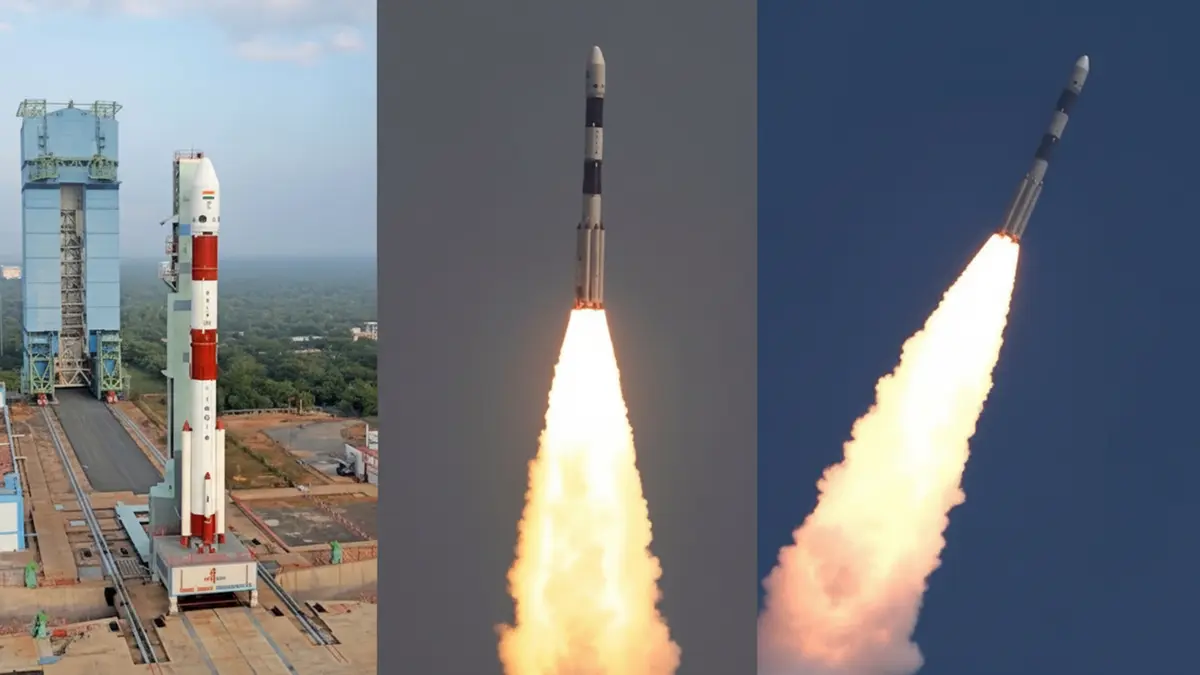
Why in news?
ISRO’s workhorse rocket, the PSLV‑C62, is scheduled to lift off from Sriharikota on 12 January 2026, marking India’s first space launch of the year. The mission will deploy one primary satellite and 18 secondary payloads, and its success is expected to restore confidence after a previous mission setback.
Background
The Polar Satellite Launch Vehicle (PSLV) has been India’s reliable launcher since the 1990s. However, in May 2025 the PSLV‑C61 mission experienced a third‑stage anomaly and failed to place its satellite in the intended orbit. PSLV‑C62 is therefore a comeback mission, demonstrating improvements and carrying a diverse set of instruments for defence, scientific and commercial applications.
Mission payloads
- EOS‑N1 (Anvesha): The main payload is a hyperspectral Earth observation satellite built mainly for the Defence Research and Development Organisation (DRDO). Hyperspectral sensors observe hundreds of wavelengths, allowing precise identification of materials and improved surveillance, mapping and resource monitoring.
- Kestrel Initial Demonstrator (KID): An experimental re‑entry capsule developed in Europe with a Spanish start‑up. After orbiting Earth, it will re‑enter the atmosphere and splash down in the South Pacific Ocean to test recovery technologies.
- Indian and international payloads: Seventeen small satellites from Indian start‑ups and universities, as well as from Mauritius, Luxembourg, the UAE, Singapore, Europe and the United States, will fly aboard the rocket. These include OrbitAID Aerospace’s AayulSAT, India’s first on‑orbit satellite refuelling demonstrator; CGUSAT‑1 from C. V. Raman Global University; Dhruva Space’s DA‑1; Space Kidz India’s SR‑2; Assam Don Bosco University’s Lachit‑1; Akshath Aerospace’s Solaras‑S4; and Dayanand Sagar University’s DSAT‑1.
Why this mission matters
- Strategic capability: EOS‑N1 will enhance India’s surveillance, border management and resource mapping capabilities while also supporting civilian applications such as agriculture and urban planning.
- Technology demonstration: AayulSAT’s on‑orbit refuelling experiment could pave the way for longer‑lived satellites and reduce space debris by enabling servicing and fuel replenishment.
- International collaboration: Carrying a European re‑entry capsule and multiple foreign satellites shows ISRO’s growing role in the global small‑satellite market.
- Restoring reliability: A successful launch will reaffirm the PSLV’s status as a dependable launch vehicle after the C61 setback.
Source: India Today