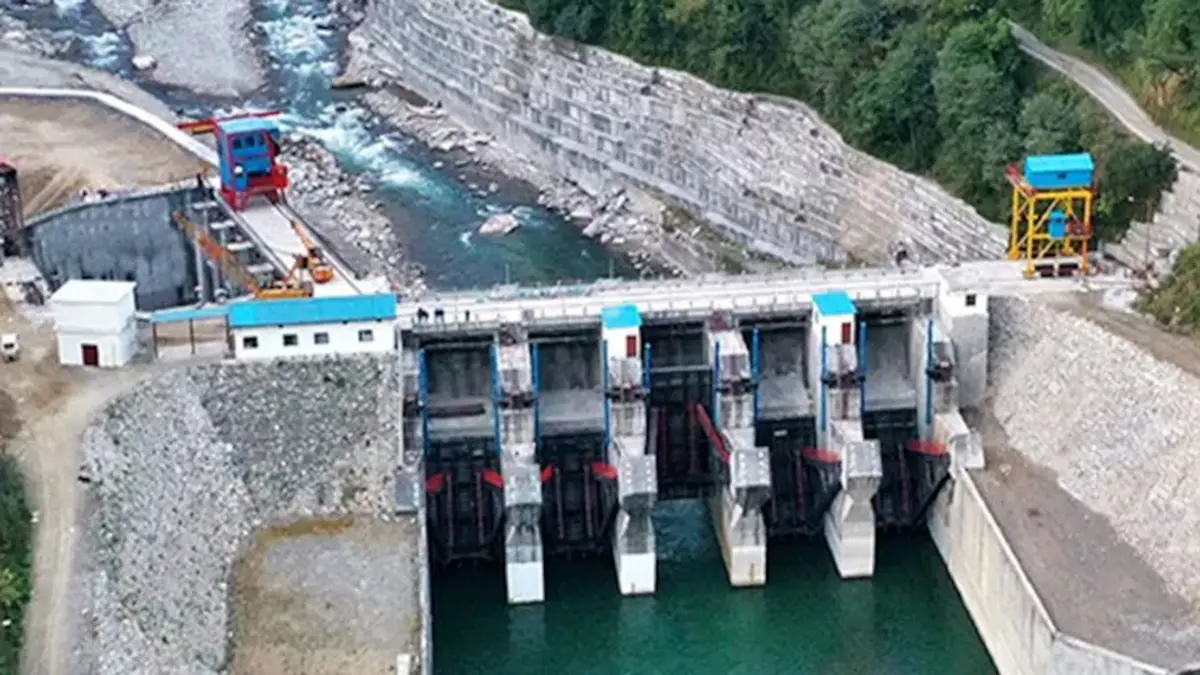
Why in news?
Construction has resumed on the Punatsangchhu‑I hydroelectric project in Bhutan after a seven‑year halt caused by geological problems. On 10 April 2026 engineers began pouring concrete for the dam, signalling a fresh start for the 1,200 MW run‑of‑the‑river plant. The project is expected to raise Bhutan’s generation capacity by about 30 percent and export surplus power to India under a financing arrangement in which India provides 40 percent grant and 60 percent loan.
Background
Punatsangchhu‑I is the largest hydropower project under construction in Bhutan. It sits on the Punatsangchhu river near Wangduephodrang Dzongkhag and uses the head created by the meeting of two mountain rivers—the Pho Chu and Mo Chu—to drive six turbines of 200 MW each. The project began in 2008 as part of the India–Bhutan 10,000 MW initiative. A concrete dam roughly 136 metres high and 239 metres long, an 11‑kilometre headrace tunnel and a huge underground powerhouse were planned. However, in 2013 instability on the right bank forced suspension of work. After extensive studies, India and Bhutan agreed in July 2025 to resume construction with slope stabilisation measures.
Design and features
- Run‑of‑the‑river scheme: The plant will harness the river’s natural flow without creating a large reservoir. A small pondage will smooth out daily fluctuations.
- Six turbines: An underground powerhouse will house six Francis turbines of 200 MW each. Water diverted through the 10‑metre‑diameter headrace tunnel will drop 357 metres to turn the turbines before returning to the river.
- Annual generation: Once operational, Punatsangchhu‑I will produce about 5,670 million units of electricity every year, providing reliable clean power for Bhutan and export to India.
- Funding model: India is financing 40 percent of the project costs as a grant and 60 percent as a loan at concessional interest. By February 2026, the project had achieved more than 87 percent physical progress and 93 percent financial progress.
River and location
The Punatsangchhu river system arises from two glacier‑fed tributaries, the Pho Chu and the Mo Chu, which converge at Punakha before flowing south through Bhutan’s valleys and into Assam. The project site in Wangduephodrang lies downstream of the confluence, where the river descends steeply through gorges. The area has high hydropower potential but is prone to landslides and seismic activity, requiring careful engineering.
Significance
- Energy cooperation: Bhutan exports most of its hydropower to India, earning revenue and strengthening bilateral ties. Punatsangchhu‑I will contribute significantly to this partnership.
- Economic benefits: The project will boost Bhutan’s GDP, create local employment and help fund social programmes.
- Engineering lessons: Addressing slope instability provides valuable experience for other Himalayan hydropower projects where geology is challenging.
Source: NDTV