

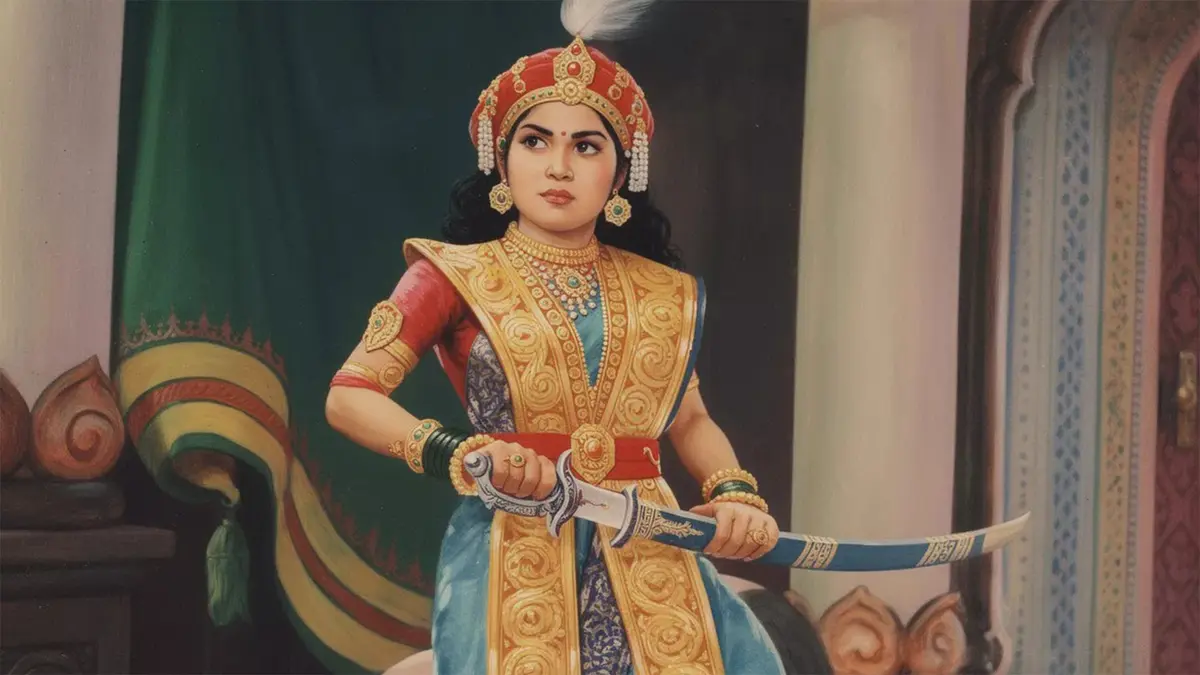
Why in news?
The Prime Minister recently paid homage to Rani Velu Nachiyar on her birth anniversary, calling attention to her role as one of India’s earliest freedom fighters and the first queen to wage war against the British East India Company.
Background
Born on 3 January 1730 in Ramanathapuram, Tamil Nadu, Velu Nachiyar was the only daughter of the Sethupathy rulers of the Ramnad kingdom. Trained from childhood in martial arts, horseback riding and archery, she was also fluent in Tamil, English, French and Urdu. At age 16 she married Muthu Vaduganatha Periyavudaya Thevar, the prince of the Sivaganga estate, and soon became a trusted adviser to him.
Struggle against the British
- In 1772 British forces allied with the Nawab of Arcot killed her husband during an attack on Sivaganga. Velu Nachiyar escaped with her young daughter and sought refuge with Palayakkarar (Poligar) Gopala Nayaker.
- Over the next eight years she built alliances and an army. Hyder Ali of Mysore provided shelter and military support, while the Marudhu brothers and her confidante Kuyili helped organise troops, including a women’s regiment named Udaiyaal in memory of her adopted daughter.
- In 1780 she led a coordinated assault on the British garrison at Sivaganga. Kuyili famously set fire to the British armoury, sacrificing herself to secure victory. The liberation of Sivaganga marked the first recorded instance of an Indian queen defeating British forces.
- After reclaiming her kingdom she governed for about a decade before handing administrative powers to the Marudhu brothers. Velu Nachiyar died on 25 December 1796, but her legacy as Veeramangai (“brave woman”) endures in popular memory.
Rani Velu Nachiyar’s resistance predates the more widely known Sepoy Mutiny by almost eight decades. Her story inspires present‑day celebrations of women’s courage and leadership in India’s freedom struggle.
Source: DD News