

Why in news?
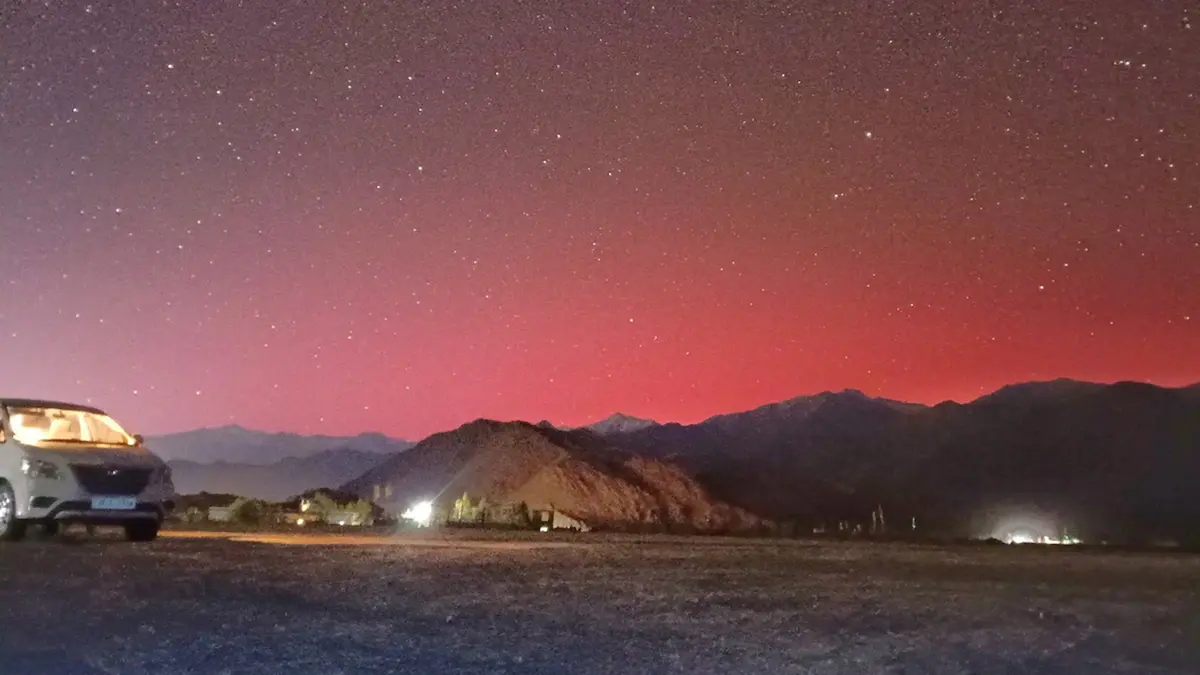
On the nights of 19 and 20 January 2026, the skies above Ladakh’s Hanle Dark Sky Reserve glowed an eerie crimson as a powerful solar storm produced a rare red aurora. The phenomenon, captured by the Indian Astronomical Observatory, drew global attention and raised concerns about the impact of space weather on technology.
Background
Auroras occur when charged particles from the Sun interact with Earth’s magnetic field and atmosphere. They are usually seen near the poles and appear green when oxygen atoms at lower altitudes (around 100 km) emit light. Red auroras are uncommon and occur when particles excite high‑altitude oxygen atoms at 200–300 km. In mid‑January 2026 a massive coronal mass ejection from an X‑class solar flare struck Earth, triggering a severe geomagnetic storm.
Understanding the event
- Solar tempest: A coronal mass ejection carries a cloud of magnetised plasma. Travelling at about 1,700 km/s, the January 18 eruption reached Earth in roughly 25 hours, compressing our magnetic shield.
- Red glow: The storm pushed the auroral oval southwards. As a result, observers in Ladakh viewed the upper portion of the aurora, which emits red light. Photographs showed curtains of crimson light over the mountains.
- Potential threats: Geomagnetic storms can induce electric currents in power grids, degrade radio communications and disturb satellite orbits. During the January event, astronauts on the International Space Station took shelter because of elevated radiation.
- Need for preparedness: Scientists emphasise strengthening space‑weather forecasting and hardening infrastructure. India’s Aditya‑L1 mission monitors solar activity from the Lagrange 1 point, giving a 24‑ to 48‑hour warning of approaching storms. Ground‑based observatories like Hanle complement these efforts.
Protecting the Hanle Dark Sky Reserve
Hanle, located in a remote part of Ladakh, is India’s first designated dark sky reserve. It offers exceptional night‑sky views and supports astrophysics research. However, growing tourism and development threaten its pristine darkness. The recent aurora underscores the need to control light pollution so that instruments can continue detecting subtle signals from space and so that visitors may enjoy unspoiled views of the Milky Way.
Source: ET