Why in news?
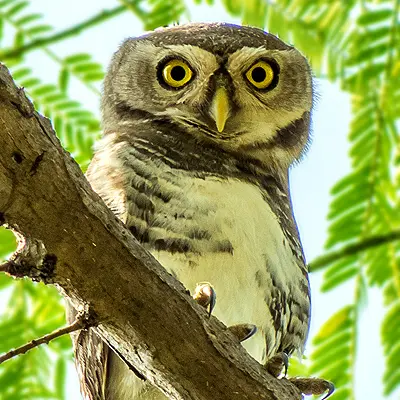
A Forest Owlet was sighted in Kuno National Park, Madhya Pradesh in February 2026 — the first confirmed record from this park and a rare observation of a species once thought extinct. The find comes 113 years after its last documented sighting in the region.
Background
The Forest Owlet (Athene blewitti) belongs to the typical owl family Strigidae. It was first described in 1872 and seen until 1884 before vanishing from scientific records. In 1997 ornithologists rediscovered the species in the Nandurbar district of Maharashtra, proving it had survived in remote forest pockets.
Characteristics and habitat
- Physical traits: The owlet has a relatively unspotted crown, a full white throat collar, heavily banded wings and tail, and heavily feathered legs. Unlike many owls it is active during the day.
- Habitat: Prefers tropical and subtropical moist lowland forests, dense deciduous woodlands and open dry teak forests. It is endemic to central India and has been recorded in Madhya Pradesh, Maharashtra, Gujarat, Odisha and Chhattisgarh.
- Diet: Feeds on rodents, small reptiles like lizards and skinks, and large insects.
- Conservation status: Listed as Endangered on the IUCN Red List and in Appendix I of CITES; population estimates range from 250 to 999 mature individuals.
Recent sighting and its significance
- The owlet was spotted by local wildlife enthusiasts in Kuno National Park and confirmed by experts from the Wildlife Research and Conservation Society. The observation coincides with ecological restoration efforts linked to the cheetah reintroduction project.
- Rediscoveries like this highlight the resilience of endangered species when habitats are protected and restored.
- The sighting underscores the need for continued monitoring, anti‑poaching measures and habitat preservation to ensure the survival of this rare bird.
Source: The Times of India