

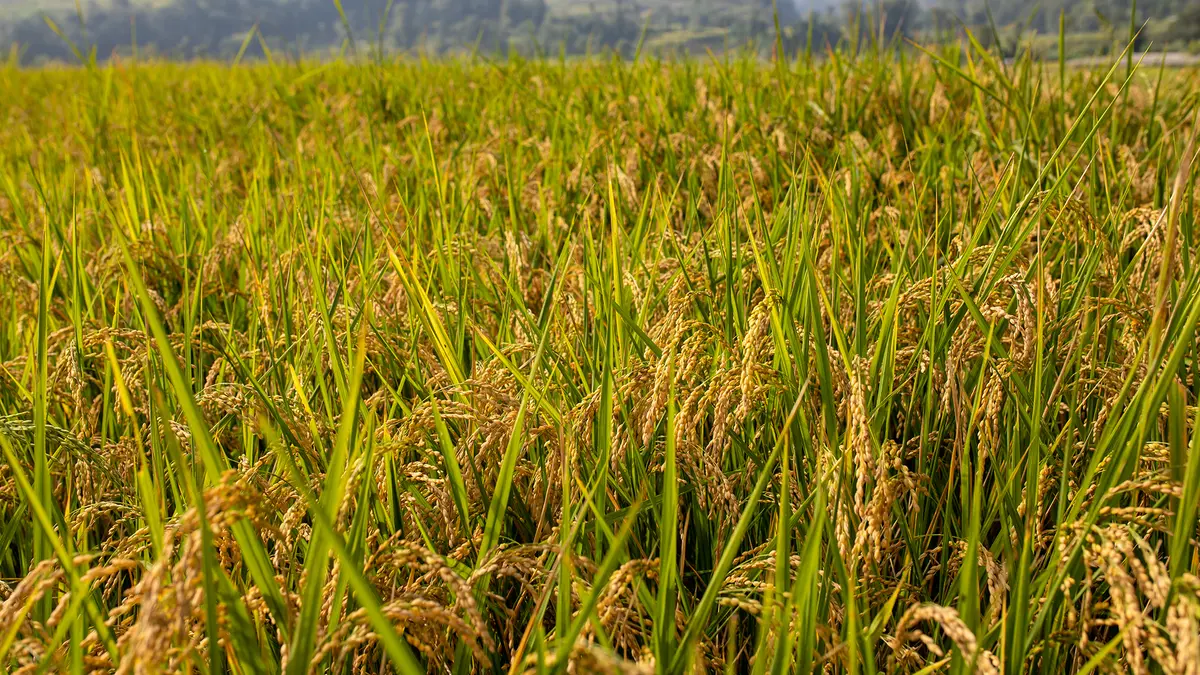
Why in news?
India has overtaken China to become the world’s largest rice producer. According to the Union Ministry of Agriculture, India produced about 150.2 million tonnes of rice in the 2024‑25 season, slightly ahead of China’s 145.3 million tonnes. The announcement was made by Agriculture Minister Shivraj Singh Chauhan, who also unveiled 184 improved crop varieties developed by Indian research institutes.
Background
Rice is the staple food for more than half of India’s population and accounts for a significant share of its agricultural output. The crop has been cultivated in the subcontinent for thousands of years and thrives under hot, humid conditions. India’s success in rice production is due to irrigation expansion, high‑yielding varieties and government procurement at minimum support prices. The crop is grown during both the kharif (monsoon) and rabi (winter) seasons.
Growing conditions
- Climate: Rice requires high temperatures and humidity. The optimum temperature ranges from 20 °C during germination to about 27 °C during ripening. Consistent rainfall of 150 cm or more is ideal, and fields are often kept flooded with 10–12 cm of standing water to suppress weeds and supply nutrients.
- Latitude and altitude: In India rice is grown from 8° to 25° N latitude and up to elevations of about 2,500 metres. It can even be cultivated below sea level in the Kuttanad region of Kerala and in terraced fields on mountain slopes.
- Soils: The crop grows best on deep, fertile clayey or loamy soils that retain water. However, it can tolerate a wide range of soils, including silty and gravelly types, and withstands slight acidity or alkalinity.
- Labour: Paddy cultivation is labour‑intensive, requiring transplanting of seedlings, continuous monitoring of water levels and manual weed control.
Production pattern in India
Rice cultivation is spread across all regions of India:
- Eastern and north‑eastern: States such as West Bengal, Assam and Odisha cultivate rice extensively in deltaic plains with abundant rainfall.
- Northern and central: Uttar Pradesh, Bihar and Chhattisgarh produce large quantities using canal irrigation and groundwater.
- Southern: Andhra Pradesh, Telangana and Tamil Nadu rely on tank irrigation and river water to grow rice twice a year.
- Western: Punjab and Haryana, though semi‑arid, have become major producers thanks to tube‑well irrigation and adoption of high‑yielding varieties.
Recent data show that the top producers are Telangana (around 16.9 million tonnes), Uttar Pradesh (15.9 million tonnes) and West Bengal (15.7 million tonnes), together accounting for over a third of India’s output. Punjab, Andhra Pradesh, Chhattisgarh and Odisha are also significant contributors.
Significance
- Food security: Achieving record rice production ensures adequate stocks for India’s public distribution system, which supplies subsidised grain to millions of low‑income families.
- Economic impact: Rice exports bring valuable foreign exchange. India remains the world’s largest rice exporter, shipping both basmati and non‑basmati varieties to Africa, West Asia and Europe.
- Challenges ahead: Water scarcity, depleting groundwater and climate change pose risks to future production. Shifts towards less water‑intensive crops and improved irrigation efficiency will be necessary to sustain yields.
Conclusion
India’s ascent to the top spot in rice production highlights the progress made by farmers and researchers. Continued investment in improved varieties, sustainable farming practices and efficient water use will help maintain this lead and ensure food security for the nation.
Source: News On Air