
Why in news?
Roopkund, a small glacial lake high in Uttarakhand’s Himalayas, continues to fascinate scientists and travellers because hundreds of ancient human skeletons lie around its shores. Recent genetic studies have shed light on the diverse origins of these remains, renewing interest in the lake’s mysterious past.
Background
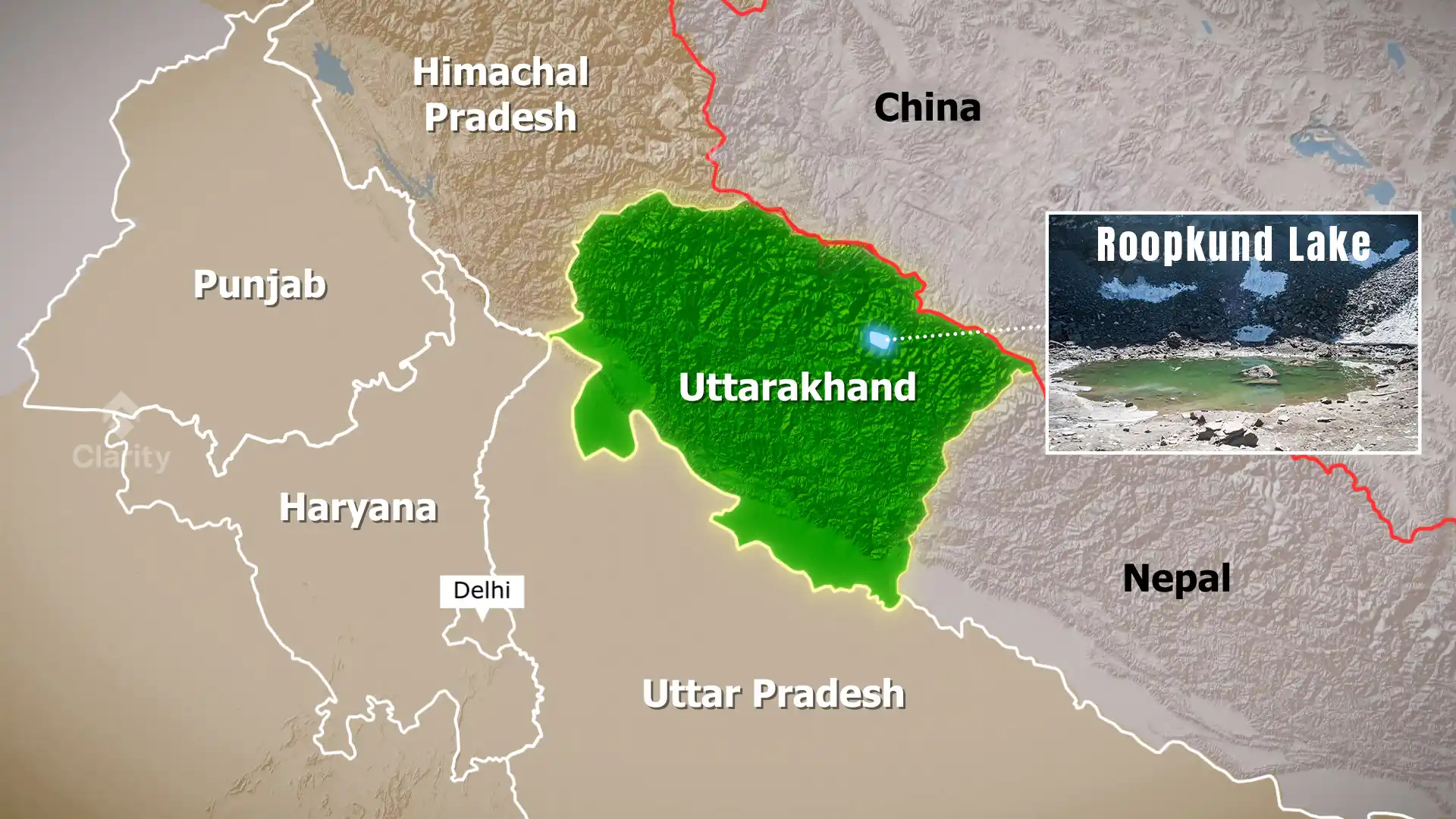
Roopkund Lake sits at an altitude of about 5,029 metres on the flanks of Mount Trishul in the Garhwal Himalayas. Roughly 40 metres wide and frozen for most of the year, it is surrounded by snow‑clad peaks and alpine meadows. In 1942 a British forest ranger stumbled upon human bones in and around the lake when the ice thawed. Local legends spoke of a royal procession slain by divine wrath, while scientific investigations proposed hailstorms or landslides as possible causes.
Recent radiocarbon dating and DNA analysis of the skeletons have upended earlier theories. Researchers found that the remains belong to at least three distinct groups and were deposited at the site in separate events. One group comprises South Asian individuals who died around the 8th or 9th century CE. Another group consists of people with ancestry linked to the eastern Mediterranean region, likely arriving in the 18th or 19th century. A single individual with Southeast Asian ancestry was also identified. This diversity suggests that Roopkund served as a site visited by different communities over centuries, possibly for pilgrimage or trade, rather than being the scene of a single calamity.
Key details
- Location: Roopkund lies in Uttarakhand’s Chamoli district, at the base of Mount Trishul.
- Altitude and size: The lake sits at 5,029 metres (16,500 feet) and measures about 40 metres (130 feet) across. It remains frozen for most of the year.
- Lake of skeletons: Hundreds of human bones lie in and around the lake. The skeletons become visible when the snow and ice melt during summer.
- Scientific discoveries: DNA and radiocarbon analyses indicate that the remains belong to individuals from at least three distinct ancestry groups (South Asian, Eastern Mediterranean and Southeast Asian) who died in separate events. These findings challenge earlier theories of a single catastrophic incident.
Significance
- Archaeological mystery: The lake provides a rare natural repository of human remains, offering insights into ancient travel routes and interactions between distant populations.
- Cultural importance: Roopkund lies on a pilgrimage trail to the Nanda Devi shrine. Its eerie reputation adds to its allure among trekkers and pilgrims.
- Scientific curiosity: Ongoing research continues to refine our understanding of the individuals at Roopkund and the circumstances of their deaths, illustrating how modern science can illuminate historical mysteries.
Conclusion
Roopkund’s grim moniker as the “Lake of Skeletons” belies its value as a window into history. Through careful scientific study, researchers are piecing together the stories of those who perished there. The lake remains both a haunting reminder of mortality and a testament to the enduring fascination of the Himalayas.

