

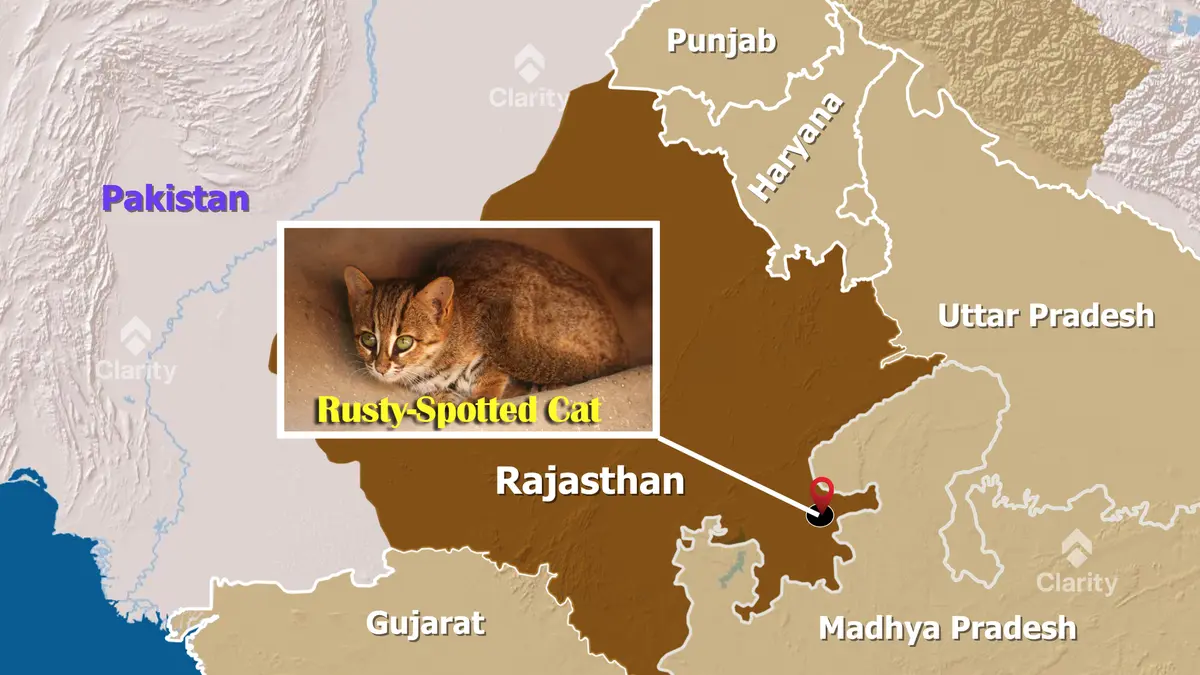
Why in news?
Images of a rare rusty‑spotted cat captured in a protected forest in western India recently went viral, drawing attention to this elusive species. Wildlife authorities used the opportunity to urge greater awareness and habitat protection for one of the world’s smallest wild cats.
Background
The rusty‑spotted cat (Prionailurus rubiginosus) measures just 35–48 cm in body length—about half the size of a domestic cat—and weighs between 1 and 2 kg. Its short, soft coat is fawn‑grey with a rufous tinge and dotted with reddish‑brown spots that merge into streaks along the back. Large eyes, accented by white streaks, and a tail half as long as its body aid its nocturnal, stealthy lifestyle. Three subspecies are recognised: P. r. rubiginosus in India and Nepal, P. r. phillipsi in Sri Lanka’s wet forests, and P. r. koladivius in the island’s dry zone.
Distribution and habitat
Once thought to occur only in southern India, the rusty‑spotted cat is now known from scattered localities across the subcontinent—including dry forests of central India, agricultural fields on the Deccan plateau and the Terai grasslands of Uttar Pradesh and Nepal. In Sri Lanka it inhabits both humid forests and arid coastal scrub. The species favours dense vegetation, rocky outcrops and scrub forests, but has shown surprising tolerance of human‑modified landscapes—denning in tea plantations and sugarcane fields and even nesting in the attics of rural homes.
Ecology and behaviour
- Nocturnal and secretive: Rusty‑spotted cats hunt mainly at night, resting during the day in tree hollows, rock crevices or dense shrubs. Camera traps reveal that they are agile climbers and often pounce from branches onto unsuspecting prey.
- Diet: Their prey consists of rodents, small birds, lizards, frogs and large insects. In farming areas they may help control rodent populations.
- Reproduction: Females experience oestrus for about five days. After a gestation of roughly 65–70 days they give birth to one to three kittens, each weighing around 60 grams. Captive individuals can live up to 18 years.
Threats and conservation status
- Habitat loss: Conversion of forests to farmland, expansion of solar plants and urban development fragment the cat’s habitat. Large irrigation projects may create barriers to movement.
- Hunting and trade: Though protected in India, Nepal and Sri Lanka, rusty‑spotted cats are occasionally killed for their fur or meat, or mistakenly captured as pets.
- Human conflict and predators: Predation by jackals and larger cats, persecution for raiding poultry and possible hybridisation with domestic cats all threaten the species.
The IUCN Red List classifies the rusty‑spotted cat as Near Threatened. Its population is fragmented and nowhere common. Conservationists emphasise protecting remaining forest patches, securing wildlife corridors and conducting more research on its ecology. Raising local awareness—especially in agricultural areas where the cat quietly coexists with people—can help minimise conflict and ensure that this diminutive hunter persists in the wild.
Sources : RM