
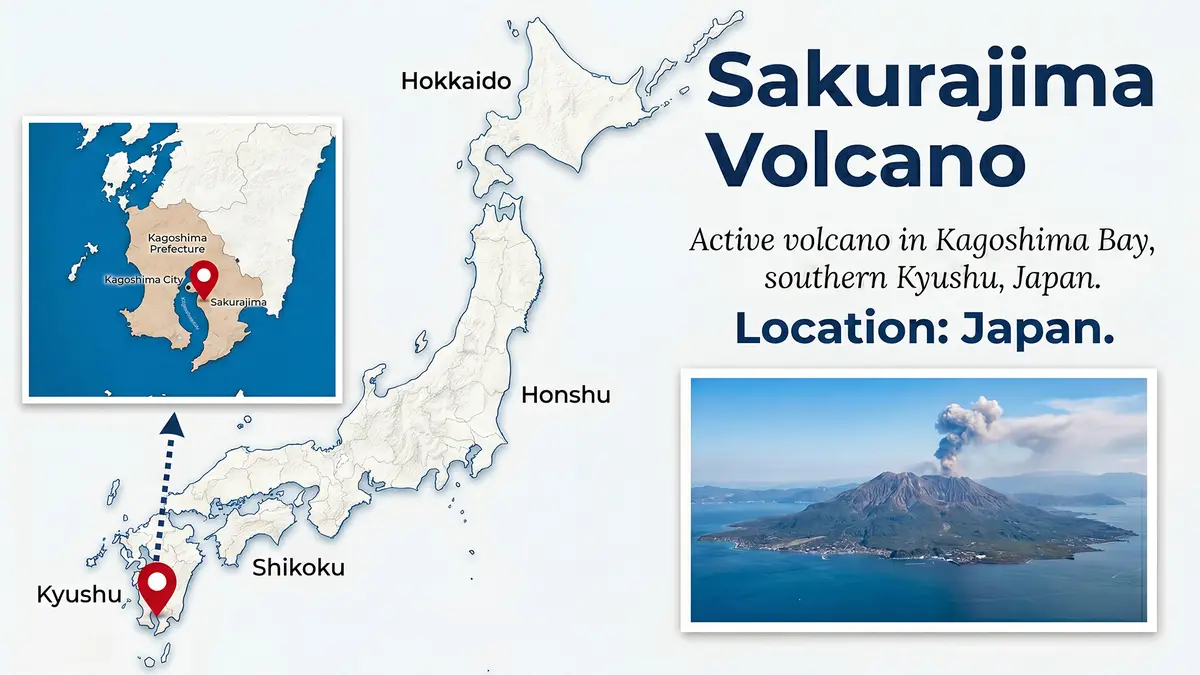
Why in news?
The Japan Meteorological Agency reported a series of powerful eruptions from Sakurajima volcano in April 2026. Ash plumes rose up to 3.4 km above the crater and drifted over nearby cities. Authorities maintained alert level 3, which prohibits entry within 2 km of the craters.
Background
Sakurajima is a stratovolcano on the southern island of Kyushu, Japan, situated within the Aira caldera in Kagoshima Bay. It began forming about 13 000 years ago. Before a massive eruption in 1914 it was an island; lava flows from that eruption bridged it to the mainland. The volcano has three peaks—Kita‑dake (north), Naka‑dake (central) and Minami‑dake (south)—with Minami‑dake and the adjacent Showa crater being the most active. Stratovolcanoes are tall, steep cones built from alternating layers of lava, ash and volcanic debris. Their magma is viscous and gas‑rich, leading to explosive eruptions. Sakurajima is among the world’s most active, producing frequent ash emissions and occasional lava flows. Its proximity to the city of Kagoshima makes monitoring and hazard mitigation essential.
Recent activity and characteristics
- Ongoing eruptions: Weekly reports from the Smithsonian’s Global Volcanism Program recorded ash plumes rising 1.5–3.4 km in April 2026, with incandescent ejecta visible at night.
- Alert levels: The Japan Meteorological Agency maintains a five‑level warning system. Level 3 warns residents not to approach the volcano; higher levels trigger evacuations.
- Hazards: Ash fall can damage crops, disrupt transportation and cause respiratory problems. Explosions occasionally generate pyroclastic flows and volcanic lightning.
- Stratovolcano structure: Sakurajima exemplifies the classic stratovolcano, with steep slopes and layers of hardened lava interspersed with ash. Such volcanoes form mainly at convergent plate boundaries where subducting oceanic plates melt and produce magma.
Conclusion
Sakurajima’s persistent activity reminds residents and scientists alike that living near an active stratovolcano requires constant vigilance. Early‑warning systems and hazard education help reduce risk even as the mountain continues to erupt.
Source: NASA Earth Observatory · Smithsonian Global Volcanism Program

