
Why in news?
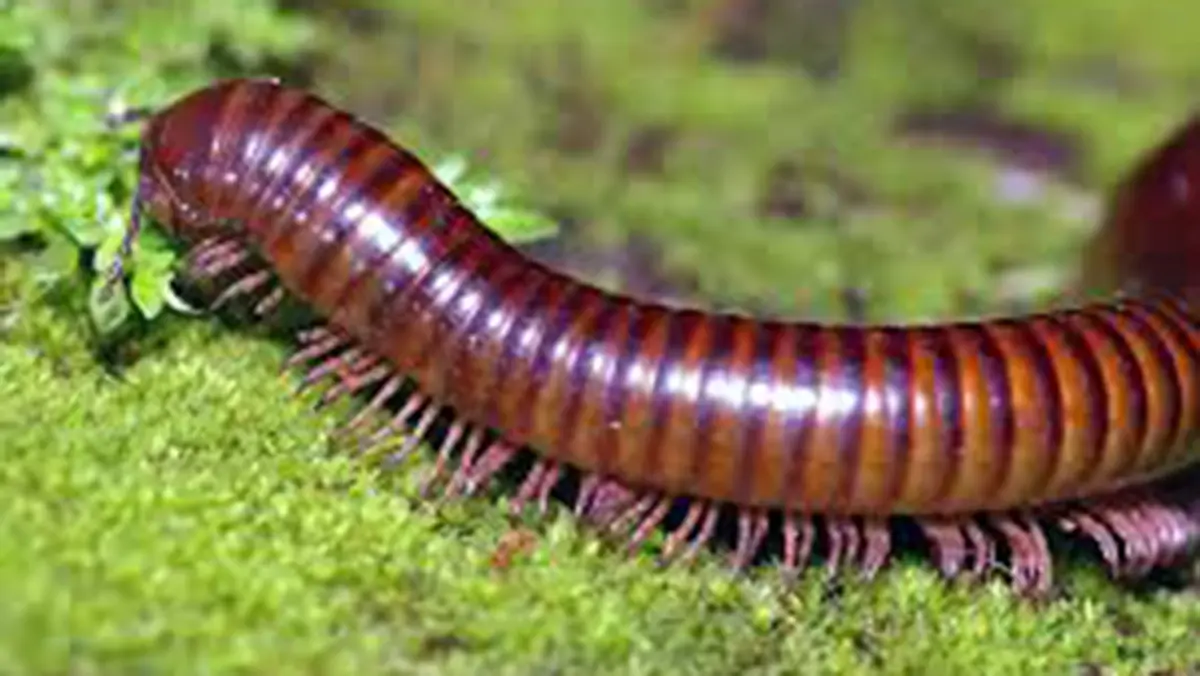
A recent study has revealed that the green pill millipede (Arthrosphaera lutescens), a species native to India’s Western Ghats, possesses a natural self‑cleaning surface similar to the “lotus effect.” The millipede’s exoskeleton sheds dirt and microbes by causing water droplets to bead up and roll off, keeping the animal clean in muddy habitats.
Background
Millipedes belong to the class Diplopoda within the phylum Arthropoda. Their bodies are long and cylindrical, composed of many segments, most bearing two pairs of legs. They lack venomous fangs and move slowly, feeding mainly on decaying plant material. Millipedes play an important ecological role as decomposers, recycling nutrients in soil.
Key findings of the study
- Microstructure: Using atomic force microscopy, researchers observed that the millipede’s exoskeleton is covered with microscopic peaks and valleys. Tiny hair‑like projections and a waxy coating make the surface extremely water‑repellent.
- Lotus effect: Water droplets form almost spherical beads on the shell and roll away, carrying dirt and microbes. This phenomenon is similar to the self‑cleaning behaviour seen on lotus leaves.
- Material properties: The shell is tough yet lightweight because of its mineral‑rich composition, which includes calcium deposits. These features help the millipede withstand pressure without adding weight.
- Applications: Understanding this natural design could inspire the development of self‑cleaning, water‑repellent surfaces in industries such as textiles, coatings and biomedical devices.
About millipedes
- There are an estimated 10,000 described species of millipedes worldwide, with thousands more yet to be catalogued.
- Unlike centipedes, which have one pair of legs per segment and are predatory, millipedes have two pairs of legs per segment and are mostly detritivores.
- They have existed for over 400 million years and are among the oldest known land animals. Their hard exoskeleton protects them from predators and prevents dehydration.
- When threatened, millipedes coil into a tight spiral and may secrete foul‑smelling chemicals or, in some species, cyanide‑rich fluids as a defence.
Source: The New Indian Express · Macalester College

