

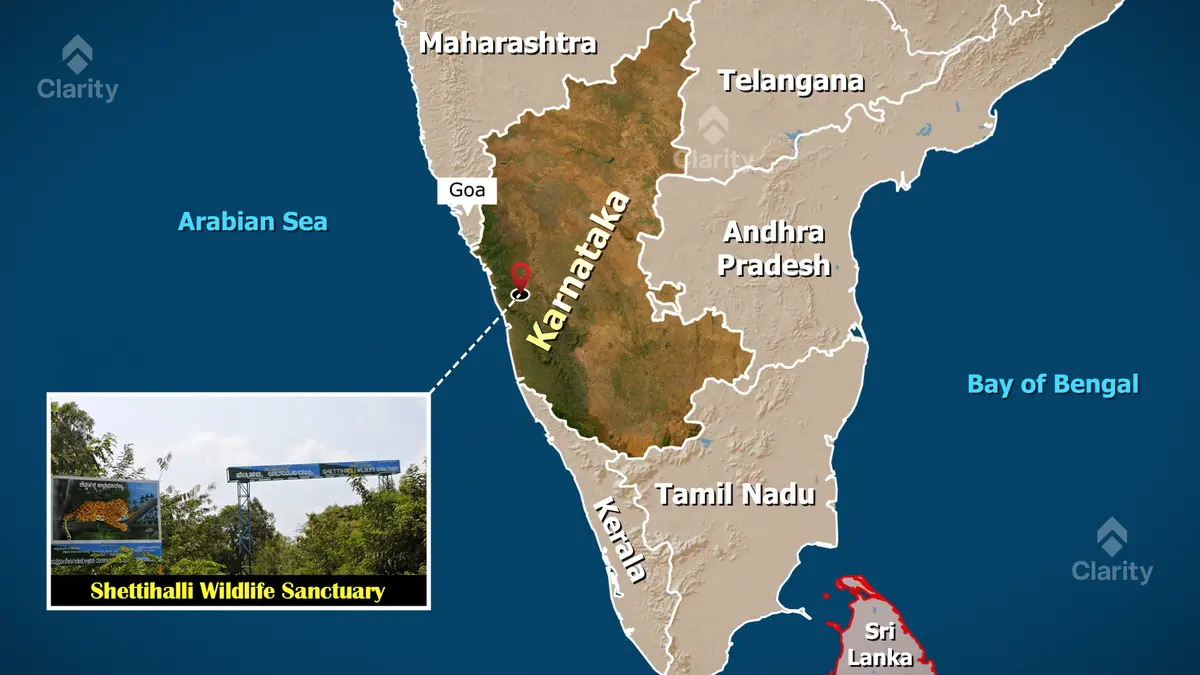
Why in news?
The Karnataka government has proposed reducing the area of Shettihalli Wildlife Sanctuary, sparking opposition from ecologists and conservationists. Critics argue that shrinking a protected area without scientific justification would violate the Wildlife (Protection) Act and set a dangerous precedent.
Background
Shettihalli Wildlife Sanctuary lies in the foothills of the Western Ghats in Karnataka’s Shivamogga district. Established in 1974, it covers about 395 square kilometres. Important aspects are:
- Landscape: The sanctuary contains a mosaic of dry deciduous, moist deciduous and semi‑evergreen forests. Common trees include teak (Tectona grandis), silver oak (Grevillea robusta), bamboo, Terminalia, Gmelina, amla (Phyllanthus emblica) and Shorea species.
- Fauna: It harbours tigers, leopards, Indian gaur, elephants, sloth bears, wild dogs, jackals, sambar deer, spotted deer, giant squirrels and primates such as bonnet macaques and langurs. The sanctuary also includes the Mandagadde bird sanctuary, home to darters, egrets, cormorants and other waterbirds during the monsoon.
- Human presence and threats: Families displaced by the Sharavathi dam project were resettled inside the sanctuary. Infrastructure like highways and dams, and encroachments by agriculture and plantations, pose threats to wildlife movement. Denotification could further fragment habitats and encourage land conversion.
- Current controversy: The state intends to denotify parts of the sanctuary to divert land for development. Conservationists emphasise that any reduction must be based on scientific assessment and approved by the National Board for Wildlife and the Supreme Court. Enlarging buffer zones and implementing eco‑sensitive measures would better protect wildlife while supporting local livelihoods.
DH.