

Why in news?
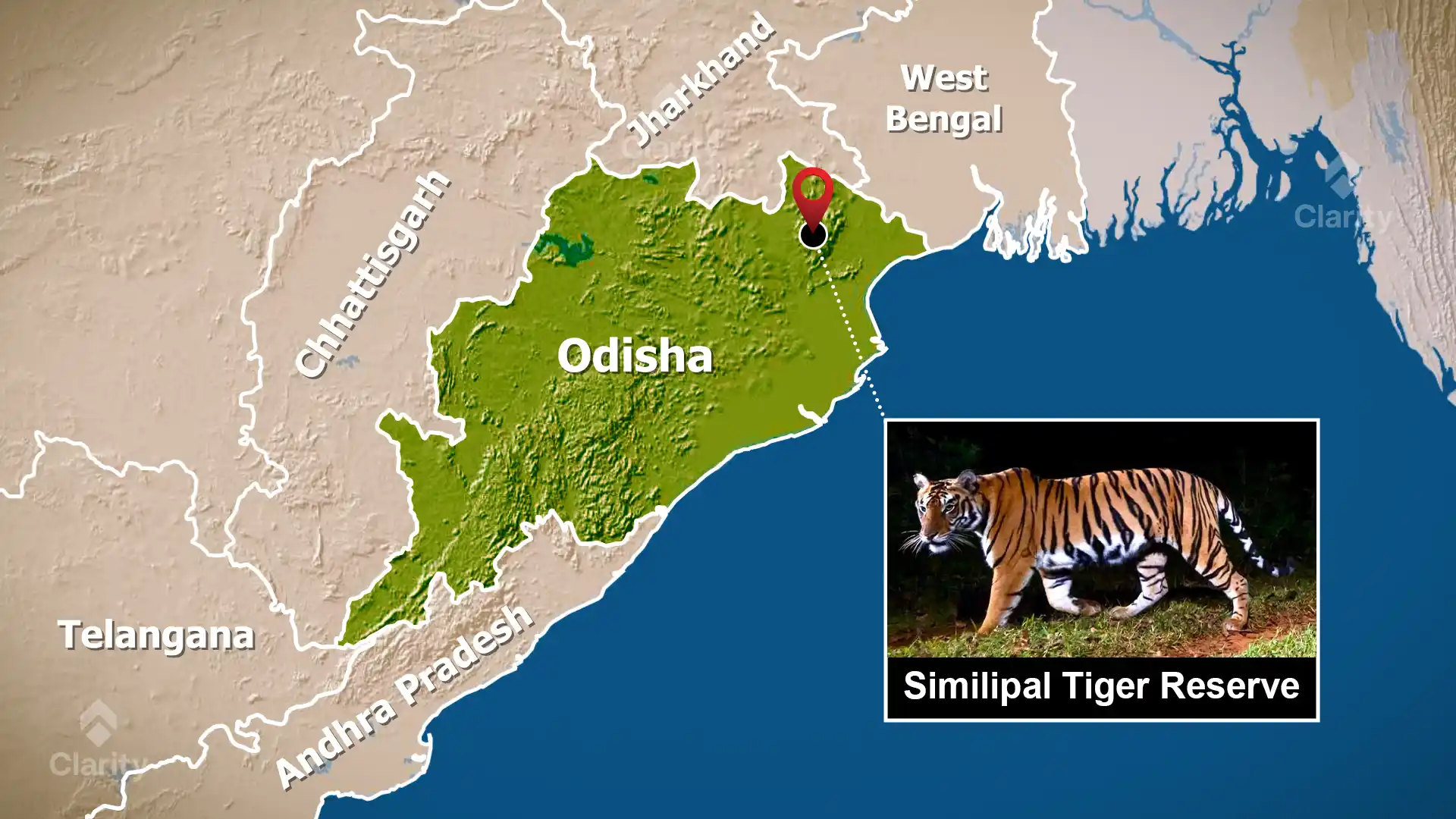
In April 2025 the Government of Odisha notified the Similipal Tiger Reserve as the country’s 107th national park. The move aims to strengthen conservation measures for one of India’s most biodiverse landscapes, home to the world’s only population of melanistic (black) tigers.
Background
Similipal is a vast forested plateau in Mayurbhanj district, Odisha. Its history of protection stretches back to 1959 when it was declared a reserve forest. In 1980 the state expressed its intention to convert it into a national park, and in 1994 UNESCO added the area to the Man and Biosphere network. It became an elephant reserve in 2001 and a tiger reserve in 2007. The Wildlife Sanctuary notification of 2009 further reinforced protection. With the latest declaration as a national park covering about 845.7 square kilometres, Similipal now receives the highest level of legal protection under India’s wildlife laws.
Ecological importance
- Diverse ecosystems: The landscape comprises sal and moist deciduous forests interspersed with semi‑evergreen patches. Numerous streams feed into major rivers such as Budhabalanga and Subarnarekha, making the park a critical watershed for northern Odisha.
- Rich wildlife: Surveys document about 55 species of mammals, 361 species of birds, 62 reptiles and 21 amphibians in Similipal. It is one of the few places on Earth where melanistic tigers occur naturally due to a mutation in the Taqpep gene. The park also shelters elephants, dholes (wild dogs), Indian gaur, sambar, four‑horned antelope, gaur, pangolins and leopards.
- Floral diversity: Over 1,200 plant species have been recorded, including more than 94 species of orchids and numerous medicinal plants used by local communities.
- Human communities: Several tribal groups, including the Ho, Munda and Kharia, live in and around Similipal. Conservation programmes such as the Ama Similipal Yojana aim to provide sustainable livelihoods, eco‑tourism opportunities and improved infrastructure while respecting customary rights.
Conservation initiatives
- Technology and surveillance: The state has installed AI‑enabled camera towers and V‑SAT communication networks to monitor wildlife and deter poaching. Special Tiger Protection Forces patrol sensitive areas.
- Population recovery: Two female tigers were translocated from the Tadoba–Andhari Tiger Reserve in Maharashtra to diversify the gene pool and support population growth.
- Community engagement: Programmes encourage villagers to participate in eco‑tourism, handicrafts and forest produce collection, ensuring that conservation benefits local people.