Why in news?
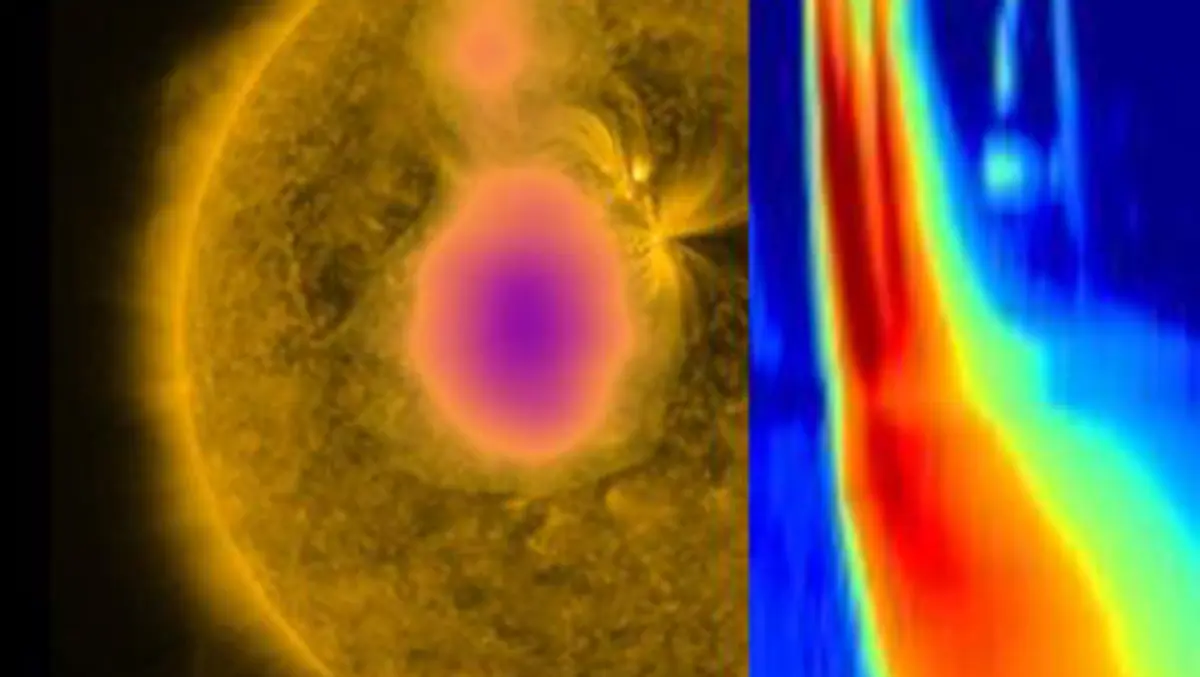
An intense solar flare erupted from the Sun’s surface on 29–30 March 2026. Classified by NASA as an X1.4‑class flare, the event produced strong radio emissions and a large coronal mass ejection. Space weather agencies reported a temporary radio blackout over parts of Southeast Asia and the Pacific, drawing attention to the hazards posed by solar activity to communication and navigation systems.
Background
Solar flares are sudden outbursts of energy from the Sun’s atmosphere caused by the release of magnetic energy around sunspots. They are classified by intensity; X‑class flares are the most powerful and can emit vast amounts of X‑rays and ultraviolet radiation. These emissions can ionise the Earth’s upper atmosphere, leading to radio blackouts and disrupting satellite operations.
What happened on 29–30 March 2026?
- Timing and classification: NASA’s Solar Dynamics Observatory recorded an X1.4 solar flare peaking at 03:19 UTC on 30 March 2026. The U.S. Space Weather Prediction Center (SWPC) categorised the event as an R3 (strong) radio blackout.
- Radio emission: A type II radio burst was detected with a velocity of around 1,872 km/s, indicating a shock wave propagating through the Sun’s corona. A ten‑centimetre (10 cm) radio burst reached a peak flux of roughly 1,800 solar flux units, causing intense “radio noise” that could interfere with radar, GPS and communication systems in East Asia and the western Pacific.
- Coronal mass ejection: The flare launched a partial‑halo coronal mass ejection (CME). Space weather forecasters predicted that the CME would deliver a glancing blow to Earth around 31 March, potentially producing geomagnetic storms and auroras at high latitudes.
Impacts and response
The R3 blackout briefly disrupted high‑frequency communications over the Maritime Continent (Southeast Asia and northern Australia). Airlines and mariners switched to backup frequencies, and satellite operators monitored their systems for anomalies. NASA clarified that the flare posed no threat to its Artemis II mission but advised following SWPC forecasts for potential impacts on power grids and navigation signals. Amateur astronomers and sky watchers reported increased auroral activity in northern latitudes after the CME arrival.