

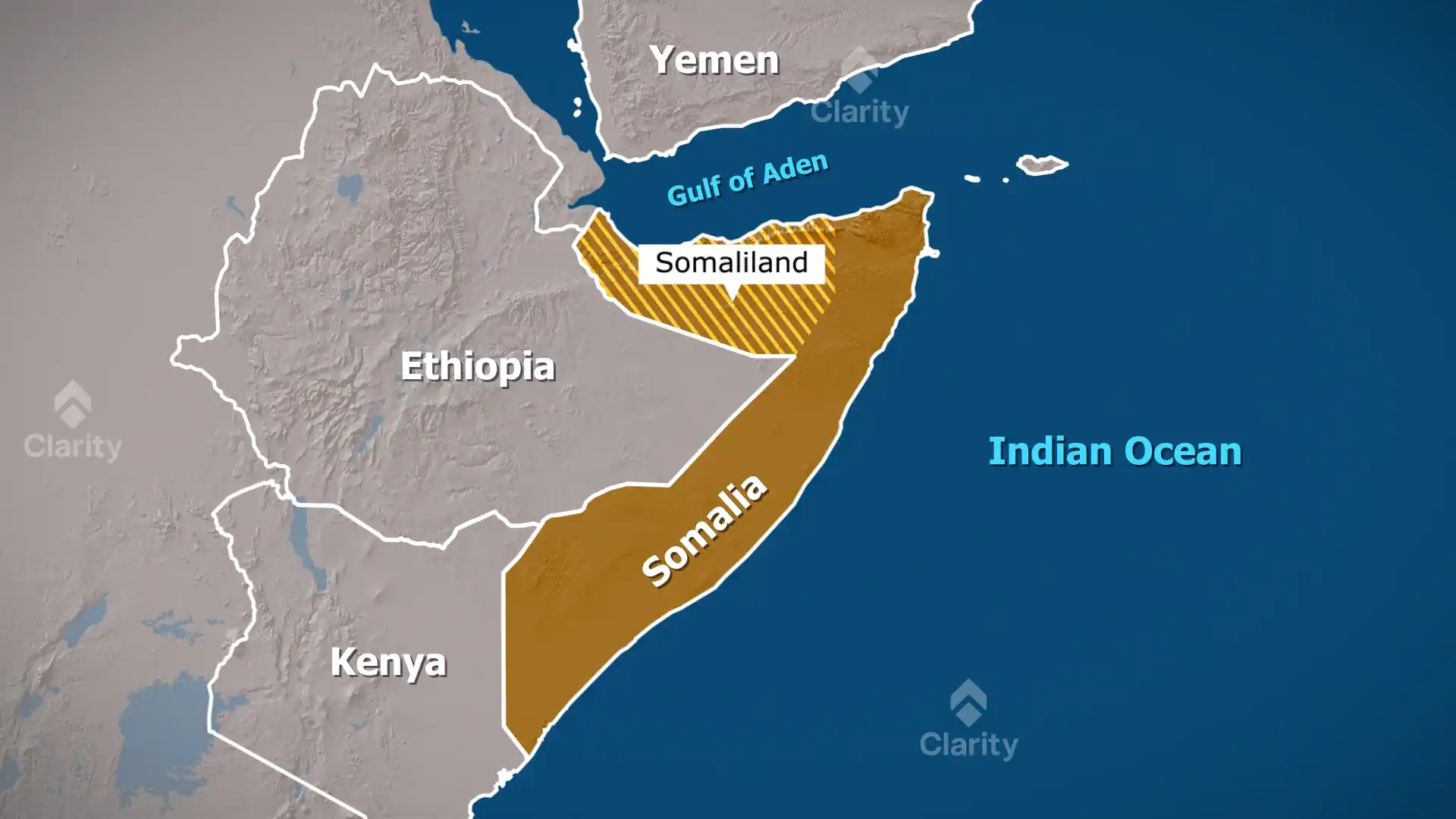
Why in news?
On 26 December 2025, Israel became the first country to officially recognise the Republic of Somaliland, a self‑declared state in the Horn of Africa. The announcement has drawn praise from Somaliland and sparked diplomatic tensions with Somalia.
Background
Somaliland was a British protectorate until it gained independence on 26 June 1960. Five days later it voluntarily united with the former Italian Somaliland to form the Somali Republic. After decades of marginalisation and civil war, Somaliland declared independence again in 1991 and established its own government, constitution and institutions. It has enjoyed relative stability compared with Somalia but has struggled for international recognition.
Governance and economy
- Political system: Somaliland operates as a de facto state with a republican constitution, elected president and legislature. A House of Elders (Guurti) blends customary consensus with modern governance.
- Economy: Livestock exports (especially to the Gulf region) are the mainstay, along with remittances from diaspora. The port of Berbera, situated on the Gulf of Aden, is being developed by DP World and is strategically important for landlocked Ethiopia.
- Security: Somaliland maintains its own police and army, keeping the region relatively peaceful compared with southern Somalia.
Significance of recognition
- Diplomatic breakthrough: Israel’s recognition could encourage other countries to consider diplomatic ties, although many African states support Somalia’s claim of sovereignty.
- Geostrategic interests: For Israel, recognition may provide a foothold near the Bab el‑Mandeb strait, a key maritime chokepoint. For Somaliland, it could bring investment and security cooperation.
- Regional reaction: Somalia strongly condemned the move as a violation of its territorial integrity. The African Union still treats Somaliland as part of Somalia and has urged dialogue.
Source: The Hindu