

Why in news?
Seismologists recently detected sonic booms generated by fragments of space debris re‑entering Earth’s atmosphere. The finding drew attention to the physics of sonic booms as well as ongoing efforts to design aircraft that can travel faster than sound without producing disruptive noise. NASA’s X‑59 Quesst research aircraft, which completed its first flight in October 2025, aims to transform sonic booms into softer “sonic thumps.”
Background
A sonic boom is a loud noise created when an object travels faster than the speed of sound in air (about 343 m/s or 1,225 km/h at sea level). As the object moves, it compresses air molecules in front of it, generating pressure waves. When the object exceeds the sound barrier, these pressure waves merge into shock waves. The sudden release of pressure behind the object produces the characteristic boom.
Formation and characteristics
- Pressure waves: At subsonic speeds, waves travel ahead of the object. Once the speed of sound is surpassed, the waves pile up and form a conical shock wave. Observers hear the boom when this shock wave reaches them.
- Influencing factors: The intensity of a sonic boom depends on the aircraft’s size and shape, its altitude, speed and flight manoeuvres, and atmospheric conditions such as temperature and wind. Larger and heavier objects generate stronger booms.
- Overpressure: Typical peak overpressure on the ground ranges from less than one to about 10 pounds per square foot (psf). Although loud (often 110 decibels or more), this pressure is usually not harmful to people but may damage brittle structures like glass.
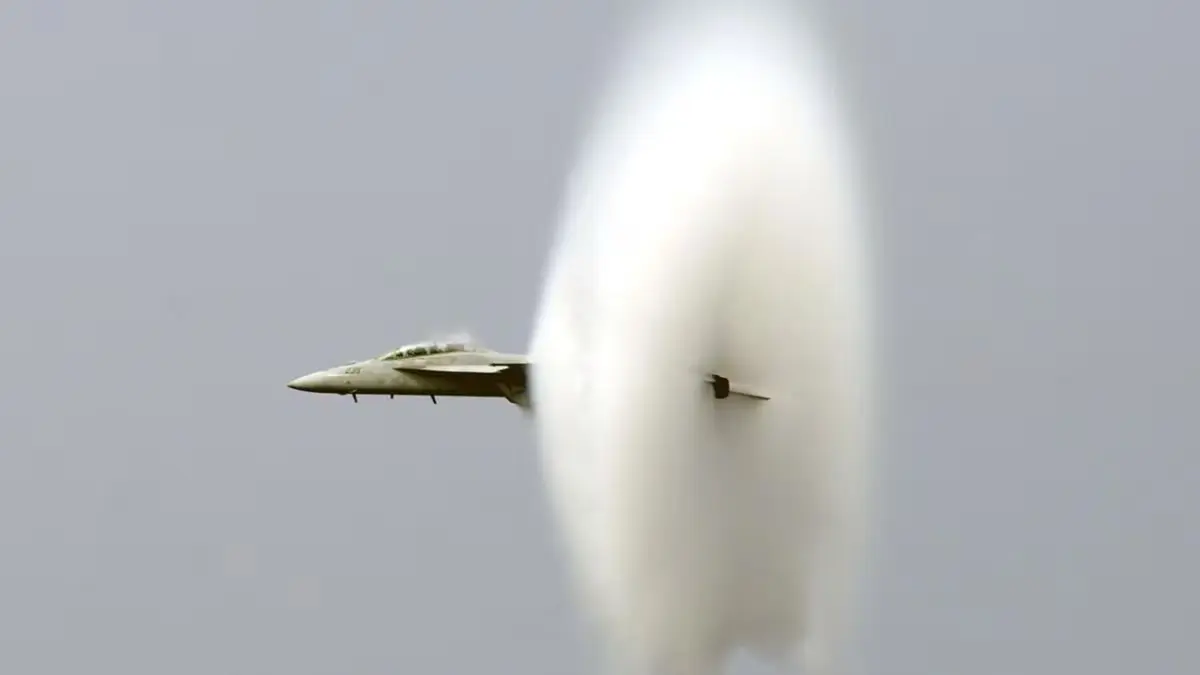
- Visual effects: The rapid pressure change can cause moisture in the air to condense temporarily around an aircraft, forming a visible vapor cone. This phenomenon is sometimes mistaken for the sonic boom itself.
Recent developments
- Detection by seismometers: Scientists have used sensitive seismometers to register tiny ground vibrations caused by sonic booms from meteoroids, rockets and returning spacecraft. Such monitoring helps in tracking re‑entering objects and assessing potential hazards.
- Quiet supersonic flight: NASA’s X‑59 aircraft, part of the Quesst mission, is designed with a long, slender fuselage and canards that spread shock waves out, reducing their intensity. The goal is to demonstrate that supersonic flight over land can be safe and quiet enough for regulatory approval.
- Civil aviation implications: If sonic thumps replace booms, commercial supersonic travel could become viable without disturbing people on the ground. Current regulations ban supersonic flight over land in many countries because of noise concerns.
Significance
- Scientific interest: Understanding sonic booms aids aerospace design, space debris monitoring and atmospheric research.
- Public safety: Monitoring sonic booms ensures that falling debris or aircraft overflights do not endanger people or infrastructure.
- Future transport: Efforts to minimise sonic booms could usher in a new era of fast air travel and spur innovations in aircraft design.
Source: TH