Why in news?
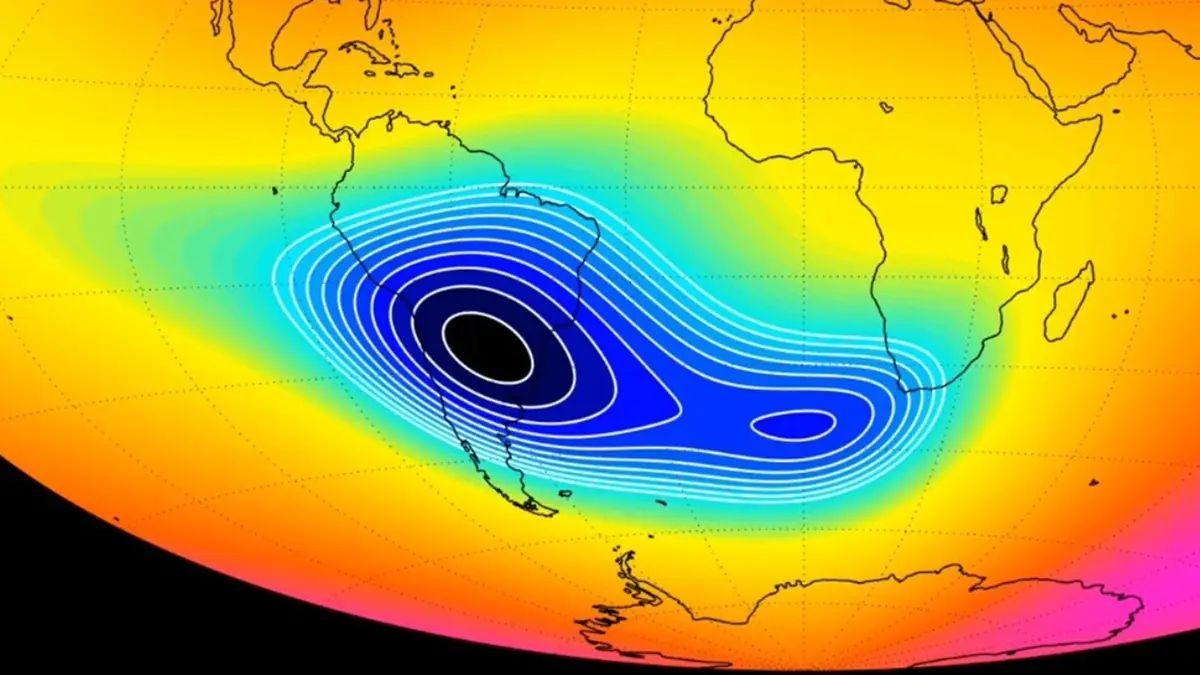
Recent measurements show that the South Atlantic Anomaly (SAA) — a region over South America and the South Atlantic where Earth’s magnetic field is unusually weak — is splitting into two separate lobes and slowly drifting westward. This evolution increases the risk of high‑energy charged particles damaging satellites, forcing operators to shut down instruments when crossing the anomaly.
Background
Earth is enveloped by a magnetic field generated by molten iron moving in its outer core. This field traps high‑energy solar and cosmic particles in two doughnut‑shaped radiation zones called the Van Allen belts. Over the South Atlantic, the inner belt dips closer to Earth, lowering the strength of the magnetic shield. Scientists attribute the SAA to the tilt between Earth’s magnetic and rotational axes and complex flows in the core.
Impacts on satellites and astronomy
- Satellite glitches: As spacecraft pass through the SAA, they encounter a higher flux of energetic protons. This can cause single‑event upsets — random bit flips or temporary malfunctions — in onboard electronics. Sensitive instruments are often switched off during transit.
- Operational adjustments: Mission planners for the Hubble Space Telescope and the International Space Station schedule observations to avoid the anomaly. Earth‑monitoring satellites, such as ESA’s Swarm mission, continuously map the SAA to track its shape and strength.
- No immediate surface danger: The anomaly does not pose a health risk to people on the ground because Earth’s atmosphere still blocks most harmful radiation. However, understanding its evolution helps scientists model changes in the planet’s magnetic field.
Why it matters
- Space weather forecasting: Monitoring the SAA helps predict when and where spacecraft may encounter increased radiation, allowing for protective measures.
- Core dynamics: The anomaly’s westward drift and bifurcation offer clues about convection patterns deep inside Earth. Studying these changes enhances our knowledge of the geodynamo — the engine driving the magnetic field.
- Technological resilience: Designing radiation‑hardened electronics and robust mission operations reduces the risk of data loss and equipment failure for satellites traversing the SAA.
Conclusion
The South Atlantic Anomaly is a natural feature arising from Earth’s dynamic interior. Its slow drift and split into two lobes remind us that our planet’s magnetic shield is not static. Continuous monitoring and improved satellite designs will help safeguard critical space infrastructure as we rely more on satellites for communication, navigation and science.