

Why in news?
Meteorologists have warned of a potential sudden stratospheric warming (SSW) event that could disrupt winter weather patterns in the Northern Hemisphere. Although some models suggest only a minor disturbance, earlier SSW events have preceded severe cold spells, prompting forecasters to monitor the phenomenon closely.
Background
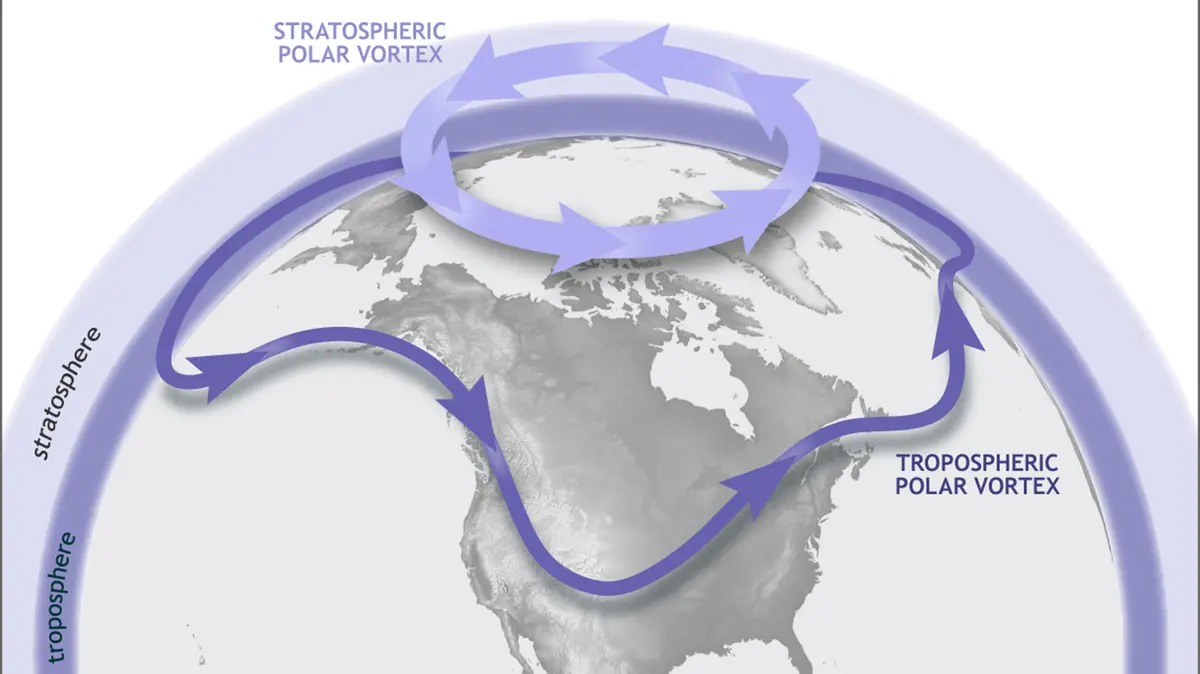
The stratosphere is the layer of the atmosphere approximately 10–50 kilometres above the Earth’s surface. Around the poles, strong westerly winds known as the polar vortex circulate cold air. SSW occurs when planetary‑scale atmospheric waves (known as Rossby waves) rise from the troposphere, weaken the polar vortex and cause its winds to reverse direction. When this happens, the stratospheric temperature can rise by 30 °C or more within a few days, and the vortex may split or shift away from the pole. This disturbance can propagate downward, influencing weather patterns at the surface.
How SSW events unfold
- Wave breaking: Large waves generated by mountains and land‑sea contrasts travel upward and “break” over the polar vortex, injecting momentum and heat into the stratosphere.
- Wind reversal: If the disruption is strong enough, the typical west‑to‑east winds around the pole weaken and may even switch to an easterly direction.
- Vortex splitting: The polar vortex can split into two smaller vortices or be displaced off the pole, allowing cold Arctic air to spill southward into mid‑latitude regions.
- Downward influence: In the weeks following an SSW, changes in the stratosphere affect the jet stream and surface weather. Not every event leads to extreme cold, but many famous cold snaps—including January 2019 and 2021—followed strong SSWs.
Impacts on weather
- Colder winters: SSW events often precede outbreaks of frigid air in North America, Europe and Asia. However, the degree of cooling varies and depends on other atmospheric factors.
- Storm track shifts: Disruptions in the polar vortex can alter the paths of storm systems, leading to unusual weather patterns, heavy snowfall or prolonged cold spells.
- Forecast challenges: Predicting SSW timing and impacts is difficult. Meteorologists monitor stratospheric conditions to anticipate possible downstream effects, improving seasonal forecasts.
Conclusion: Sudden stratospheric warming events highlight the intricate connections between the upper atmosphere and surface weather. While not every SSW results in extreme cold, understanding this phenomenon helps forecasters provide early warnings and communities prepare for winter extremes.
Source: Newsweek