

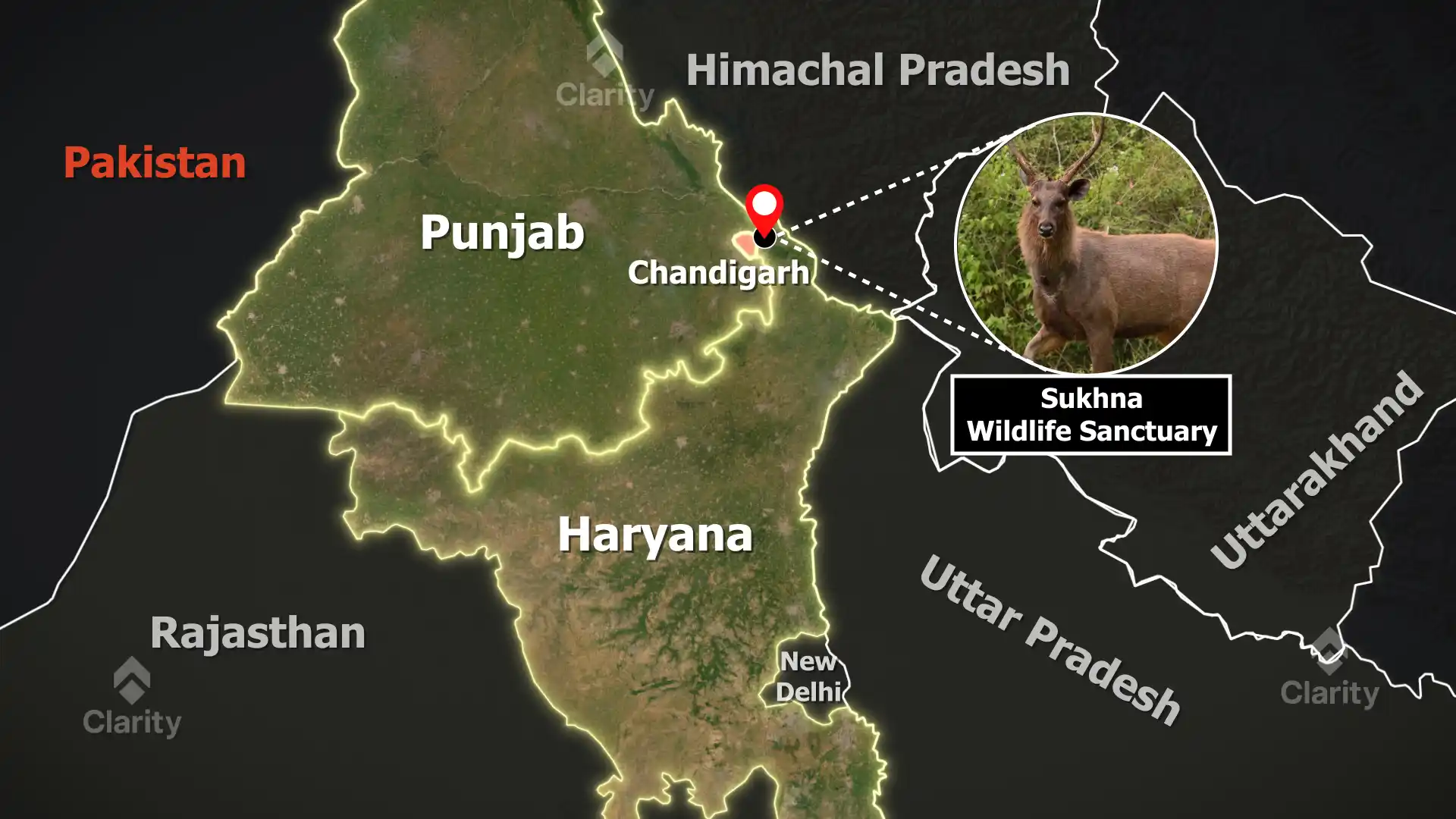
Why in news?
The Department of Forests & Wildlife in Chandigarh, in collaboration with the Wildlife Institute of India, launched a week‑long wildlife census on 20 November 2025 covering the Sukhna Wildlife Sanctuary and adjoining reserve forests. The survey aims to document mammals, birds, reptiles and amphibians, including nocturnal species, using camera traps and transect walks. Volunteers from the public have been invited to participate alongside trained naturalists.
Background
Sukhna Wildlife Sanctuary lies in the Shivalik foothills about 1 km north‑east of Chandigarh’s Sukhna Lake. Covering roughly 2,600 hectares, the catchment area was once severely eroded, leading to heavy siltation of the lake. Extensive soil conservation and afforestation measures by the Forest Department transformed the degraded hills into a verdant forest, prompting the area’s declaration as a wildlife sanctuary in 1998. It now serves as a haven for sambar, barking deer, civets, leopards, porcupines and numerous bird species.
Details of the 2025 survey
- Coverage: The census spans the Sukhna sanctuary, the Botanical Garden, Sukhna Choe reserve forest, Nepli range, Kansal forest and peripheral areas. This comprehensive coverage will help update species inventories and habitat maps.
- Methods: Teams will walk fixed transects during dawn and dusk to record animal sightings, droppings and tracks. Nocturnal species such as civets, owls and nightjars will be monitored using spotlight surveys. Camera traps will be installed at strategic points to capture elusive animals.
- Community involvement: A capacity‑building workshop preceded the survey to train volunteers in wildlife identification, data recording and ethical conduct. Public participation aims to foster stewardship and awareness about biodiversity.
- Integration with waterbird count: The survey period coincides with the Asian Waterbird Count, allowing simultaneous enumeration of migratory and resident birds at Sukhna Lake and wetlands.
Ecological importance
- The sanctuary protects the fragile catchment of Sukhna Lake, preventing erosion and regulating water flow.
- Its diverse habitats—from scrub forests to grassy slopes—support a rich variety of wildlife and serve as an ecological corridor linking the Shivalik hills to the plains.
- The area provides recreational and educational opportunities for residents of the tri‑city region and contributes to urban eco‑tourism.