

Why in news?
A long gamma‑ray burst detected on 14 March 2025 has led astronomers to a remarkably distant supernova, whose light began its journey when the universe was just about 730 million years old. Observations by the James Webb Space Telescope (JWST) captured the supernova’s glow months after the initial burst, offering a rare glimpse of star death during the era of reionisation.
Background
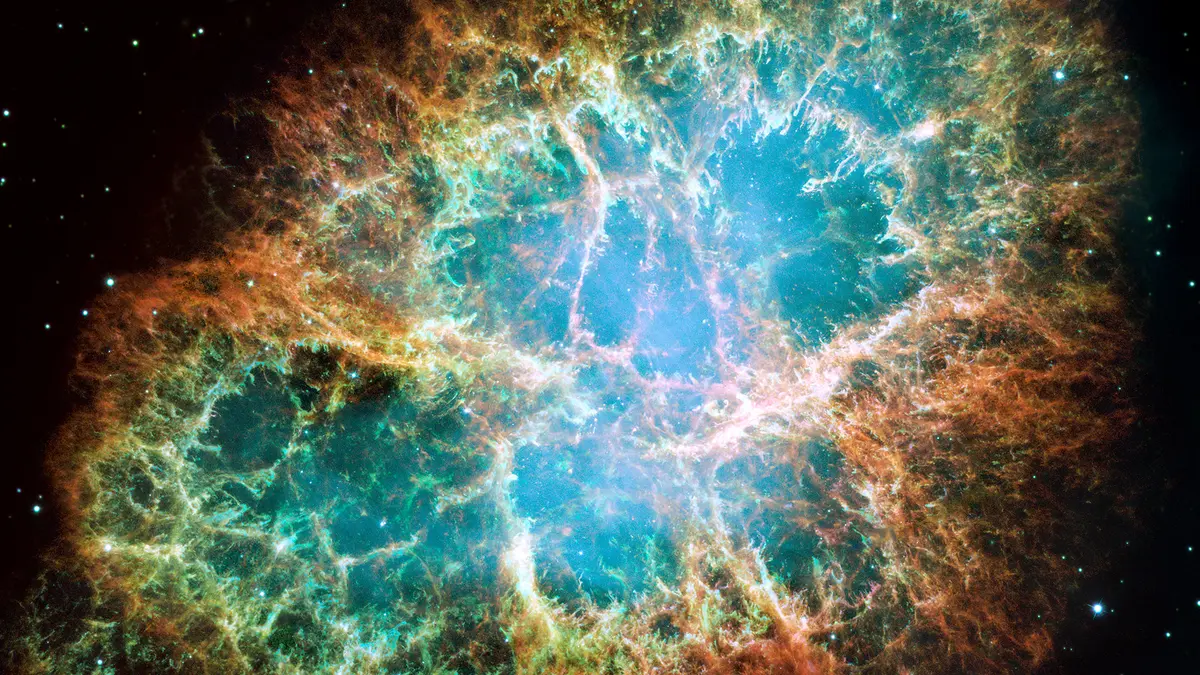
A supernova is the explosive end of a star’s life. When a massive star exhausts its nuclear fuel (Type II) or a white dwarf accretes material from a companion star until a runaway reaction occurs (Type I), the star collapses and releases an enormous amount of energy. These cosmic explosions can outshine entire galaxies for weeks, dispersing heavy elements like iron and calcium into space and seeding future generations of stars and planets.
About the latest discovery
- Gamma‑ray burst GRB 250314A: Detected on 14 March 2025, the burst signalled the death of a star in a galaxy more than 13 billion light‑years away. As the universe has expanded since then, the supernova’s light reached telescopes months later.
- Early universe snapshot: The star exploded when the universe was less than a billion years old, during a period known as the era of reionisation when the first galaxies and stars ionised intergalactic hydrogen.
- JWST observations: Scientists used the James Webb Space Telescope’s infrared sensitivity to study the supernova’s brightness and spectrum. Surprisingly, the explosion resembled supernovae seen in metal‑rich modern galaxies, suggesting that some early stars evolved similarly despite forming in primitive environments.
- Importance: Studying such early supernovae helps astronomers understand how the first stars lived and died, how quickly heavy elements enriched the universe and how galaxies formed.
Supernova facts
- Supernovae can release more energy in a few seconds than our Sun will emit in its entire lifetime.
- In galaxies like the Milky Way, astronomers expect only two or three supernovae per century, but telescopes routinely observe hundreds per year in distant galaxies.
- The elements essential for life on Earth—such as oxygen, iron and calcium—were forged in the cores of massive stars and scattered by supernova explosions.
Conclusion
The detection of this ancient supernova demonstrates the power of modern telescopes to peer deep into cosmic history. By capturing the light of a star that died billions of years ago, astronomers are piecing together the story of how the universe evolved from a dark, primordial state to the rich, structured cosmos we see today.
Source: Moneycontrol