

Why in news?
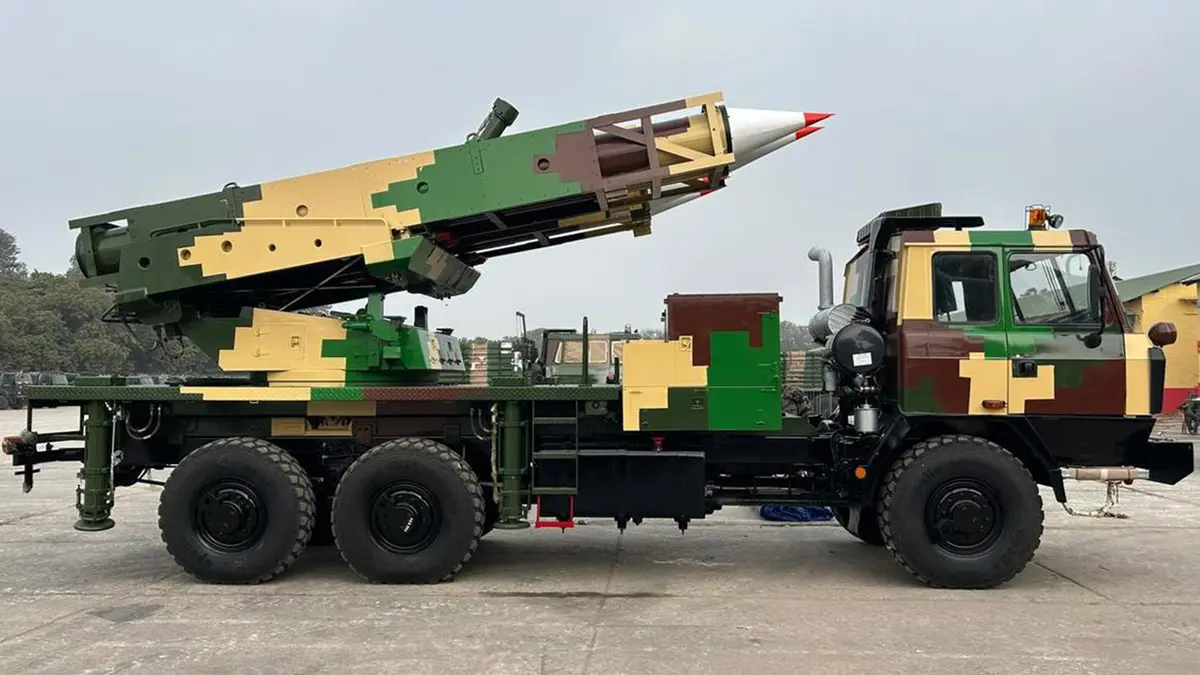
The Indian Army has cleared a contract for an indigenous Suryastra multiple‑rocket launcher system. The decision follows successful testing of the system’s ability to fire both 122 mm and 160 mm rockets with high precision at ranges of 150 km and 300 km. Built by a domestic firm in collaboration with an Israeli technology partner, the weapon system will bridge the gap between existing artillery rockets and longer‑range missiles. The deal signals a major push towards self‑reliance in long‑range precision firepower.
Background
India’s artillery arsenal currently includes the Pinaka multi‑barrel rocket launcher and the BrahMos supersonic cruise missile. There is, however, a capability gap between these systems: Pinaka rockets reach up to about 90 km, while missiles like BrahMos exceed 290 km. To address this gap, NIBE Limited, an Indian defence firm, partnered with Israel’s Elbit Systems to adapt the Precise & Universal Launching System (PULS) for Indian requirements. The resulting platform, renamed Suryastra, is India’s first universal multi‑calibre rocket launcher capable of firing different types of rockets from a single vehicle. It emerged under the Emergency Procurement scheme that allows rapid acquisition of weapons when operational needs demand quick delivery.
Key features
- Universal launcher: Suryastra can fire rockets of multiple calibres (122 mm and 160 mm) from the same launch tubes. This flexibility allows the army to choose ammunition based on mission requirements.
- Longer ranges: The 122 mm rockets can strike targets at around 150 km, while the larger 160 mm rockets reach up to 300 km. These ranges fill the gap between existing artillery rockets and ballistic missiles.
- High precision: The rockets are guided by advanced navigation systems and have a circular error probable of less than 5 metres, enabling accurate strikes on distant targets.
- Multiple target engagement: Suryastra can fire salvoes at several targets in quick succession. It is also capable of launching different types of ammunition including high‑explosive fragmentation and precision‑guided warheads.
- Mobility: The system is mounted on high‑mobility trucks and can be fitted onto tracked or wheeled chassis. This makes it suitable for deployment in various terrains and allows quick shoot‑and‑scoot operations.
Significance
- Bridging capability gaps: Suryastra provides a new layer of precision firepower between short‑range artillery rockets and long‑range missiles. This allows commanders greater flexibility in planning strikes.
- Indigenisation: By producing the launcher in India and integrating imported technologies domestically, the project advances the government’s Atmanirbhar Bharat (self‑reliant India) initiative. It also sets the stage for local manufacturing of propulsion systems and warheads.
- Strategic deterrent: The long range and accuracy enhance India’s deterrence posture by enabling deep strikes on enemy infrastructure without crossing international borders.
- Export potential: The universal nature of the launcher and its modular design could attract interest from foreign buyers, opening new markets for India’s defence industry.
Conclusion
The Suryastra rocket system exemplifies how collaboration between domestic firms and foreign partners can yield cutting‑edge weaponry tailored to India’s needs. Once inducted, the system will strengthen the army’s long‑range strike capabilities and showcase the country’s growing ability to develop sophisticated weapon systems within its own borders.
Source: The Hindu