
Why in news?
Syntactic foam has gained attention in recent months due to new applications in marine research and aerospace engineering. Engineers have highlighted its ability to provide buoyancy and structural strength in deep‑sea probes, unmanned underwater vehicles and lightweight aircraft components.
Background
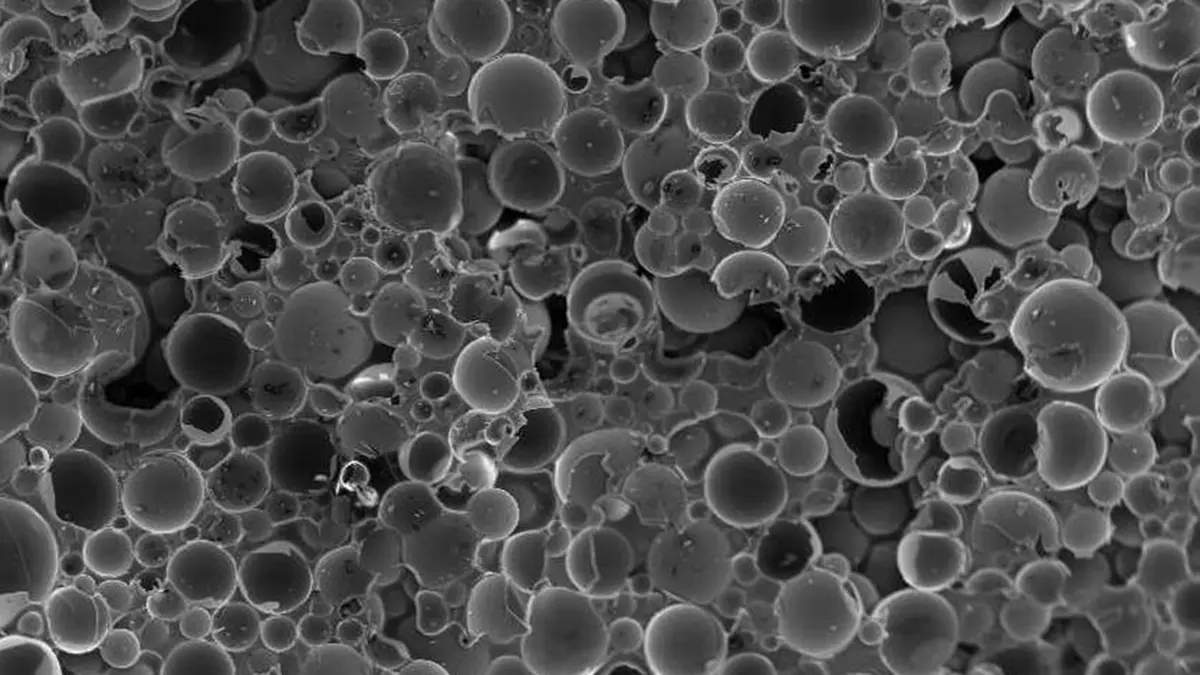
Syntactic foam is a composite material made by embedding hollow microspheres (or microballoons) within a matrix of polymer, metal, ceramic or cement. The term “syntactic” refers to the ordered arrangement of these spheres. Invented in the 1950s by the Bakelite Company and further developed in the 1960s, syntactic foams were originally designed as improved buoyancy materials for marine applications. The presence of hollow spheres greatly reduces density while maintaining high specific strength, making the material attractive wherever weight savings are crucial.
Properties and advantages
- Low density, high strength: The voids inside the microspheres lower the overall density, yet the rigid matrix maintains structural integrity. This gives syntactic foams a high strength‑to‑weight ratio.
- Thermal and acoustic insulation: Air‑filled or gas‑filled spheres act as insulators, making the material resistant to temperature changes and useful for damping sound waves.
- Tailored properties: By adjusting the type, size and volume fraction of microspheres and the surrounding matrix, engineers can design foams with specific compressive strength, buoyancy and thermal characteristics.
- Radar and sonar transparency: Certain syntactic foams exhibit low radar or sonar signatures, making them useful for stealth applications and underwater equipment.
Applications
Syntactic foams are used across several industries:
- Marine engineering: They serve as buoyancy modules for deep‑sea submersibles, remotely operated vehicles and offshore drilling risers, where resistance to hydrostatic pressure is critical.
- Aerospace and defence: Lightweight panels, helicopter blades and aircraft fairings incorporate syntactic foams to reduce weight without compromising strength. Radar‑transparent variants are used in radomes and stealth structures.
- Automotive and industrial: The material is employed in sandwich panels, sporting goods, thermal insulation and blast mitigation structures due to its energy‑absorbing properties.
- Civil engineering: Cementitious syntactic foams provide void filling and structural reinforcement in tunnelling and underwater construction.
Conclusion
Syntactic foam exemplifies how clever materials engineering can unlock new possibilities. By combining light weight, strength and customisability, it supports innovation in sectors ranging from deep‑sea exploration to aviation. Ongoing research aims to develop greener microspheres and recyclable matrices, ensuring that this versatile material continues to find sustainable applications.
Source: TH

