

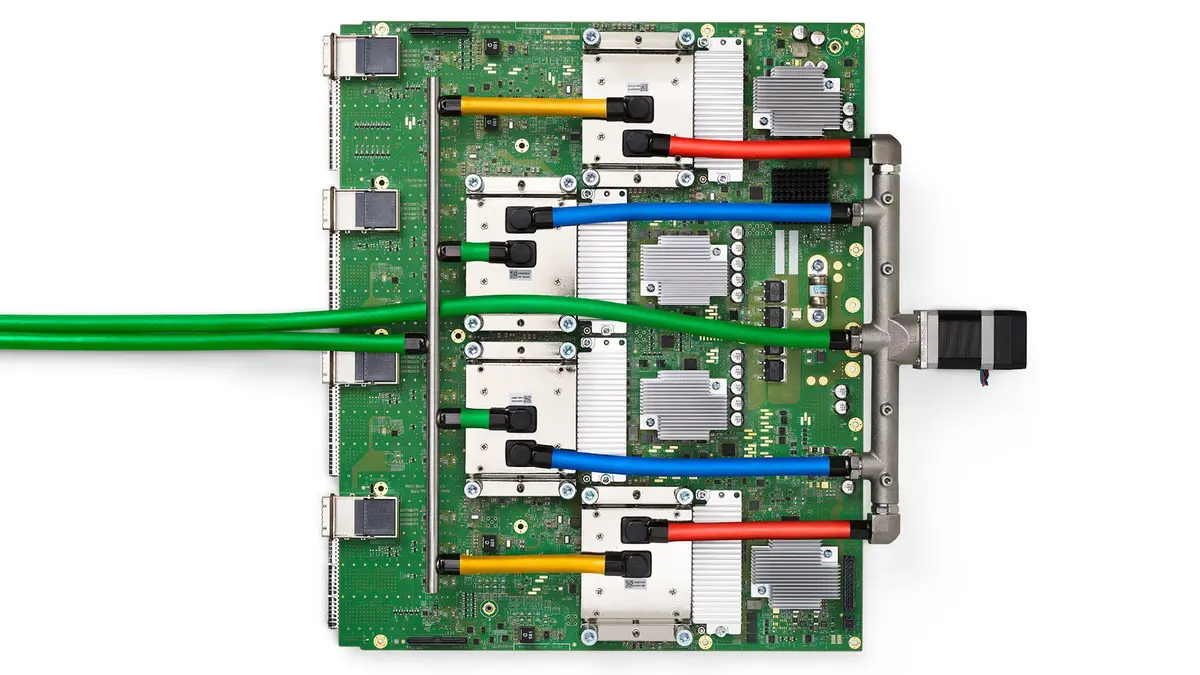
Why in news?
With the rapid growth of artificial‑intelligence applications in 2025, specialised chips known as Tensor Processing Units (TPUs) have gained prominence. Recent reports highlight how these chips, developed by Google, significantly speed up machine‑learning tasks such as natural‑language processing and image recognition, making AI more accessible and affordable for businesses and researchers.
Background
A Tensor Processing Unit is a custom application‑specific integrated circuit created by Google to accelerate neural‑network computations. The first TPUs were deployed internally in 2015 to handle the computational demands of Google Search and later became available to other organisations through Google Cloud. Unlike general‑purpose processors, TPUs are designed specifically for the matrix and vector operations that form the basis of deep learning. Their architecture emphasises massive parallelism and low‑precision arithmetic, allowing them to perform millions of calculations simultaneously while using less energy.
How TPUs work
- Matrix multiplication engine: At the heart of a TPU is a large matrix‑multiply unit that rapidly executes tensor operations (multi‑dimensional arrays), which are common in neural networks.
- High bandwidth memory: TPUs use on‑chip memory and high‑speed interconnects to reduce the time spent fetching data, enabling faster training and inference.
- Low‑precision arithmetic: Many AI models do not require full‑precision 32‑bit computations. TPUs often operate on 8‑bit or 16‑bit numbers, which cuts power consumption and increases throughput without sacrificing accuracy.
- Scalable clusters: Multiple TPUs can be linked together in “pods” to provide thousands of teraflops of processing power, allowing researchers to train very large models.
Applications and benefits
- Natural‑language processing: TPUs power speech recognition, translation and conversational AI services by processing vast amounts of text quickly.
- Computer vision: Tasks like image classification, object detection and medical imaging benefit from the chip’s parallelism.
- Recommendation systems: E‑commerce and streaming platforms use TPUs to analyse user data and generate personalised suggestions in real time.
- Scientific research: TPUs support climate modelling, genomics and materials science by enabling researchers to run complex simulations at lower cost.
- Energy efficiency: By tailoring hardware to specific workloads, TPUs reduce the energy required per computation compared with traditional CPUs and even some GPUs.
Conclusion
Tensor Processing Units represent an important shift toward specialised hardware for artificial intelligence. By aligning the design of processors with the needs of machine learning, TPUs lower barriers to innovation and help bring AI‑powered services to a wider audience. As demand for AI grows, similar accelerators from other companies are expected to emerge, driving further advances in computing.
Source: MSN