

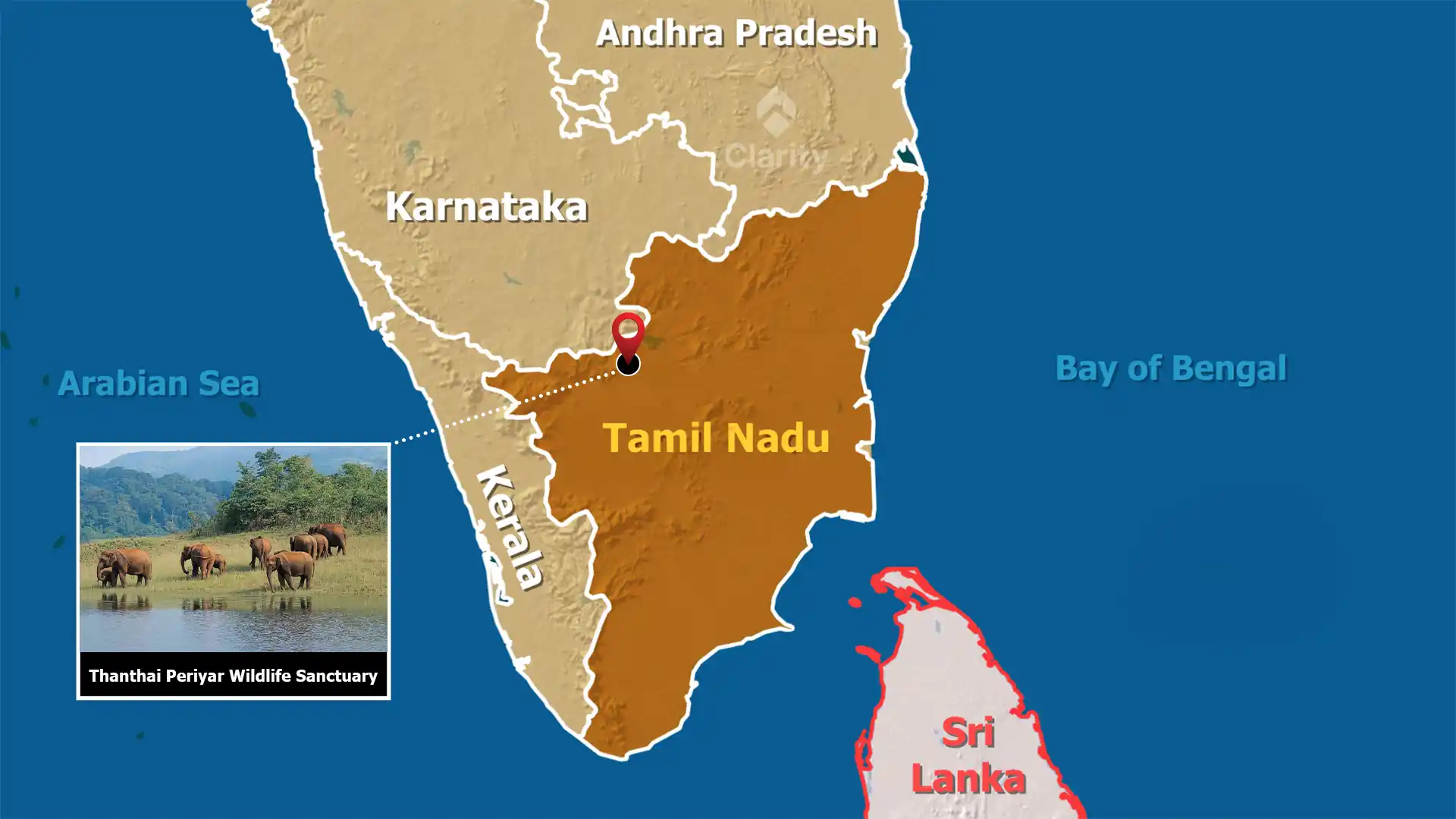
Why in news?
The first phase of the All‑India Tiger Estimation 2026 has begun at the Thanthai Periyar Wildlife Sanctuary in Tamil Nadu. The large‑scale census, conducted every four years, will assess tiger numbers, prey populations and habitat conditions across the country.
Background
Thanthai Periyar Wildlife Sanctuary was notified in February 2024 when 80,567 hectares of the Bargur Hills in Erode district were designated as protected forest. The sanctuary bridges the Western Ghats and Eastern Ghats, connecting the Sathyamangalam Tiger Reserve in Tamil Nadu with the Male Mahadeshwara and Cauvery wildlife sanctuaries in Karnataka. This corridor is critical for tiger movement and genetic exchange. The area is part of the Nilgiris Elephant Reserve, forms the catchment of the Palar River (a tributary of the Cauvery) and includes natural sandalwood forests. Rights of indigenous communities living within the sanctuary continue to be protected under the Forest Rights Act.
All‑India Tiger Estimation (AITE)
- Largest monitoring exercise: AITE is coordinated by the National Tiger Conservation Authority (NTCA) and the Wildlife Institute of India. It holds a Guinness World Record for the world’s most extensive wildlife survey.
- Regular cycle: The exercise is carried out once every four years (previous cycles were in 2006, 2010, 2014, 2018 and 2022). The 2026 cycle is the sixth and its final report is expected in 2027.
- Comprehensive data: The estimation counts tigers, co‑predators (such as leopards and wild dogs), prey species (including deer and gaur) and maps habitats using sign surveys, line transects, camera traps and genetic sampling.
- Technology and volunteers: New tools like M‑STrIPES (Monitoring System for Tigers – Intensive Protection and Ecological Status) and trained volunteers are employed to collect and verify data across tiger reserves, corridors and even private lands with predator presence.
Importance of the exercise at Thanthai Periyar
- Baseline for a new sanctuary: As Thanthai Periyar was only recently declared, the census will establish baseline data on its tiger population and prey base for future management.
- Corridor conservation: Accurate data will help authorities preserve and restore corridors between Western and Eastern Ghats, ensuring long‑term genetic diversity for tigers and elephants.
- Adaptive management: Findings will guide habitat restoration, anti‑poaching measures and community programmes in and around the sanctuary.
Source: The Hindu