Why in news?
The Lucknow bench of the Allahabad High Court has set aside a district‑level committee’s decision that rejected community forest rights claims filed by Tharu families in Uttar Pradesh’s Lakhimpur Kheri district. The court directed officials to reconsider the claims under the Forest Rights Act 2006, emphasising that traditional forest dwellers cannot be denied rights based on outdated colonial rules.
Background
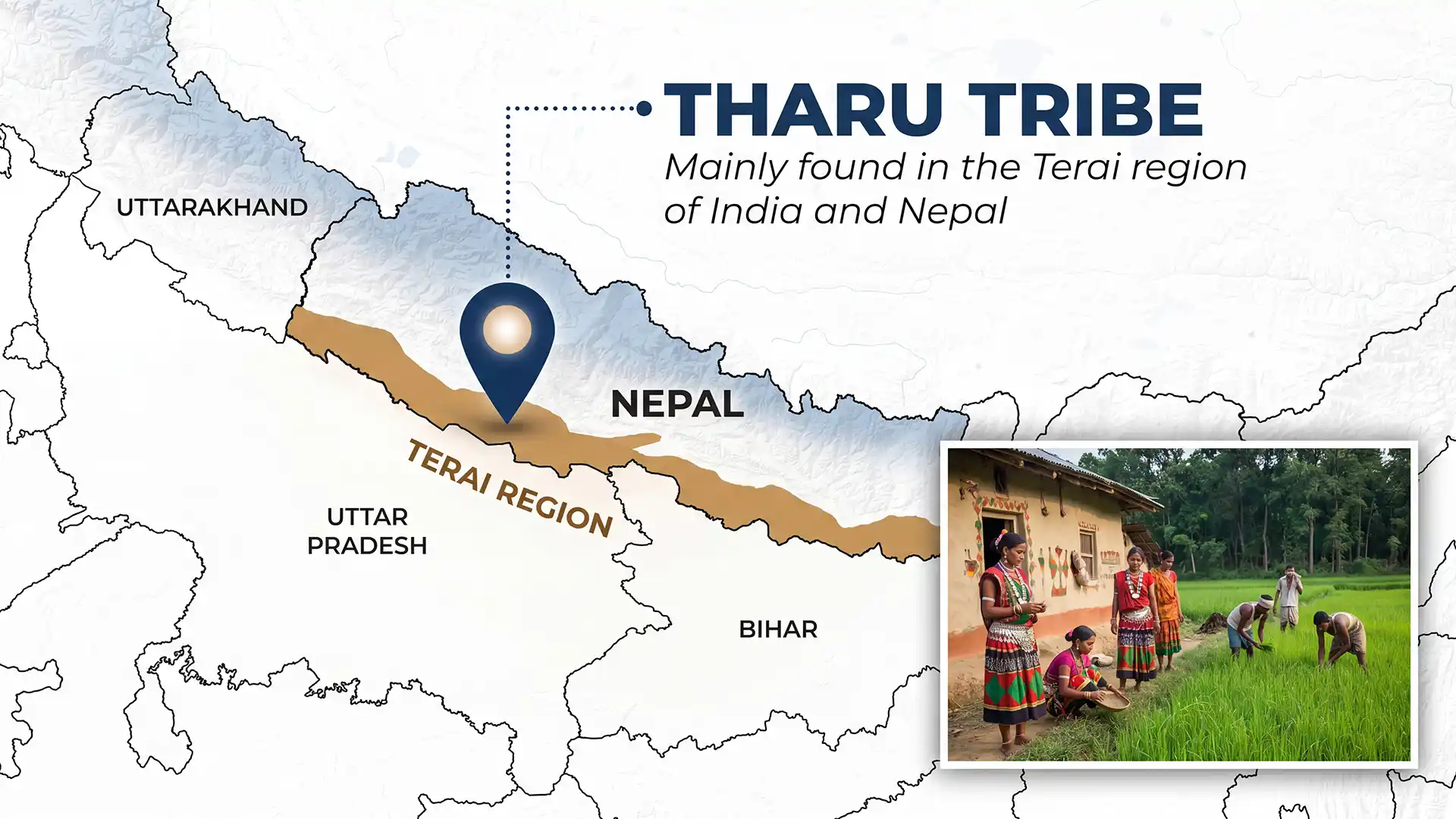
The Tharu are an indigenous people of the Terai plains along the India–Nepal border. Historical records suggest that they have inhabited this region for centuries and maintained a distinct culture, language and identity. In India they are mainly found in the states of Uttarakhand, Uttar Pradesh and Bihar, and have been recognised as a Scheduled Tribe since 1967. Traditional Tharu communities practise settled agriculture, raise cattle, fish and collect forest products. Their houses, called Badaghar, are built using mud, wood and thatch. Women enjoy relatively greater property rights compared with many other Indian societies, and decisions are often made through a panchayat system led by a Pradhan. Their faith blends animism, nature worship and elements of Hinduism.
Forest rights issue
- The Forest Rights Act 2006 recognises the traditional rights of forest‑dwelling communities to land, minor forest produce and management of community forest resources.
- In Lakhimpur Kheri, Tharu families filed claims to collectively manage their forest patches but these were rejected by a local committee, prompting them to approach the courts.
- The High Court held that administrative bodies must interpret the Act in favour of forest dwellers and not dismiss claims based on technicalities or antiquated government orders.
- The case sets a precedent for other tribal communities seeking recognition of their customary rights, highlighting the judiciary’s role in protecting marginalised groups.
Significance
- Recognising community rights can help conserve forests by empowering indigenous communities to manage their resources sustainably.
- Legal recognition provides security of tenure, preventing arbitrary evictions and improving livelihoods through access to forest produce.
- The ruling underscores the importance of participatory decision‑making in environmental governance and the need to implement the Forest Rights Act in letter and spirit.
Conclusion
The High Court’s decision is a step toward fulfilling the promises of the Forest Rights Act. Empowering the Tharu and other forest‑dwelling communities honours their traditional stewardship and can lead to more effective conservation outcomes.