
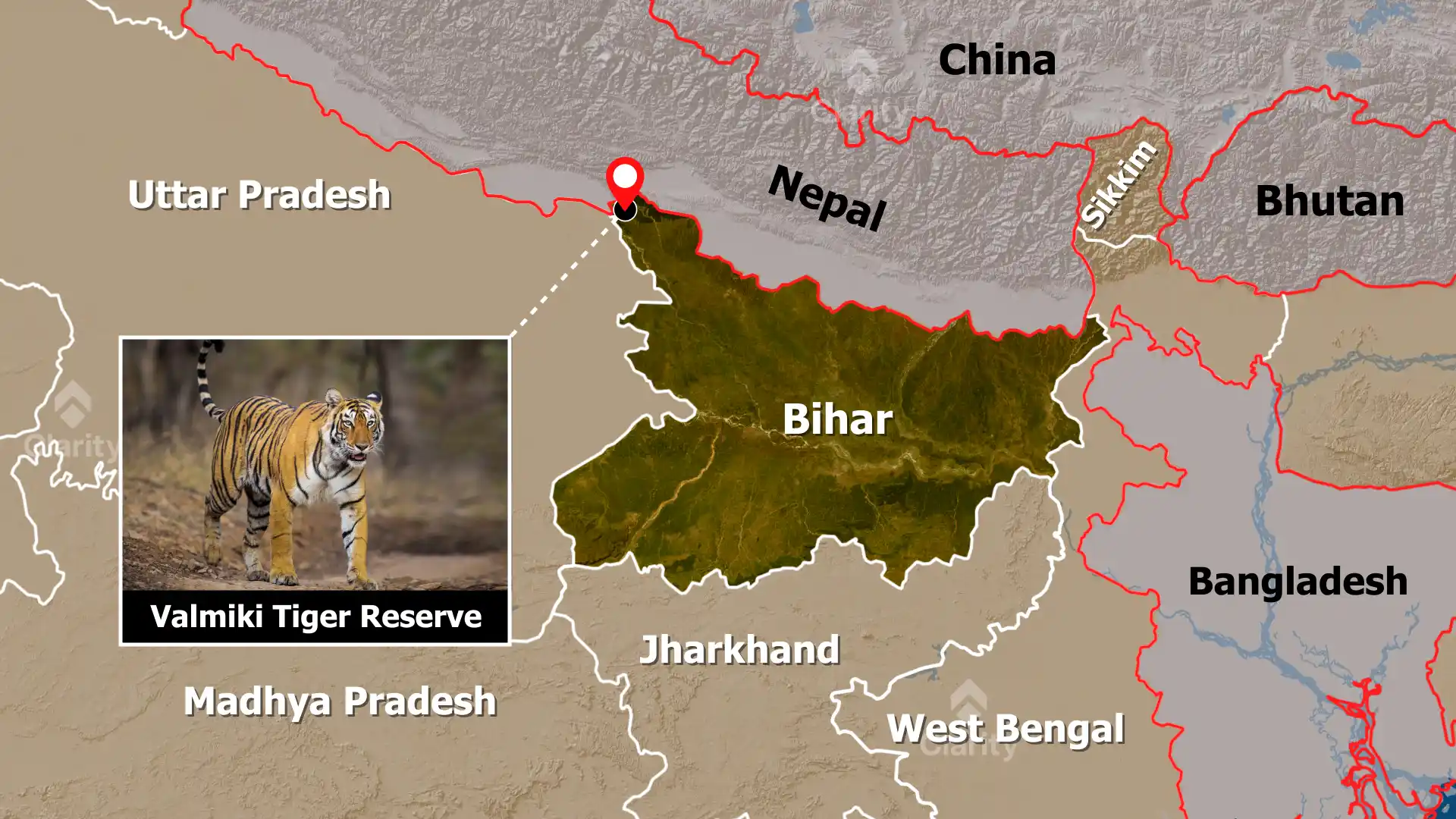
Why in news?
The Valmiki Tiger Reserve in Bihar has recorded a remarkable rebound in its tiger population. According to the latest census, the number of tigers grew from just eight in 2010 to 54 in 2022. Conservationists hail this sevenfold increase as a major success story for wildlife management in the region.
Background
Valmiki Tiger Reserve, established in 1990 as India’s 18th tiger reserve, lies along the Indo‑Napla border in the West Champaran district of Bihar. Covering a core area of about 909.86 km2, it comprises Valmiki National Park and the surrounding wildlife sanctuary. The reserve lies at the easternmost limit of the Terai region and is bounded by the Gandak river to the west and the Himalaya foothills to the north. It adjoins Nepal’s Royal Chitwan National Park and protects both Bhabar grasslands and moist deciduous forests.
Key features of the reserve
- Landscape: The terrain includes alluvial plains, gentle hills and swampy depressions. Rivers such as the Gandak, Masan and Harha meander through, creating rich riparian habitats.
- Flora: Tropical moist deciduous forests dominate, characterised by sal, teak, asan, bamboo and tall grasses. Patches of riverine forests and open grasslands provide grazing for deer species.
- Fauna: Besides tigers, the reserve hosts leopards, wild dogs, sloth bears, chital, sambar, barking deer and many bird species. It forms part of a vital wildlife corridor linking India and Nepal.
Reasons for the population increase
- Enhanced anti‑poaching patrols and strict surveillance have reduced illegal hunting.
- Habitat restoration, such as grassland management and water conservation, has improved prey availability.
- Community engagement programmes have encouraged local people to participate in conservation efforts and reduce human–wildlife conflict.
Sources: The Times of India

