

Why in news?
Scientists revisiting data from NASA’s Cassini mission have suggested that Saturn’s largest moon, Titan, may not harbour a single global ocean beneath its icy crust. Instead, new modelling shows that the moon’s interior likely consists of layers of slush with pockets of liquid water. The finding modifies earlier assumptions about Titan’s hidden seas and provides fresh insights into where life might exist beyond Earth.
Background
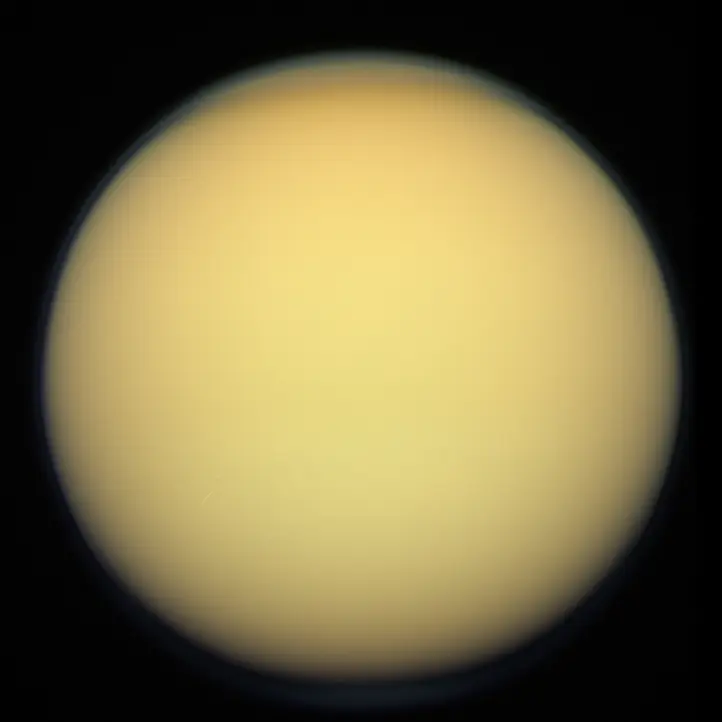
Titan is the largest of Saturn’s satellites and the second‑largest moon in the solar system. Dutch astronomer Christiaan Huygens first observed it in 1655. With a diameter of about 5,150 km, Titan is only slightly smaller than the planet Mercury. It is unique among moons because it possesses a dense, nitrogen‑rich atmosphere with a smog of methane and other hydrocarbons. Lakes, rivers and seas of liquid methane and ethane dot its frigid surface, making Titan the only world besides Earth known to have stable liquids on its surface. The moon is tidally locked to Saturn, taking just under 16 Earth days to orbit and rotate once.
Cassini mission and new insights
- Cassini–Huygens mission: Launched in 1997 by NASA, the European Space Agency (ESA) and the Italian Space Agency, the Cassini spacecraft spent 13 years studying Saturn and its moons. In 2005 the Huygens probe landed on Titan’s surface, sending back unprecedented images and data.
- Previous view: Based on gravity measurements and radar observations, researchers once hypothesised that Titan hid a global ocean of liquid water or ammonia‑water beneath a rocky core and icy crust.
- Reanalysis findings: Scientists have now recalculated how Titan flexes as it orbits Saturn. They found that the moon dissipates about three to four terawatts of energy – much more than expected if its interior were a uniform liquid ocean. The large energy loss makes sense if Titan’s ice shell and underlying layers are slushy: tidal forces would stir these layers, causing significant friction and heat. The modelling therefore suggests a mosaic of slush and small pockets of liquid water rather than one continuous ocean.
- Implications for life: Even without a global sea, Titan could still host habitats. Localised pockets of water warmed by tidal energy might provide environments where simple life could develop. The findings thus refine – but do not eliminate – the prospects for life in the outer solar system.
Sources: Earth.com