

Why in news?
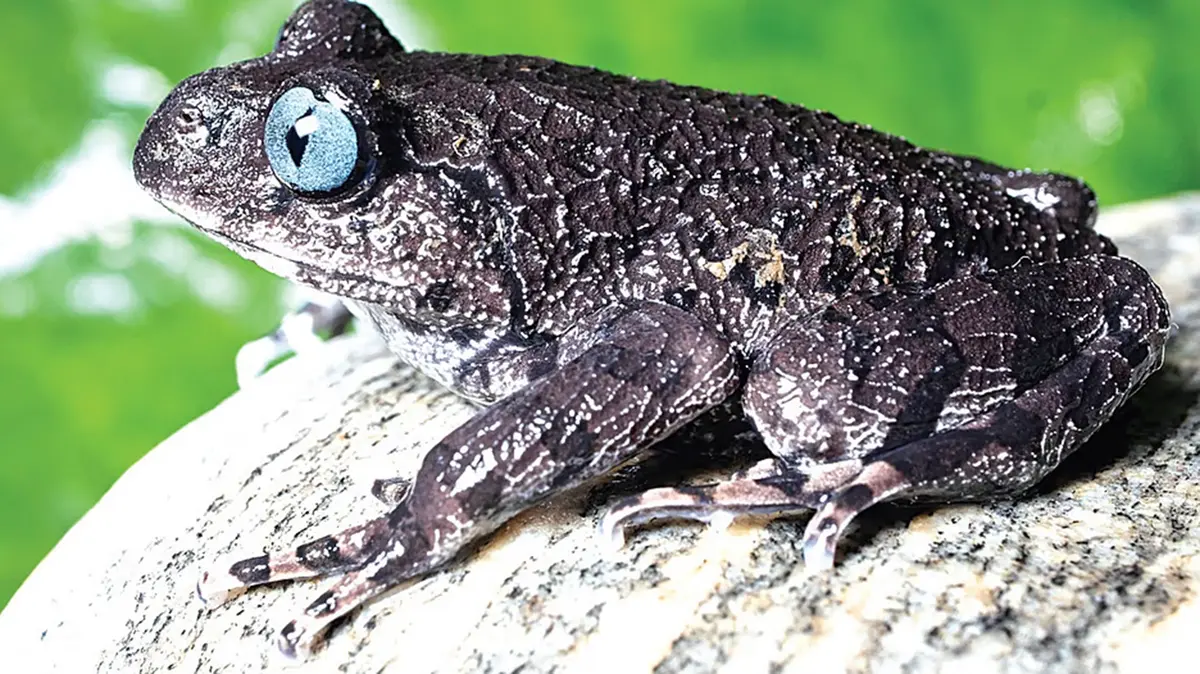
Researchers studying amphibians in Arunachal Pradesh have described two previously unknown frogs: Soman’s Slender‑Arm Frog (Leptobrachium somani) and Mechuka Slender‑Arm Frog (Leptobrachium mechuka). The discoveries were announced in early January 2026 and highlight the rich biodiversity of the Eastern Himalaya.
Background
Slender‑arm frogs belong to the genus Leptobrachium in the family Megophryidae. These medium‑sized amphibians inhabit forest streams in Southeast Asia. Until now, all known Indian species lived south of the Brahmaputra River. The new species were found north of the river in the Dibang Valley and Shi Yomi districts. The research team led by herpetologist S.D. Biju used DNA sequences and detailed measurements to confirm that the frogs were distinct species. Their names honour journalist E. Somanath and the town of Mechuka.
Identifying features
- Soman’s Slender‑Arm Frog: About 55 mm long, it has a greyish‑brown body with irregular light markings and a dark stripe along the head. The eyes are silver‑grey to light blue. It lives in moist evergreen forests near stream banks in the lower Dibang Valley.
- Mechuka Slender‑Arm Frog: Slightly larger at roughly 60 mm, this species has a uniformly brown body with a reddish tinge and silvery‑white eyes. It was collected from evergreen forests and adjoining grasslands near Mechuka in Shi Yomi district.
- Shared traits: Both frogs have stout bodies, short forelimbs and a skin fold behind the head. They belong to the L. bompu species group and were discovered during nocturnal surveys.
Significance
- Biogeographic insight: The Brahmaputra River appears to act as a natural barrier for many species. Finding these frogs north of the river suggests that the region harbours distinct evolutionary lineages.
- Biodiversity hotspot: Arunachal Pradesh lies within the Himalaya biodiversity hotspot and supports many endemic amphibians. New discoveries underscore the need for conservation in these forests.
- Scientific value: Documenting new species improves our understanding of frog diversity and helps researchers study evolutionary relationships within the Megophryidae family.
Conclusion
The discovery of Soman’s and Mechuka slender‑arm frogs illustrates how much remains to be learned about India’s amphibian fauna. Protecting the pristine forests of Arunachal Pradesh will be crucial for preserving these and other newly described species.
Source: The Indian Express