

Why in news?
Soft matter physics has gained prominence because of its role in everyday products and emerging technologies. Materials such as gels, polymers, foams and liquid crystals are essential in food, cosmetics, electronics and biomedicine. Recent discussions highlight how understanding soft matter can lead to better materials design and sustainable applications.
Background
The term soft matter refers to a broad class of substances that can be easily deformed by small stresses or thermal fluctuations. Their building blocks are intermediate in size between atoms and grains – often tens to thousands of nanometres – and their energies are comparable to the thermal energy kT. As a result, entropy plays a dominant role in their behaviour. Soft matter sits between liquids and solids, displaying both fluidity and structural organisation.
Examples and characteristics
- Everyday examples: Milk, yogurt, honey, whipped cream, toothpaste, paints, inks, gels, soaps, foams, rubber bands and plastics are all soft matter. Even biological materials like blood, cell membranes and DNA fall into this category.
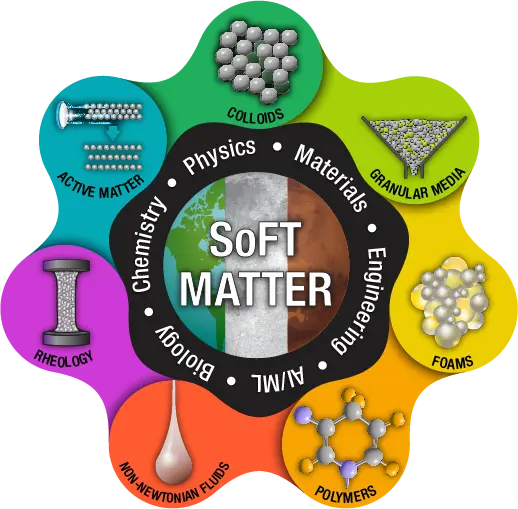
- Types: Key categories include liquids and solutions, colloids (suspensions of fine particles), polymers (long-chain molecules such as plastics and rubber), liquid crystals (materials that flow like liquids but have directional order, used in displays), foams and emulsions, gels, granular materials (sand, powders) and biomaterials.
- Properties: Soft materials deform readily under weak forces and can change shape without breaking. They often exhibit viscoelastic behaviour, meaning they have both liquid‑like and solid‑like responses. Because their structures exist on mesoscopic scales, they can self‑assemble into complex arrangements such as micelles, vesicles and liquid‑crystal phases.
Applications
- Industrial uses: Soft matter is critical in packaging, adhesives, detergents, lubricants, cosmetics, paints and food products. Control over viscosity and elasticity enables products like shampoos, spreads and ice cream to have appealing textures.
- Technology: Liquid crystals are used in televisions, smartphones and other displays. Polymer composites make flexible electronics, solar cells and lightweight car parts possible. Gels and hydrogels are used in biomedical devices, drug delivery and tissue engineering.
- Research frontier: Soft matter science bridges physics, chemistry, biology and engineering. It helps explain the mechanics of biological membranes, the behaviour of complex fluids and the formation of colloidal crystals. Researchers also study soft matter to develop sustainable materials and biomimetic systems.
Why it matters
Understanding soft matter gives insight into the behaviour of everyday substances and allows engineers to tailor materials for specific purposes. For example, controlling the alignment of liquid crystals has made flat‑panel displays possible, while manipulating polymer chains has led to biodegradable plastics. For civil services aspirants, the topic illustrates how interdisciplinary science can produce both theoretical insights and practical innovations.
Sources: TH