
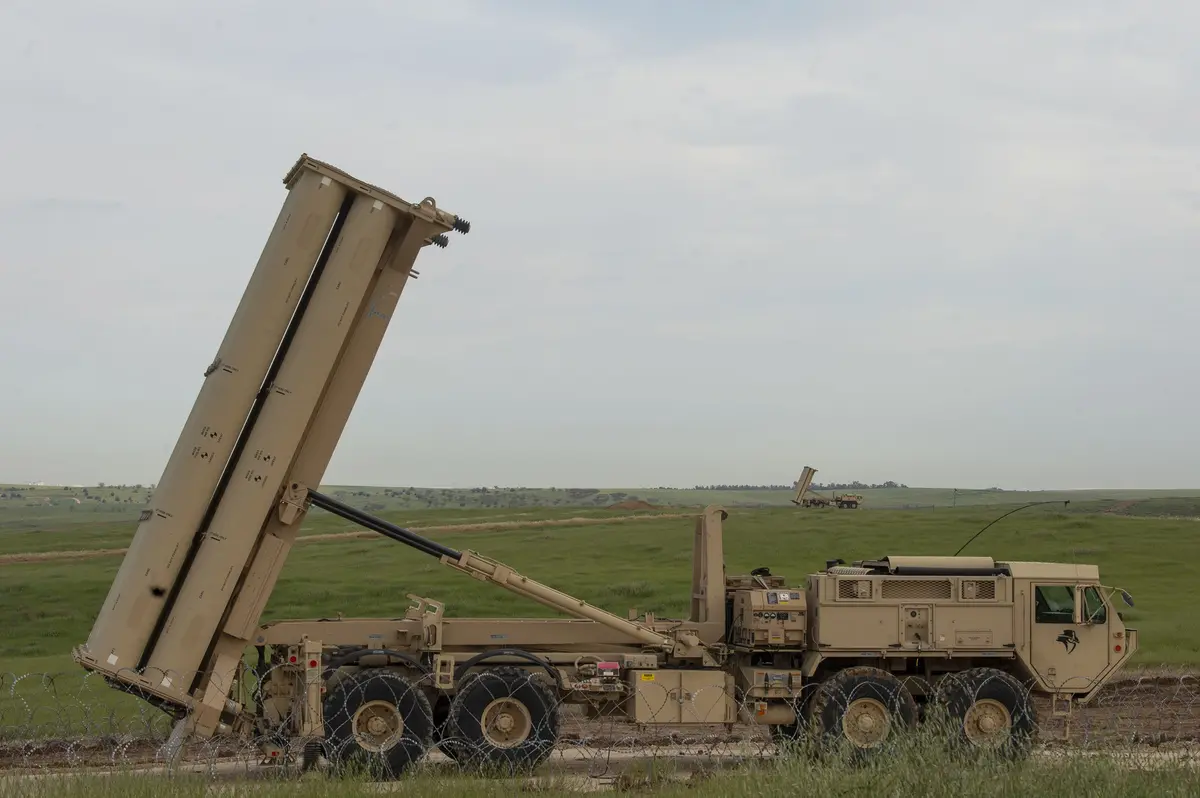
Why in News? The ongoing conflicts in West Asia have increased reliance on missile defence systems. One key asset is the United States’ Terminal High Altitude Area Defence (THAAD), which has been deployed to protect allies and intercept incoming ballistic missiles. Recent attacks have drawn attention to how THAAD operates and its capabilities.
Background
THAAD was developed by the US Missile Defense Agency to intercept short‑ and intermediate‑range ballistic missiles during the final stage of their flight. Unlike traditional interceptors that explode near a target, THAAD uses a “hit‑to‑kill” approach, destroying incoming missiles by colliding with them at high speed. The system first entered service in 2008 and has been exported to a few US allies.
Capabilities
- Interception range: THAAD can engage targets at distances of roughly 150–200 kilometres and altitudes up to about 150 kilometres.
- Radar: Its AN/TPY‑2 X‑band radar can detect and track missiles up to approximately 3 000 kilometres away. In “forward‑based” mode it provides early warning, while in “terminal” mode it guides interceptors during the last phase of flight.
- Launch system: Each THAAD battery consists of six truck‑mounted launchers, each carrying eight interceptor missiles, plus a radar and a fire control centre.
- Mobility and integration: The system can be air‑lifted by large transport aircraft, allowing rapid deployment. It works in concert with other missile defence systems such as the Patriot PAC‑3 and Aegis ship‑based interceptors to create a layered defence.
- Hit‑to‑kill technology: THAAD interceptors are not equipped with explosive warheads. Instead, they rely on kinetic energy to destroy incoming missiles, reducing collateral damage.
By intercepting missiles outside the atmosphere, THAAD provides a crucial defensive layer. It has been deployed in regions such as South Korea, Guam and the Middle East. However, it is not designed to counter cruise missiles or low‑flying drones, so a combination of systems is necessary for comprehensive defence.
Sources: Times of India explainer on THAAD

