

Why in news?
On 3 January 2026 the United States launched large‑scale air strikes on Venezuelan military installations and communications centres. The coordinated attack involved more than 150 aircraft from multiple bases and targeted air‑defence systems near Caracas, La Guaira and Higuerote. U.S. forces later landed helicopters near the presidential palace and detained President Nicolás Maduro and several officials. Washington announced that it would oversee a transitional administration and help rebuild the country’s crippled oil sector. Venezuela’s government condemned the action as a grave violation of its sovereignty and reported civilian and military casualties.
Geographical overview of Venezuela
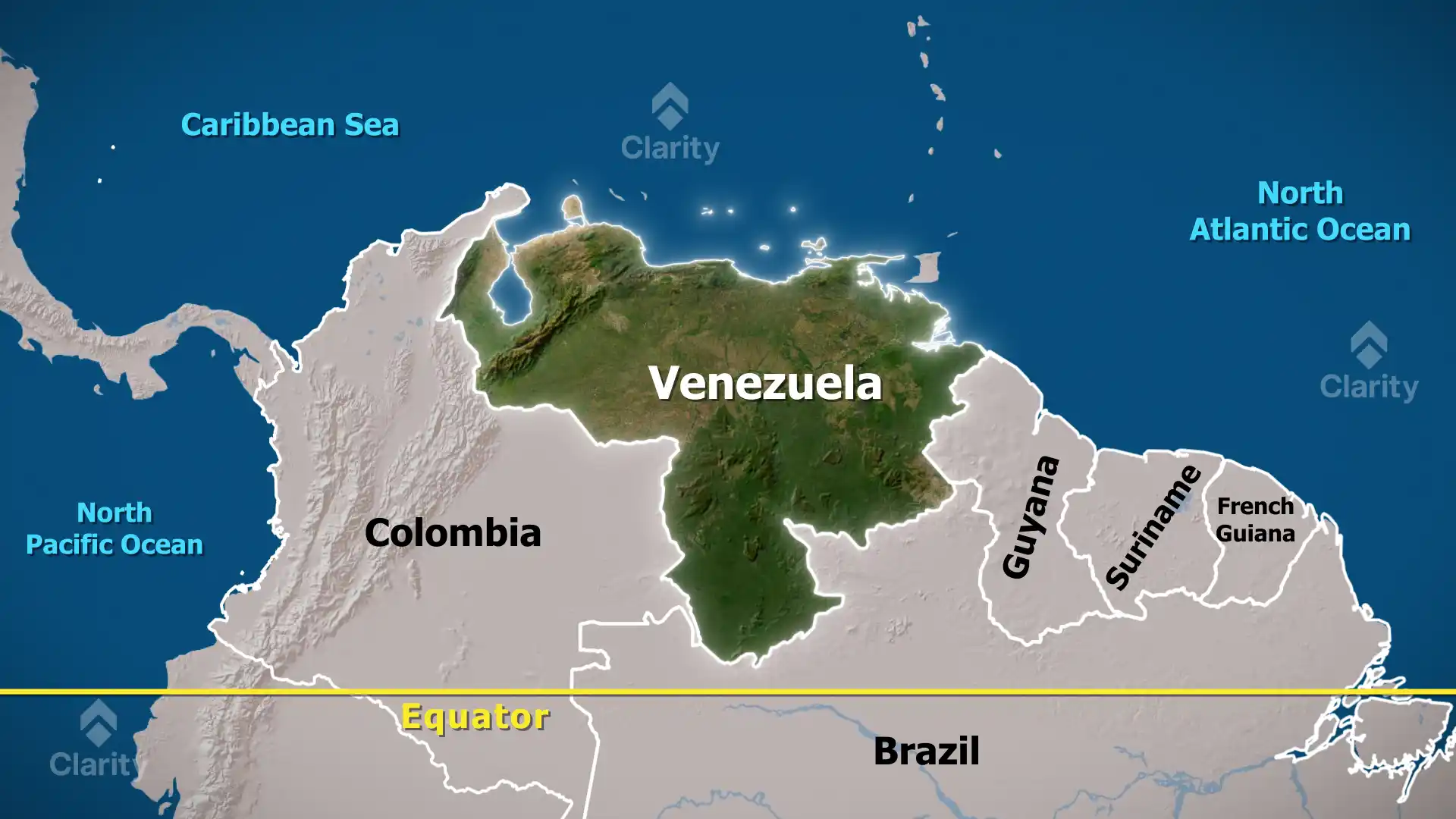
Venezuela lies on the northern coast of South America. To the east it borders Guyana, to the south Brazil, and to the west Colombia. The Caribbean Sea and Atlantic Ocean form its northern shoreline. The capital city is Caracas.
- Landscapes: The Andes mountains rise in the west, culminating at Pico Bolívar (4,978 m), the nation’s highest point. Central Venezuela is dominated by broad grasslands called the llanos, while the south‑eastern Guiana Highlands are home to tepui mesas and Angel Falls, the world’s tallest uninterrupted waterfall.
- Waterways: The Orinoco River, one of South America’s great rivers, flows for more than 2,000 km from the Guiana Highlands to the Atlantic Ocean. The Orinoco and its tributaries support hydroelectric projects and transport.
- Natural resources: Venezuela has some of the largest proven oil reserves in the world, along with natural gas, coal, iron ore, bauxite and gold. Petroleum accounts for most export earnings and government revenue.
- Climate: The country experiences a tropical climate, with wet and dry seasons. Higher elevations in the Andes have cooler temperatures, while the lowland plains are hot and humid.
Details of the strikes
- Targets: U.S. fighter jets struck missile batteries, radar sites, communications antennas and ammunition depots across northern Venezuela. At least one Russian‑supplied BUK surface‑to‑air missile system was reportedly destroyed.
- Operation: The air assault disabled Venezuela’s air defence network, allowing helicopters to transport special forces to the presidential compound. President Maduro and his wife were flown to New York under U.S. custody.
- Aftermath: President Donald Trump declared that the United States would help run Venezuela temporarily and rebuild its oil infrastructure. The Justice Department unsealed indictments against Maduro, accusing him of drug trafficking and corruption.
- Venezuelan response: Officials in Caracas described the attack as an invasion and claimed that both military personnel and civilians were killed. Protests erupted in several cities, and neighbouring countries called for restraint.
Implications
- Regional stability: The intervention could reshape politics in Latin America and strain relations between the U.S. and countries sympathetic to Venezuela’s government.
- Energy markets: Control of Venezuela’s vast oil reserves may affect global energy prices and supply chains.
- Humanitarian concerns: Conflict and sanctions have already led to shortages of food, medicine and fuel in Venezuela. Continued instability could worsen the humanitarian crisis and spur further migration.
Conclusion
The dramatic events in Venezuela mark a critical juncture for the country and the region. While some see the intervention as an opportunity for political change and economic recovery, others view it as a violation of national sovereignty. The coming months will determine whether a peaceful transition is possible and how the international community responds.
Source: The Indian Express