Why in news?
Scientists from the SETI Institute have identified a rare iron sulphate, ferric hydroxysulphate, in layered deposits near Mars’s vast Valles Marineris canyon system. The mineral likely formed when ancient sulphate‑rich sediments were heated by volcanic or geothermal activity and oxidised. This discovery sheds light on the role of heat, water and oxygen in shaping Mars’s geology.
Background
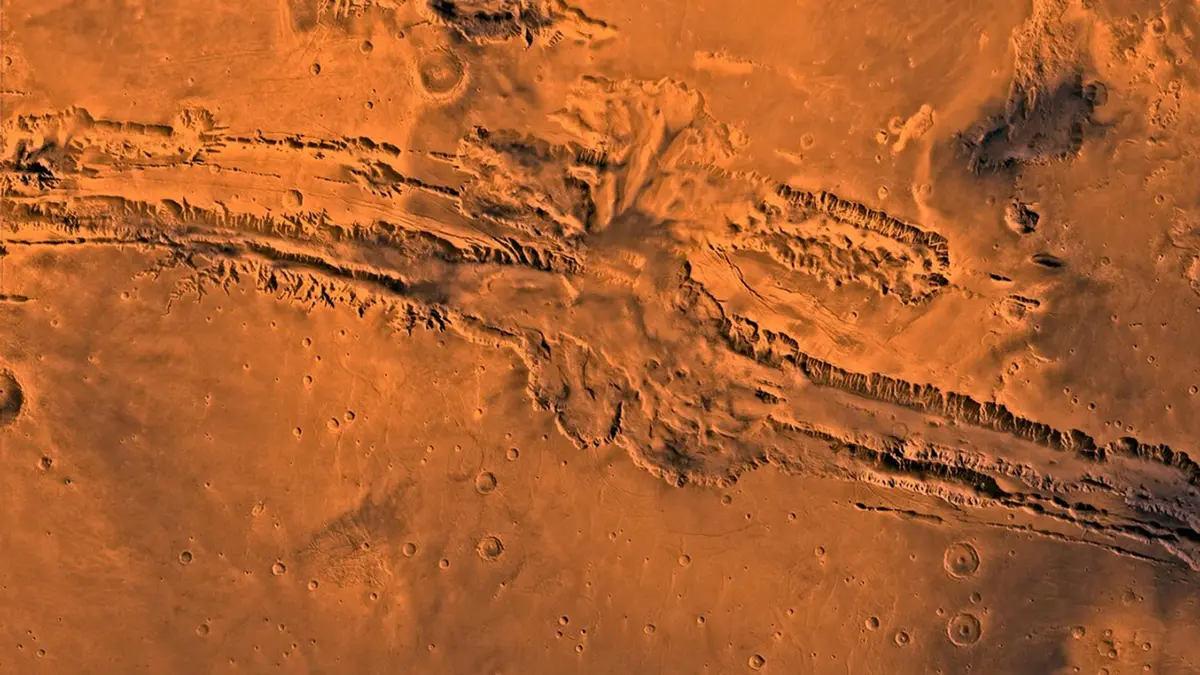
Valles Marineris is the largest canyon system in the Solar System. It stretches roughly 4,000 km along Mars’s equator, is about 200 km wide in places and plunges up to 7–10 km deep, dwarfing Earth’s Grand Canyon. Scientists believe it formed when the Martian crust cracked and sagged as the planet cooled, with additional collapse caused by tectonic and volcanic forces near the Tharsis uplift. Chasms such as Hebes, Melas and Candor are part of this complex; some contain deposits of hydrated minerals, indicating that water once altered the rocks.
The newly detected ferric hydroxysulphate occurs in thin layers between monohydrated and polyhydrated sulphates at two sites near Valles Marineris: Aram Chaos and Juventae Plateau. Laboratory experiments show that heating polyhydrated sulphates to about 50 °C converts them to monohydrated forms, and heating them above 100 °C in the presence of oxygen produces ferric hydroxysulphate. The mineral’s presence therefore points to episodes when ancient sediments were buried and heated, perhaps by nearby volcanic activity.
Key points
- Largest canyon system: Valles Marineris is roughly as long as the continental United States and covers about one‑fifth of Mars’s circumference. Its depth may exceed 7 km in places.
- Formation and features: The canyon likely began as a tectonic crack that widened when the planet’s crust stretched. Volcanic uplift at Tharsis caused further collapse. Features include steep cliff faces, landslides, layered sediments and evidence of past water flow.
- New mineral: Ferric hydroxysulphate is a rare mineral formed by heating sulphate‑rich deposits in the presence of oxygen. Its discovery on Mars implies that both heat and oxygenated fluids once interacted with sulphate deposits, broadening our understanding of Martian geochemistry.
- Implications: Identifying such minerals helps reconstruct Mars’s thermal history and assess potential habitats for past microbial life, as heat and water are essential ingredients for chemical evolution.