Why in news?
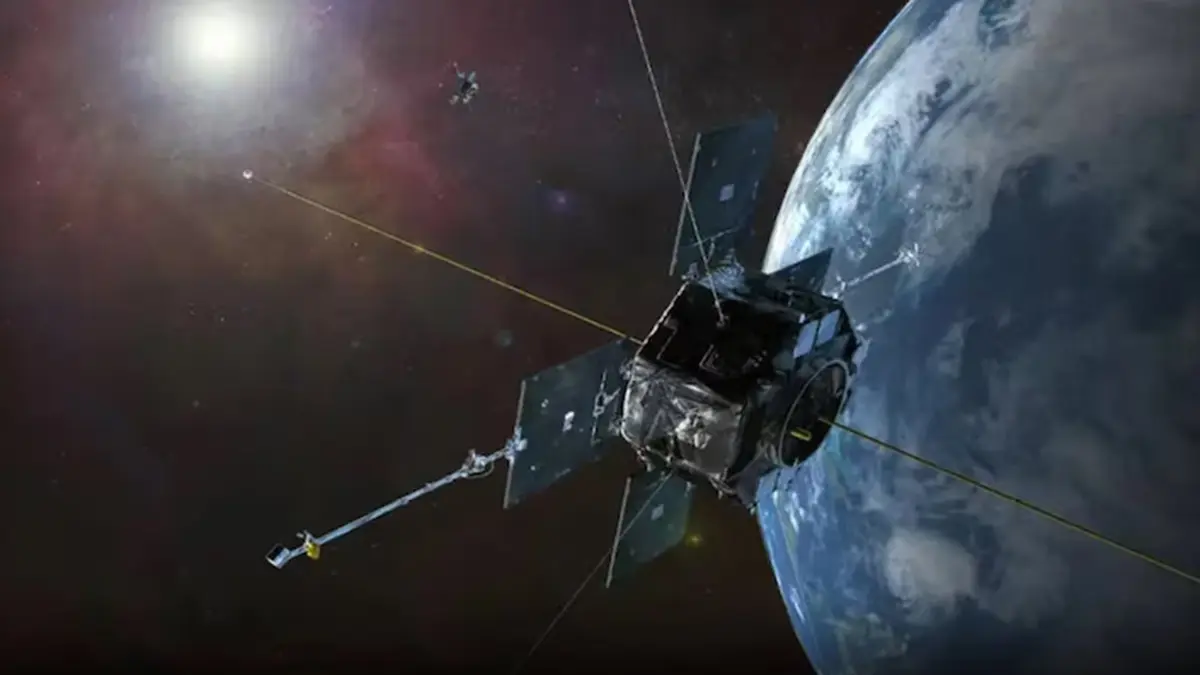
NASA announced that Van Allen Probe A, one of two identical spacecraft launched in 2012 to study Earth’s radiation belts, re‑entered the atmosphere on 11 March 2026. After 14 years in space, the probe burned up harmlessly over the Pacific. Its sister spacecraft, Probe B, is expected to fall back to Earth around 2030.
Background
The Van Allen Probes (formerly known as the Radiation Belt Storm Probes) were launched by NASA in August 2012 to explore the Van Allen radiation belts—two doughnut‑shaped zones of charged particles trapped by Earth’s magnetic field. These belts shield Earth from cosmic rays and solar storms but can pose hazards to satellites and astronauts. The mission was designed for two years but operated until 2019, gathering unprecedented data on the structure and dynamics of the belts.
Key discoveries
- Transient third belt: Early in the mission, the probes detected a temporary third radiation belt created by a powerful solar storm. This finding challenged the previous two‑belt model and showed that the belts can dramatically change.
- Particle acceleration: Data revealed how electromagnetic waves accelerate electrons to near‑light speeds, helping scientists understand radiation hazards to spacecraft electronics.
- Solar influence: The craft measured how variations in the solar wind compress and expand the belts. Enhanced solar activity during the current solar maximum increased atmospheric drag, causing Probe A to re‑enter earlier than predicted.
Significance
- Space weather forecasting: Insights from the Van Allen Probes inform models that predict radiation storms, enabling operators to protect satellites and astronauts.
- Designing resilient spacecraft: Understanding the belts helps engineers build satellites and human‑rated spacecraft that can withstand intense radiation.
- Legacy of collaboration: The mission was a joint effort by NASA and Johns Hopkins University Applied Physics Laboratory, showcasing the value of long‑term scientific partnerships.
Source: NDTV