

Why in news?
India plans to roll out vehicle‑to‑vehicle (V2V) communication technology across its road network by 2026. Officials announced that new vehicles will be required to install on‑board units allowing cars to exchange safety messages directly with each other. The aim is to dramatically reduce road accidents by warning drivers of hazards, particularly in poor visibility conditions such as fog or smog.
Background
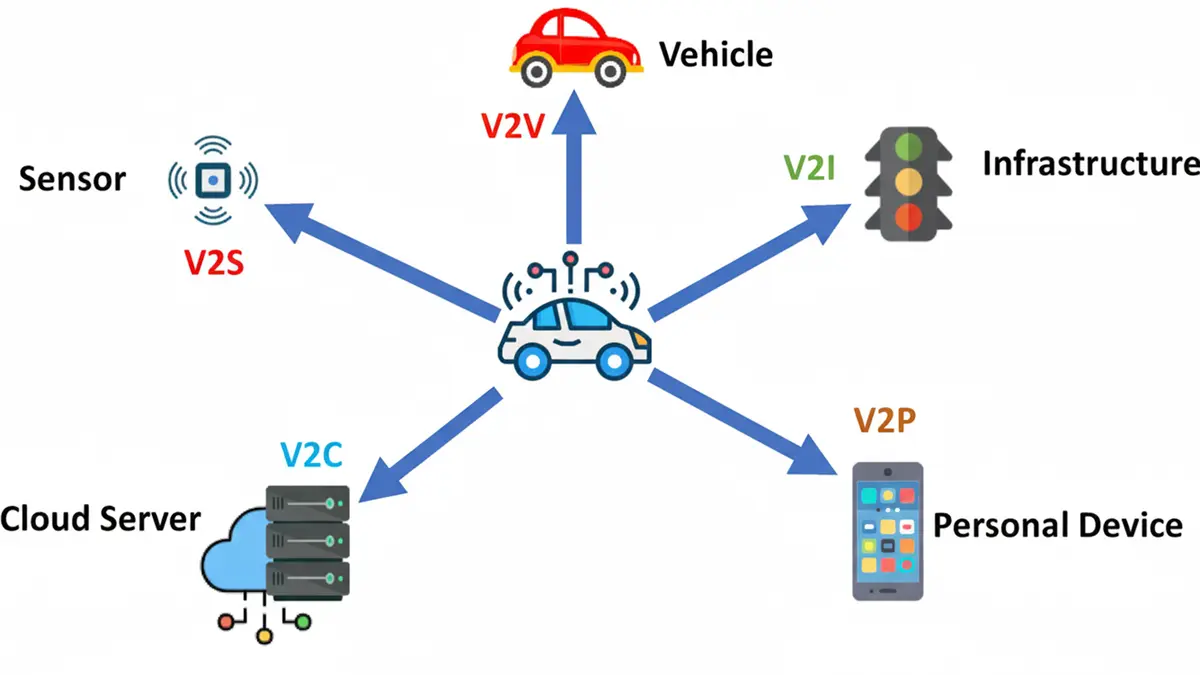
V2V communication uses short‑range wireless radio to allow vehicles to share data about their speed, direction, braking and location. Unlike mobile networks, the system operates autonomously with minimal latency, enabling real‑time alerts. Countries like the United States and Japan have tested similar systems to enhance road safety and support autonomous driving.
Key features and benefits
- On‑board unit: Vehicles will carry a small device costing about ₹5,000–₹7,000. It sends and receives signals 10 times per second, alerting drivers if another vehicle nearby suddenly slows down or veers off course. The Department of Telecommunications has set aside dedicated spectrum for this service.
- Hazard warnings: The technology warns about imminent collisions, vehicles in blind spots and dangers ahead such as stalled cars or potholes. This is especially useful in low‑visibility conditions common during winter months in northern India.
- Integration with ADAS: When combined with advanced driver‑assistance systems (ADAS) like automatic braking and lane keeping, V2V communication can prevent accidents before drivers react, potentially reducing crashes by up to 80 percent.
- Scalable deployment: Authorities plan to initially mandate the system for new vehicles, then offer retrofitting kits for existing cars. As more vehicles join the network, the system becomes more effective. Data is broadcast anonymously, with no reliance on mobile towers, ensuring privacy and low operating costs.
Implementation timeline
The Ministry of Road Transport and Highways expects standards to be finalised by late 2025, with installation in new cars beginning thereafter. Full roll‑out is targeted for the end of 2026. Authorities are coordinating with automobile manufacturers and telecom regulators to ensure interoperability. Over the long term, V2V technology could pave the way for connected and autonomous vehicles on Indian roads.
Conclusion
Vehicle‑to‑vehicle communication represents a major leap towards safer roads. By enabling cars to “talk” to each other, the technology can help drivers anticipate hazards and make informed decisions. Successful implementation will require robust standards, investment by industry and public awareness about its benefits.
Source: NDTV