

Why in news?
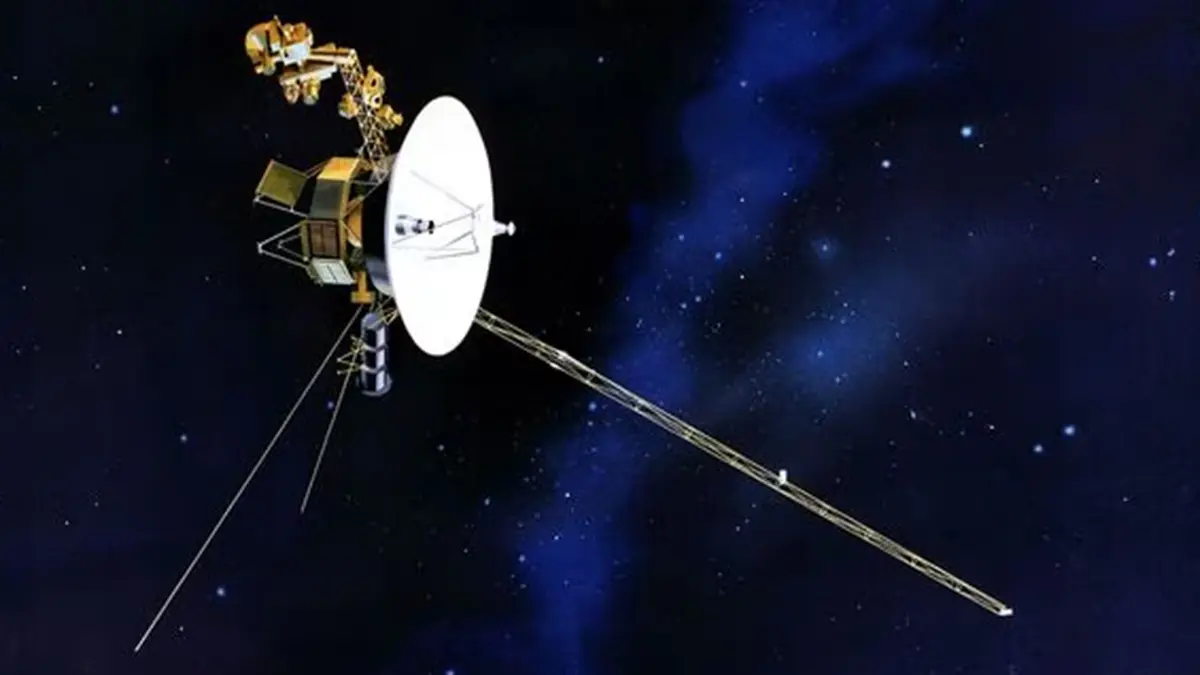
N ASA announced that by November 2026, the Voyager 1 spacecraft will be so far from Earth that radio signals will take an entire day to travel one way. This milestone underscores the longevity and distance of humanity’s most distant spacecraft.
Background
Voyager 1 was launched on 5 September 1977 to explore the outer planets. It flew past Jupiter in March 1979, discovering a thin ring and two new moons (Thebe and Metis). It then encountered Saturn in November 1980, finding five new moons and a faint G‑ring. After completing its planetary tour, Voyager 1 continued outward and in August 2012 it became the first human‑made object to enter interstellar space by crossing the heliopause. Powered by radioisotope thermoelectric generators, its instruments have operated far beyond their intended lifespan.
Current status
- Distance: By late 2025 the probe was about 25.3 billion kilometres from Earth (approximately 169 astronomical units). Radio signals took around 23 hours and 32 minutes to reach it.
- Light‑day milestone: On 15 November 2026, Voyager 1 will be roughly 25.9 billion kilometres away. At that distance a one‑way transmission will take 24 hours and 6 minutes, meaning the spacecraft will be one light‑day from Earth.
- Scientific instruments: Four instruments remain operational, measuring plasma waves, magnetic fields and charged particles in the interstellar medium. Data are relayed via NASA’s Deep Space Network.
Why it matters
- Pioneering mission: Voyager 1’s discoveries at Jupiter and Saturn revolutionised our understanding of the outer planets. Its entry into interstellar space opened a new frontier of science.
- Longevity: Operating for almost five decades, the spacecraft demonstrates the durability of well‑engineered space probes. Its nuclear power source is expected to support communications through the late 2020s.
- Interstellar messenger: Voyager 1 carries a golden record containing sounds and images from Earth, intended as a message for any intelligent life it may encounter. As it travels deeper into the galaxy, it becomes a symbolic emissary of humanity.