

Why in news?
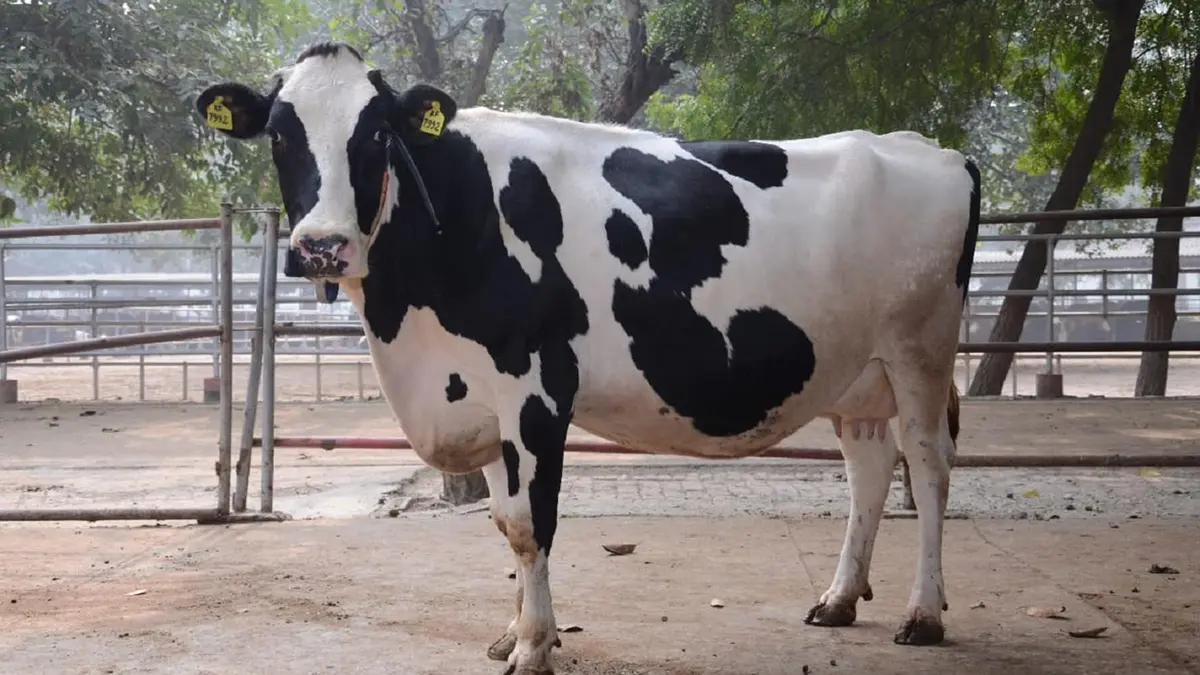
The Indian Council of Agricultural Research (ICAR) recently recognised Vrindavani and Karan Fries cattle as new high‑yielding breeds. These synthetic dairy animals attracted attention at agricultural expos for their impressive milk production.
Background
Synthetic cattle breeds are created by crossbreeding indigenous Indian cattle with exotic breeds to combine disease resistance, heat tolerance and high milk yield. India’s dairy sector depends largely on smallholders, and improving productivity without losing adaptability is a major goal of breeding programmes. Vrindavani and Karan Fries have been developed over decades to suit Indian conditions.
Vrindavani
- Origin: Developed by the ICAR–Indian Veterinary Research Institute in Bareilly, Uttar Pradesh, Vrindavani combines Holstein Friesian, Brown Swiss and Jersey bloodlines with the Indian Hariana breed.
- Genetic makeup: Its stabilised blood composition is about 39.5 percent Holstein Friesian, 26.9 percent Hariana, 22 percent Jersey and 10.7 percent Brown Swiss.
- Milk yield: Cows produce between 3,000 and 3,500 kilograms of milk per lactation (approximately 10 months). High‑performing animals can yield more than 5,000 kilograms.
- Distribution: The breed is found mainly in Uttar Pradesh’s districts of Bareilly, Pilibhit, Shahjahanpur and Budaun. The animals have a predominantly brown coat, a prominent poll and a concave forehead.
Karan Fries
- Origin: Developed by the National Dairy Research Institute (NDRI) in Karnal, Haryana, Karan Fries is a cross between Holstein Friesian bulls and Tharparkar cows. Early breeding also used Brown Swiss and Jersey bulls before stabilisation.
- Characteristics: Cows are larger than indigenous breeds and have black‑and‑white or brown patches. They mature early and have good fertility.
- Milk yield: Average lactation yield is around 3,550 kilograms in 10 months (about 11.6 kg/day). Exceptional cows have produced up to 5,851 kilograms in 305 days with peak daily yields of more than 40 kilograms.
- Adaptability: The breed tolerates hot and humid conditions better than pure exotic cattle and responds well to balanced feeding.
Significance
- Boosting milk production: These breeds provide higher yields than most indigenous cattle while retaining some local hardiness, helping farmers increase incomes.
- Supporting dairy self‑reliance: By developing home‑grown breeds, India reduces dependence on imported genetics and tailors animals to local climates.
- Conservation: Even as synthetic breeds gain popularity, researchers stress the need to conserve pure indigenous breeds like Tharparkar and Hariana, which contribute crucial traits.