

A tonne of carbon dioxide affects the atmosphere wherever it is emitted. Yet countries have very different histories, resources and development needs. Some built their wealth through two centuries of fossil-fuel use. Others still need reliable electricity, transport and resilient infrastructure. International climate negotiations try to turn this unequal starting point into cooperative action.
The United Nations Framework Convention on Climate Change (UNFCCC) provides the framework for that cooperation. Its annual Conference of the Parties (COP) attracts attention, but the system works throughout the year. Treaties establish obligations, technical bodies develop rules, and governments negotiate finance and implementation. Understanding these connections makes the many abbreviations easier to remember.
1. Why climate change requires international cooperation
Greenhouse gases mix in the atmosphere rather than remaining within national borders. A country reducing emissions creates benefits beyond its own territory. However, it bears many immediate costs of changing energy and industrial systems. This mismatch can encourage governments to wait for others to act.
1.1 A shared problem with unequal contributions
Historical emissions contribute to today's accumulated greenhouse-gas concentrations. Present emissions, population, income and vulnerability also differ greatly between countries. A low-lying island may face severe damage despite contributing little to the problem. A developing country may need to expand electricity access while limiting future emissions.
Cooperation therefore involves both environmental effectiveness and fairness. Mitigation must reduce the drivers of warming. Adaptation must reduce harm from changes already occurring. Finance, technology and capacity building help countries carry out both tasks.
1.2 Evidence, impacts and the limits of a single image
Climate science draws on measurements, models and many independent observations. Glacier change is one visible example of a changing physical environment. Individual glaciers also respond to local snowfall, temperature, debris and geometry. One glacier photograph cannot establish every cause or describe the entire Himalaya.
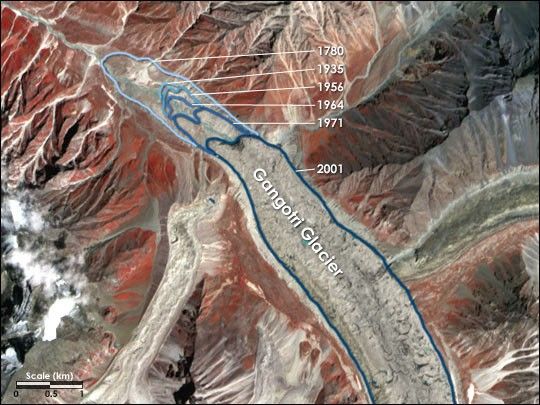
The wider scientific assessment comes from the Intergovernmental Panel on Climate Change (IPCC). The IPCC assesses research; it does not negotiate national emissions targets.
2. What the UNFCCC is
The United Nations Framework Convention on Climate Change is an international treaty adopted in 1992. It opened for signature at the Rio Earth Summit and entered into force in 1994. Its central purpose is to stabilise greenhouse-gas concentrations at a level that prevents dangerous human interference with the climate system.
2.1 A framework treaty rather than one uniform emissions limit
The Convention sets principles, institutions and broad commitments. It recognises that ecosystems, food production and sustainable development matter when addressing climate change. It did not initially assign the same quantified emissions cap to every country. Later agreements developed different ways of turning cooperation into action.
The Kyoto Protocol and Paris Agreement sit within this Convention framework. Kyoto introduced quantified commitments for specified developed-country parties. Paris established nationally determined contributions (NDCs) across its parties, with common reporting and review arrangements. Neither agreement should be confused with the Convention itself.
2.2 What “Party” means
A Party is a state or eligible regional organisation that has joined a treaty. The European Union participates alongside its member states within relevant arrangements. Signing a treaty and becoming legally bound by it are different steps. Ratification, acceptance, approval or accession can establish consent to be bound.
Membership can also change through the treaty's withdrawal procedures. Therefore, “all countries” is often too loose when describing a particular agreement. The more precise expression is “the Parties to that agreement.”
3. Fairness and differentiated responsibilities
Common but differentiated responsibilities and respective capabilities (CBDR-RC) means that every country shares responsibility for addressing climate change. However, the scale and form of its contribution should reflect relevant differences. Historical contribution and economic or technological capacity are central to this debate.
3.1 Common responsibility does not mean identical obligations
Imagine two households sharing the cost of repairing a damaged building. Both benefit from repairs, but one caused more damage and has greater resources. Equal cash payments may look simple while ignoring these differences. Climate negotiations face a much more complex version of this fairness problem.
The principle supports developed-country leadership in mitigation and assistance. It does not give developing countries a permanent exemption from climate action. Under Paris, every Party has duties concerning its national contribution. Differentiation continues through ambition, support, flexibility and national circumstances.
3.2 How Paris expresses differentiation
The Paris Agreement applies equity and CBDR-RC in light of different national circumstances. This wording allows the system to recognise changing economies and capabilities. Countries still disagree about how much responsibility each should carry. The principle guides negotiations but does not mechanically calculate every country's target.
India uses equity, historical responsibility and development needs in its negotiating position. Vulnerable countries also invoke fairness when demanding stronger mitigation and adaptation support. Different arguments can therefore draw on the same principle.
4. Annex I, Annex II and non-Annex I
The Convention's annexes organise certain commitments according to country groups. They reflect the treaty's historical structure, rather than a continuously updated income ranking. Understanding their membership helps explain the Kyoto system and ongoing finance debates.
4.1 Annex I and economies in transition
Annex I includes industrialised countries and specified economies in transition. Germany, Japan and the Russian Federation are examples. The United States is also included in the Convention's Annex I list. Annex status and current membership in the Paris Agreement are separate questions.
Economies in transition were countries moving from centrally planned systems toward market economies. Russia illustrates why Annex I cannot simply be equated with Annex II. The two lists overlap, but they are not identical.
4.2 Annex II and support obligations
Annex II identifies developed countries with specific finance and technology-support responsibilities under the Convention. Germany and Japan provide straightforward examples. Russia is Annex I but not Annex II. This distinction often appears in questions about who provides support.
India, China and Brazil are non-Annex I countries. Their economies and emissions profiles differ considerably, despite sharing that classification. Paris did not abolish the Convention's annexes. It created a broader contribution framework while retaining differentiation and developed-country support obligations.
Reading the Convention's country groups
| Group | Examples | Main distinction |
|---|---|---|
| Annex I | Germany, Japan, Russian Federation | Industrialised countries and specified economies in transition |
| Annex II | Germany, Japan | Specific Convention responsibilities for financial and technological support |
| Non-Annex I | India, China, Brazil | Countries outside Annex I; national circumstances vary widely |
On smaller screens, swipe across the table to read every column.
The comparison describes the Convention's institutional categories. It does not rank present-day emissions, vulnerability or income, and it does not by itself establish current Paris membership.
5. Who does what in the climate system
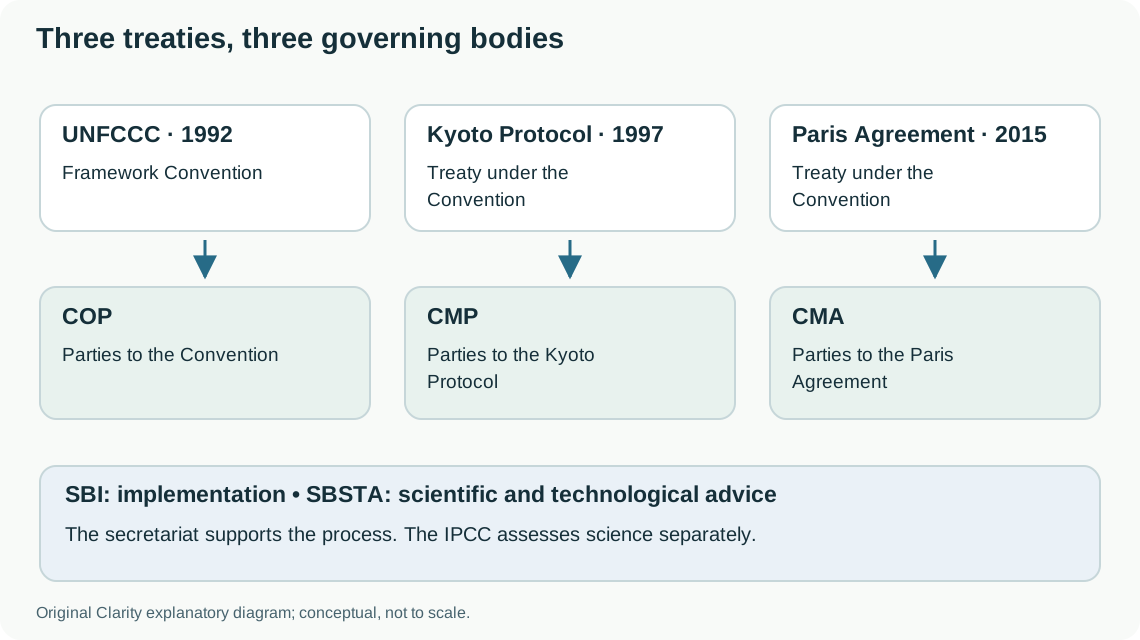
Several governing bodies meet during the same United Nations climate conference. One serves the Convention, another the Kyoto Protocol, and another the Paris Agreement. Each takes decisions under its own legal instrument. Technical bodies and the secretariat support their work.
5.1 The Convention's governing body
The Conference of the Parties (COP) is the Convention’s decision-making body. It reviews implementation and adopts decisions within its mandate. Its session numbers begin with COP1, held in Berlin in 1995.
5.2 The Kyoto Protocol’s governing body
The Conference of the Parties serving as the meeting of the Parties to the Kyoto Protocol (CMP) oversees that Protocol. Only countries that are Parties to Kyoto take decisions in this body. Other Convention Parties can attend as observers. Its first session took place in Montreal in 2005.
5.3 The Paris Agreement’s governing body
The Conference of the Parties serving as the meeting of the Parties to the Paris Agreement (CMA) oversees the Paris Agreement. Paris Parties take decisions on implementation, including national contributions, transparency and cooperation. Countries outside the Agreement may observe but do not take decisions under it.
The three bodies are related, but they are not interchangeable. COP serves the Convention; CMP serves Kyoto; CMA serves Paris. A headline about “COP29 finance” may therefore refer legally to a CMA decision adopted at that conference.
5.4 How often does COP meet?
COP normally meets once every year, unless the Parties decide otherwise. The Kyoto and Paris governing bodies meet during the same conference period. This allows governments to handle related negotiations together without merging the three treaties or their decision-making powers.
Conference numbers count sessions, so they do not always match a calendar year. The pandemic postponed COP26 from 2020 to 2021. The three bodies also began in different years: the 2025 Belém conference hosted COP30, CMP20 and CMA7. Technical work continues between these annual meetings.
5.5 Implementation and scientific advice
The Subsidiary Body for Implementation (SBI) examines practical implementation. Its work includes reporting arrangements, capacity building and institutional questions. It helps assess how agreed commitments and support are being put into practice.
The Subsidiary Body for Scientific and Technological Advice (SBSTA) addresses scientific, methodological and technological questions. It helps develop technical approaches that governing bodies can use when adopting rules. For example, comparable emissions reporting requires agreed methods.
The two bodies prepare work for the governing bodies. They also hold sessions between the major annual conferences. Their technical negotiations can determine whether a broad political promise becomes usable rules.
5.6 The secretariat and scientific assessment
The UNFCCC secretariat, based in Bonn, supports meetings and treaty implementation. It handles information, reporting processes and administrative coordination. It does not act as a world government imposing national energy policies.
The IPCC assesses scientific knowledge relevant to climate change. Governments consider that evidence during negotiations, alongside political and economic questions. Scientific assessment and negotiated decisions therefore interact, but they are different activities.
6. Who negotiates at a COP
National delegations conduct negotiations on behalf of governments. Delegations may include diplomats, ministries, scientists, lawyers and technical specialists. Ministers and leaders often become involved when difficult political trade-offs remain. Observers contribute expertise and advocacy but do not vote as treaty Parties.
6.1 Negotiating groups help countries coordinate
Countries often share positions through negotiating blocs. Coordination gives smaller delegations greater influence and helps manage many simultaneous meetings. Memberships can overlap because a country has several interests. A bloc is not necessarily a fixed alliance on every issue.
- The Group of 77 (G77) and China coordinates many developing-country positions, including finance and equity. The name reflects its founding membership, not its present size. Members still differ in wealth, emissions and vulnerability.
- Brazil, South Africa, India and China (BASIC) coordinate on important climate-negotiation questions. These four large developing economies share some priorities, although their national circumstances differ.
- The Alliance of Small Island States (AOSIS) emphasises vulnerability, ambitious mitigation and support. Maldives and Fiji illustrate the concerns of small island countries.
- The Least Developed Countries group advocates priorities including adaptation, finance and capacity constraints. Its classification differs from the Convention's annex system.
- The European Union coordinates a common negotiating position through its institutions and member states. Other groups include the African Group and the Like-Minded Developing Countries.
These groupings help explain why negotiations do not reduce to two uniform camps. A developing fossil-fuel exporter and a low-lying island can share some finance positions while disagreeing strongly about energy-transition language.
6.2 Observers and public participation
Research institutions, civil-society organisations, Indigenous representatives, businesses and international organisations attend through observer arrangements. Their research and advocacy can influence the agenda. They also scrutinise whether commitments translate into action.
A corporate announcement or side-event pledge is not automatically a negotiated treaty decision. Always identify who made the promise, its legal form and its implementation arrangements. This distinction is essential when reading crowded COP news coverage.
7. How a COP decision takes shape
A conference begins long before leaders arrive for speeches. Governments prepare positions, submit proposals and negotiate through technical sessions. At the conference, several tracks can advance at different speeds. A disagreement about finance may affect willingness to accept stronger mitigation language.
7.1 From agenda to negotiated text
Parties first organise the agenda and negotiation arrangements. Contact groups and informal consultations then work through draft language. Square brackets often mark text that remains unresolved. Removing brackets usually requires agreement on the underlying political or technical issue.
Ministers or facilitators may be asked to resolve difficult questions. The presidency can assemble a package intended to balance competing interests. The final plenary considers adoption, after which implementation and further rule-making continue.
7.2 Consensus and its practical limits
Most substantive UNFCCC decisions are adopted by consensus in practice. Consensus should not be confused with a recorded unanimous vote on every sentence. Parties can express reservations, and the handling of objections can become controversial. The rules and political practice are more complex than “every country votes yes.”
Consensus encourages broad participation but can make agreement difficult. Wording may become less specific to secure acceptance. Assessing an outcome therefore requires reading what was adopted, what was deferred, and what remains voluntary.
8. From Kyoto's targets to the Paris framework
Climate cooperation has changed as experience revealed the limits of earlier arrangements. Kyoto used internationally agreed targets for a defined group of countries. Paris sought wider participation through nationally determined commitments and recurring review. Each approach reflects a different balance between coverage, flexibility and enforceability.
8.1 Kyoto's design and commitment periods
The Kyoto Protocol was adopted in 1997 and entered into force in 2005. Its first commitment period ran from 2008 to 2012. The Doha Amendment established a second period from 2013 to 2020 for participating parties. India's role differed from countries assigned binding quantified Kyoto targets.
Kyoto also created flexibility mechanisms. Emissions trading allowed eligible units to be traded under specified rules. Joint Implementation involved projects between countries with relevant commitments. The Clean Development Mechanism (CDM) allowed eligible projects in developing countries to generate certified emission reductions.
For example, an eligible Indian project could generate credits purchased for Kyoto compliance. The project had to satisfy applicable rules rather than merely claim to be “green.” Additionality, baselines and verification were central concerns. The CDM's project experience later informed debates about Paris cooperation.
8.2 Paris broadens participation
The Paris Agreement was adopted in 2015 and entered into force in 2016. It aims to hold warming well below 2°C and pursue efforts toward 1.5°C above pre-industrial levels. Its mitigation framework centres on nationally determined contributions, or NDCs.
Parties set contributions reflecting national circumstances, then communicate successive contributions on a five-year cycle. Each successive NDC is expected to represent progression and reflect highest possible ambition. Transparency and the global stocktake help expose gaps between collective action and the agreement's goals.
8.3 What is legally binding under Paris
Paris is a legally binding treaty, but its provisions differ in legal effect. Parties have obligations concerning preparation, communication and maintenance of NDCs. They must pursue domestic mitigation measures aimed at achieving their objectives. This does not create an identical internationally imposed emissions cap for every country.
The compliance mechanism is facilitative rather than a global fines system. A missed national target does not automatically trigger a treaty penalty calculated per tonne. Domestic legislation can create additional enforceable obligations within a country.
Kyoto and Paris address the same problem through different designs
| Feature | Kyoto Protocol | Paris Agreement |
|---|---|---|
| Adoption | 1997 | 2015 |
| Mitigation structure | Quantified commitments for specified developed-country parties | NDCs from all Parties to the Agreement |
| Differentiation | More sharply divided target responsibilities | Common contribution framework with differentiated circumstances and support |
| Cooperation | Emissions trading, Joint Implementation and CDM | Article 6 market and non-market approaches |
| Review and progression | Commitment-period architecture | Five-year NDC cycle, transparency and global stocktake |
On smaller screens, swipe across the table to read every column.
9. How the Paris ambition cycle works
An NDC sets out a country's contribution to climate action. Different countries express targets through absolute emissions, emissions intensity, energy indicators or other measures. Understanding the indicator is essential before comparing ambition. A percentage reduction means little without its baseline, denominator and target year.
9.1 NDCs are national plans within a shared cycle
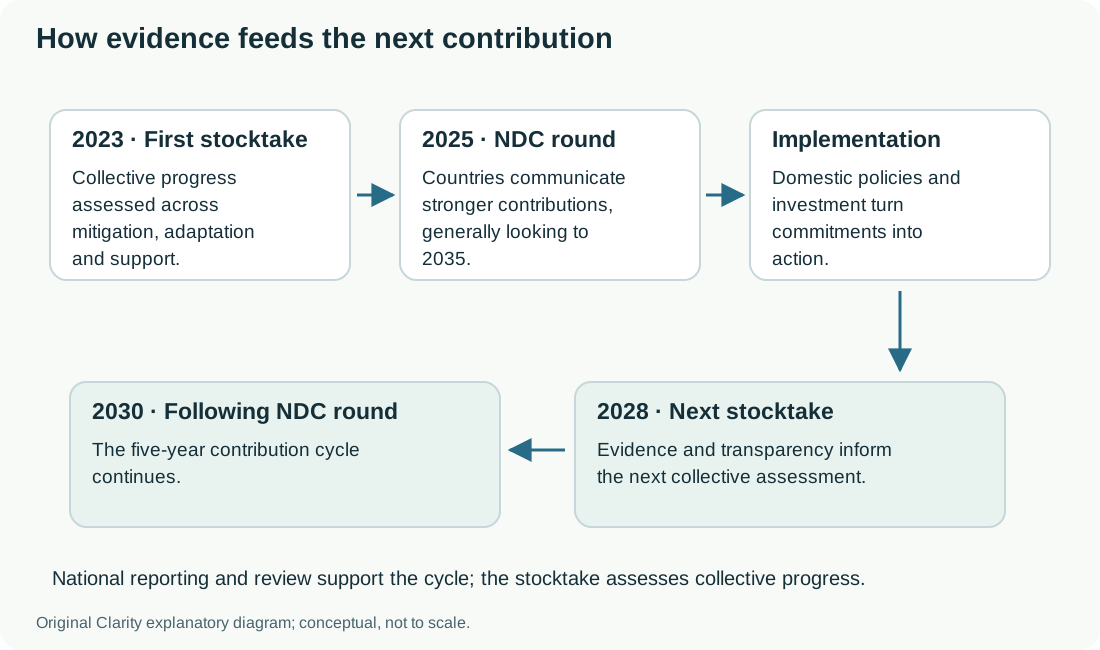
Parties communicate NDCs every five years, following agreed arrangements. The 2025 round was associated with contributions looking toward 2035. Actual submission dates can differ, and updated submissions remain visible in the registry. Countries must then translate their contributions into domestic policies and investment.
A target may contain unconditional action and additional action dependent on support. Reading only the headline percentage can hide these conditions. Credibility also depends on sectoral policies, implementation capacity and transparent accounting.
9.2 The global stocktake assesses collective progress
The global stocktake (GST) examines collective progress toward Paris goals. It covers mitigation, adaptation and means of implementation and support. The first stocktake concluded at COP28 in 2023; the next is scheduled for 2028. It is not a ranking table assigning each country a single climate score.
Its findings are intended to inform subsequent action and support, including future NDCs. Thus, the 2023 assessment informed the following contribution round. The cycle links evidence, political assessment and renewed national commitments.
9.3 Transparency makes progress assessable
The enhanced transparency framework provides common reporting and review arrangements with specified flexibility. Parties report information on emissions and progress, alongside other relevant information. Biennial transparency reports form an important part of this system. Capacity constraints are recognised, particularly for vulnerable developing countries.
Transparent reporting does not itself cut emissions. It helps reveal whether policies and results match commitments. That information supports domestic accountability, international scrutiny and better future decisions.
10. Mitigation, adaptation, and loss and damage
These three concepts answer different climate-policy questions. Mitigation addresses the causes of warming. Adaptation reduces vulnerability to its effects. Loss and damage concerns harms that are not avoided, including limits to adaptation.
10.1 Mitigation reduces the drivers of climate change
Replacing a polluting electricity source with a lower-emissions alternative can reduce emissions. Energy efficiency can provide the same service with less energy. Protecting carbon-rich ecosystems can prevent emissions and preserve carbon storage. Outcomes depend on actual implementation and credible accounting.
Mitigation also raises distributional questions. Workers, electricity consumers and fossil-fuel-dependent regions may face transition costs. A just transition addresses employment, affordability and social protection alongside emissions reductions.
10.2 Adaptation reduces exposure and vulnerability
Heat-action plans, resilient water systems and early-warning services can reduce climate-related harm. Farmers may adjust crops or water management as conditions change. Coastal planning can limit exposure to flooding and erosion. Effective adaptation depends on local risks and social conditions.
Some measures can create new problems if poorly designed. A protective structure may shift erosion elsewhere, while unsuitable crops may increase water demand. Monitoring should therefore assess actual resilience rather than spending alone.
10.3 Loss and damage addresses residual harms
Some losses remain despite mitigation and adaptation efforts. A storm may destroy homes, while rising seas can threaten land and cultural heritage. Losses can be economic, such as damaged infrastructure, or non-economic, such as cultural identity. Slow-onset processes matter alongside sudden disasters.
The Fund for responding to Loss and Damage is intended to support affected developing countries under its governing arrangements. Its creation does not establish automatic compensation for every disaster claim. The Paris adoption decision also states that Article 8 does not provide a basis for liability or compensation.
11. Climate finance and the new collective goal
Climate action requires money for infrastructure, public services, institutions and technology. Many developing countries face high borrowing costs and limited fiscal space. Finance negotiations therefore concern more than the size of a headline pledge. Countries debate sources, terms, access, recipients and delivery.
11.1 Why the type of finance matters
A grant does not create the same repayment burden as a commercial loan. A concessional loan offers more favourable terms than ordinary market borrowing. Private investment may suit a revenue-generating power project better than a community heat-warning service. Adaptation often needs public finance because benefits do not produce direct commercial returns.
Countries also distinguish pledged, approved, committed and disbursed money. A pledge announced at a conference is not proof that a vulnerable community received funding. Clear definitions and reporting are necessary to assess delivery.
11.2 What COP29 agreed
The New Collective Quantified Goal (NCQG) succeeded the earlier US$100 billion annual climate-finance goal. COP29's Paris governing-body decision set a goal of at least US$300 billion per year by 2035 for developing-country climate action, with developed countries taking the lead.
It also called for efforts by all actors to scale finance from all public and private sources to at least US$1.3 trillion annually by 2035. These figures describe different parts of the finance ambition. They are not two separate sums to add into US$1.6 trillion. Nor is the US$300 billion figure an all-grant commitment.
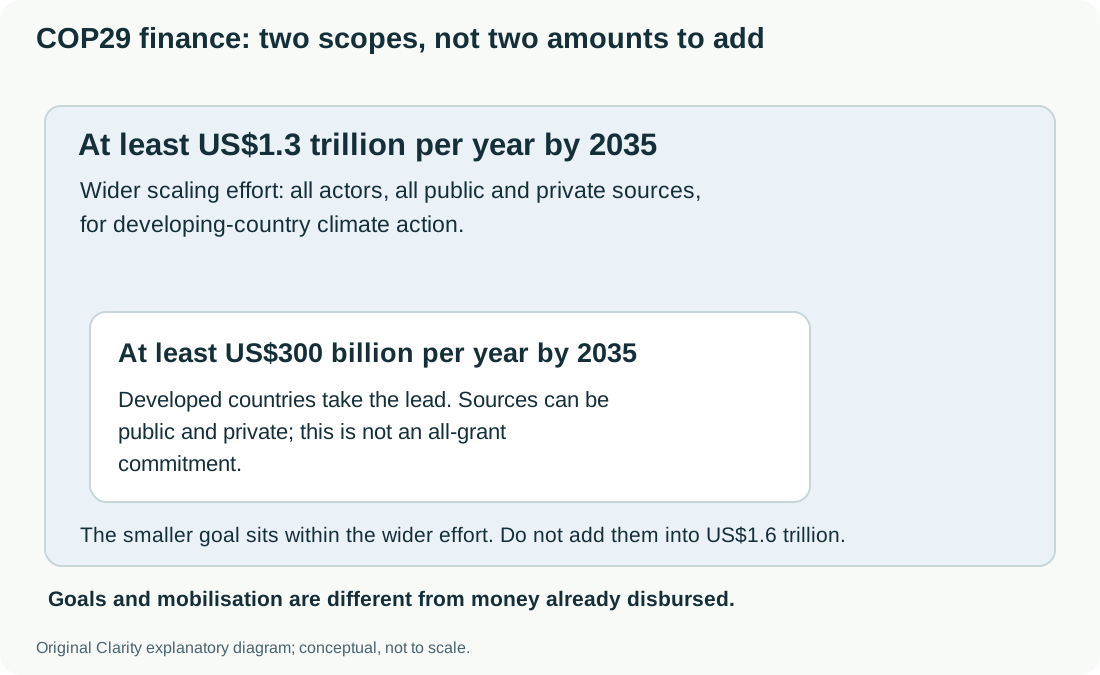
The distinction matters when assessing adequacy. A larger nominal flow can still leave concerns about debt, access and public support unresolved. India criticised the adopted scale of finance as insufficient during COP29.
12. Article 6: cooperation without double counting
Article 6 allows voluntary cooperation in implementing Paris contributions. It includes market-based and non-market approaches. The central challenge is to ensure that cooperation produces credible action. A transferred credit must not become an excuse for counting one reduction twice.
12.1 Article 6.2 and corresponding adjustments
Article 6.2 supports cooperative approaches involving internationally transferred mitigation outcomes. Suppose Country A authorises a qualifying mitigation outcome for Country B's use. Accounting adjustments are needed so the same outcome is not also claimed toward Country A's target in the same way. These are called corresponding adjustments.
This example explains the accounting principle, not every applicable rule. Authorisation, reporting and the purpose of a transfer affect the detailed requirements. A voluntary corporate offset purchase is not automatically identical to a government-authorised Paris transfer.
12.2 Article 6.4 and the UN-supervised mechanism
Article 6.4 establishes a mechanism operating under international supervision. It aims to support mitigation and sustainable development through approved activities and rules. Baselines, additionality, monitoring and safeguards influence the integrity of generated credits. Weak assumptions can exaggerate reductions even when paperwork appears complete.
Additionality asks whether the credited mitigation goes beyond what would otherwise occur under the applicable rules. A project that would happen anyway cannot simply manufacture additional climate benefit through a label. This is why accounting and methodology debates attract substantial attention.
12.3 Article 6.8 covers non-market approaches
Countries can also cooperate without trading mitigation outcomes. Cooperation might connect adaptation, technology, capacity building and policy support. Article 6.8 recognises this broader space for collaboration. Carbon trading is therefore only one part of Article 6.
UPSC's 2025 preliminary examination tested this distinction between carbon-market principles and inter-country non-market strategies. Both belong within Article 6. This is a paraphrased explanation of the examined theme, not a reproduced question or an official answer key.
13. The conference timeline: from Rio to Belém
The conference timeline shows how climate negotiations moved from agreeing principles to defining targets, implementation rules and financial support. Each meeting builds on earlier work. An agreement at one conference may need further decisions before it can operate in practice.
The timeline is easier to retain as a sequence of policy problems. Kyoto addressed developed-country quantified targets. Paris broadened the contribution framework. Subsequent conferences developed rules, assessed collective progress and negotiated implementation support.
Selected milestones in international climate negotiations
| Year and event | Location | Why it matters |
|---|---|---|
| 1992: UNFCCC | Rio Earth Summit | Convention opened for signature; international framework established |
| 1995: COP1 | Berlin | Berlin Mandate advanced negotiations on stronger commitments |
| 1997: COP3 | Kyoto | Kyoto Protocol adopted |
| 2007: COP13 | Bali | Bali Action Plan advanced a broader negotiation process |
| 2009: COP15 | Copenhagen | Copenhagen Accord noted by COP; political pledges and finance commitments gained prominence |
| 2010: COP16 | Cancún | Cancún Agreements advanced institutions including the Green Climate Fund |
| 2011: COP17 | Durban | Negotiation process launched toward the later Paris Agreement |
| 2015: COP21 | Paris | Paris Agreement adopted |
| 2018: COP24 | Katowice | Major Paris implementation guidelines adopted |
| 2021: COP26 | Glasgow | Glasgow Climate Pact and further Paris rules, including Article 6 |
| 2022: COP27 | Sharm el-Sheikh | Loss-and-damage funding arrangements and fund established |
| 2023: COP28 | Dubai | First global stocktake concluded; loss-and-damage fund operationalised |
| 2024: COP29 | Baku | New collective quantified climate-finance goal adopted |
| 2025: COP30 | Belém | Implementation decisions and Belém adaptation indicators |
On smaller screens, swipe across the table to read every column.
14. Recent COPs: Glasgow, Sharm el-Sheikh and Dubai
The 2021–2023 conferences connected stronger emissions action with support for vulnerable countries. Glasgow completed important Paris rules, Sharm el-Sheikh established a loss-and-damage fund, and Dubai operationalised that fund while concluding the first global stocktake.
14.1 COP26 — Glasgow, 2021
The Glasgow Climate Pact called for stronger action during the 2020s to keep the 1.5°C goal within reach. It urged a reduction in unabated coal power and the removal of inefficient fossil-fuel subsidies. Unabated coal refers to coal power whose emissions are not substantially reduced through suitable controls.
Glasgow also completed key Paris implementation rules for Article 6 cooperation and transparent reporting. It urged developed countries to at least double adaptation finance from 2019 levels by 2025. These were negotiated commitments and rules; their adoption did not itself prove delivery.
14.2 COP27 — Sharm el-Sheikh, 2022
At Sharm el-Sheikh in 2022, Parties agreed to establish new funding arrangements and a fund. This responded to longstanding demands from vulnerable developing countries. Work still remained on governance, eligibility, sources and operational details.
Establishing a fund was therefore a major institutional decision, not completed delivery of all required support. The gap between recognition and practical access remained important.
14.3 COP28 — Dubai, 2023
At Dubai in 2023, the first global stocktake concluded that collective action needed strengthening. Its outcome called on Parties to contribute to transitioning away from fossil fuels in energy systems in a just, orderly and equitable manner. It also addressed tripling global renewable-energy capacity and doubling the global average annual rate of energy-efficiency improvement by 2030.
These are global directions within the negotiated text. They do not impose an identical binding national renewable-capacity multiple on every country. The outcome also differs from a treaty clause banning all fossil fuels on a fixed date. Precise verbs and qualifications matter when describing legal effect.
COP28 also operationalised the loss-and-damage fund established at COP27. Initial pledges were a further step, but pledges and disbursements remain different measures.
15. Recent COPs: Baku, Belém and the next meeting
COP29 centred on the scale and structure of future climate finance. COP30 then developed further implementation and adaptation work in Belém. Neither conference removed the need for national policies or delivered every promised financial flow immediately.
15.1 COP29 — Baku, 2024
Baku's NCQG combined the US$300 billion goal with the wider US$1.3 trillion scaling effort. Developing countries raised concerns about adequacy, access and the balance between public and private sources. The outcome illustrates how agreement can coexist with strong dissatisfaction.
The conference also advanced rules and arrangements for Article 6 cooperation. Operational progress does not eliminate integrity concerns. Additionality, double counting, human rights and transparent authorisation remain important tests for actual activities.
15.2 COP30 — Belém, 2025
The 2025 Belém conference adopted 59 Belém Adaptation Indicators under the global goal on adaptation. These provide a framework for assessing progress across relevant adaptation themes. They should not be confused with larger indicator lists considered during earlier technical work.
The Belém political package also called for efforts to at least triple adaptation finance by 2035. Implementation initiatives included the Global Implementation Accelerator and the Belém Mission to 1.5. Their purpose is to support action, while actual outcomes depend on follow-through.
Fossil-fuel transition remained politically contested. Presidency-led roadmap work should be distinguished from formally negotiated decisions. COP30 did not adopt a new universal, binding fossil-fuel phase-out timetable. An accurate account separates decision text, presidency initiatives and announcements by individual coalitions.
15.3 COP31 — Antalya, 2026: the next meeting
COP31 is scheduled for 9–20 November 2026 in Antalya, Türkiye. As of this edition's preparation, it has not taken place. Its future outcomes must not be written as completed decisions.
16. India's climate commitments and negotiating position
India combines development needs with expanding climate action. Its negotiating position emphasises equity, historical responsibility and developed-country support. Domestic implementation must also address energy access, industrial growth, employment and climate vulnerability. These priorities can interact rather than simply cancel each other out.
16.1 Read the 2030 and 2035 targets separately
India's updated 2030 NDC includes reducing gross domestic product (GDP) emissions intensity by 45% from the 2005 level. It also includes about 50% cumulative installed electricity capacity from non-fossil sources, with the stated support conditions. A further target concerns an additional 2.5–3.0 billion tonnes of carbon-dioxide-equivalent sink through forest and tree cover.
India subsequently submitted its 2031–2035 NDC in April 2026, following Cabinet approval in March. It sets a 47% reduction in GDP emissions intensity from 2005 by 2035, a 60% share of non-fossil sources in installed electricity capacity by 2035, and a 3.5–4.0 billion-tonne carbon-dioxide-equivalent sink through forest and tree cover relative to the 2005 level by 2035.
The newer contribution must be read with its full wording, assumptions and support context. It should not be silently substituted into a question explicitly asking about the 2030 NDC.
India's indicators require their own baselines and target years
| Indicator | 2030 contribution | 2035 contribution | Do not confuse with |
|---|---|---|---|
| GDP emissions intensity | 45% reduction from 2005 | 47% reduction from 2005 | An equal percentage reduction in total national emissions |
| Non-fossil installed electricity capacity | About 50% | 60% | The percentage of electricity actually generated |
| Forest and tree-cover carbon sink | Additional 2.5–3.0 billion tonnes CO₂ equivalent | 3.5–4.0 billion tonnes CO₂ equivalent relative to 2005 | An annual emissions allowance or a percentage of tree cover |
On smaller screens, swipe across the table to read every column.
16.2 Intensity, capacity and net zero measure different things
Emissions intensity divides emissions by economic output. If output grows, total emissions can rise even while intensity falls. A 47% intensity reduction therefore cannot be read as a 47% fall in total emissions. The baseline year and GDP measurement also matter.
Installed capacity measures the maximum rated output of electricity equipment. Actual generation depends on utilisation, weather, maintenance and dispatch. Non-fossil capacity includes sources such as renewables and nuclear power. It is not identical to renewable generation.
India's 2070 net-zero goal is a separate long-term commitment. Net zero concerns balancing relevant emissions with removals under defined accounting. It does not mean every activity must emit nothing. The five Panchamrit announcements at Glasgow, formal NDC submissions and long-term strategy should be identified separately.
16.3 Domestic action and implementation challenges
Solar deployment, energy-efficiency programmes and cleaner transport can support mitigation. The National Action Plan on Climate Change also connects energy, water, habitats and knowledge. Its missions include solar energy, enhanced energy efficiency, sustainable habitat, water, the Himalayan ecosystem, Green India, sustainable agriculture and strategic knowledge.
Implementation requires reliable grids, storage, land planning and affordable finance. Adaptation needs resilient agriculture, urban services, heat planning and disaster preparedness. Protecting natural ecosystems can support both biodiversity and climate goals. However, plantations should not automatically be treated as substitutes for native habitats.
16.4 India's priorities at the negotiating table
India argues that stronger action in developing countries requires predictable finance and accessible technology. It also stresses policy space for poverty reduction and development. These positions sit alongside its own NDC and expanding clean-energy deployment.
The strongest evaluation examines both international fairness and domestic delivery. Historical responsibility does not remove the need for effective national action. Domestic ambition also does not erase developed countries' support obligations.
17. Why agreements still fall short
Participation alone does not guarantee sufficient emissions reductions or resilience. National political cycles can disrupt long-term commitments. Finance can arrive slowly or on unsuitable terms. Reporting gaps can make progress difficult to assess.
17.1 Ambition, implementation and trust
An ambition gap exists when planned action falls short of collective goals. An implementation gap exists when policies fail to deliver even the announced plans. The two problems require different responses. Stronger targets address the first; credible institutions, investment and enforcement address the second.
Trust also depends on keeping earlier promises. Disputes over finance delivery can weaken willingness to accept new obligations. Transparent definitions, predictable support and accessible funding can help rebuild confidence. International cooperation becomes more credible when it produces visible local results.
17.2 What a more effective process would require
Better outcomes require stronger domestic policies alongside useful international rules. Countries need investable transition plans, resilient public services and fair treatment of affected workers. Finance should match the needs of the activity and recipient. Public adaptation needs cannot always be met through commercial lending.
Cooperation can also support shared technology, regional grids, research and early-warning systems. Transparent Article 6 accounting can improve credibility where transfers are used. The test is whether institutions help deliver measurable action and resilience.
18. Writing an analytical answer
An answer should explain both what COPs achieve and why implementation remains difficult. Use a specific outcome to support each major point. Avoid treating every conference announcement as a binding obligation.
Question: “International climate negotiations have built an extensive framework, but delivery remains uneven.” Discuss.
The UNFCCC system provides a common forum for addressing a cross-border problem. The Paris Agreement widened participation through national contributions, transparency and a recurring global stocktake. Recent conferences also advanced loss-and-damage funding, adaptation indicators and climate-finance goals.
However, institutional progress does not automatically deliver adequate action. National contributions may fall short of collective temperature goals, while domestic policies may fail to achieve even announced targets. Finance negotiations also reveal disagreements over adequacy, grants, borrowing costs and access. COP29's US$300 billion goal and wider US$1.3 trillion scaling effort illustrate the gap between agreed ambition and practical delivery.
A stronger response requires credible national implementation, transparent reporting and predictable support. Developing countries need accessible finance and technology, while domestic transitions must protect vulnerable households and workers. Adaptation should be assessed through reduced vulnerability rather than expenditure alone.
Climate conferences remain necessary for coordination and accountability. Their success ultimately depends on whether negotiated frameworks produce effective, equitable action within countries and communities.
19. Practice MCQs
These newly written questions test institutions, legal distinctions and the meaning of climate targets. They are separate from the past-exam theme discussed under Article 6.
1. Which body takes decisions specifically under the Paris Agreement?
- CMP
- CMA
- IPCC
- UN Security Council
Answer and explanation
B. CMA is the meeting of Parties to the Paris Agreement. CMP serves Kyoto; COP serves the Convention. The IPCC assesses science.
2. Which country illustrates Annex I membership without Annex II membership?
- India
- Brazil
- Russian Federation
- Japan
Answer and explanation
C. Russia is an Annex I economy in transition and is not in Annex II. Japan appears in both lists; India and Brazil are non-Annex I.
3. CBDR-RC implies that:
- Only developing countries must act
- Every country has an identical numerical target
- Responsibility is shared, while relevant differences influence contributions and support
- Developing countries can never have treaty obligations
Answer and explanation
C. Differentiation recognises responsibility, capabilities and circumstances. It does not eliminate common responsibility or require identical targets.
4. Which statement about the global stocktake is correct?
- It gives each country an annual fine
- It assesses collective progress and informs subsequent action
- It first concluded in 2015
- It replaces national contributions
Answer and explanation
B. The first GST concluded in 2023. It informs further action and support, including later NDCs, rather than replacing them.
5. How should COP29's finance figures be read?
- US$300 billion plus US$1.3 trillion equals a separate US$1.6 trillion obligation
- All US$300 billion must be grants already disbursed
- The US$300 billion goal sits within a broader effort toward at least US$1.3 trillion annually by 2035
- Both figures are India's national budget commitments
Answer and explanation
C. The figures have different scopes and should not be added. The wider effort includes all actors and public and private sources.
6. A corresponding adjustment is primarily intended to prevent:
- Double counting of transferred mitigation outcomes
- Any international technology cooperation
- Publication of national emissions data
- All domestic carbon pricing
Answer and explanation
A. It addresses accounting when authorised mitigation outcomes are transferred. The same reduction must not be claimed twice in incompatible ways.
7. Which pairing is correct?
- Article 6.8—non-market approaches
- Article 6.4—IPCC scientific assessment
- Article 6.2—mandatory identical national targets
- Article 6—only carbon trading
Answer and explanation
A. Article 6 includes both market and non-market cooperation. Its different provisions should be distinguished.
8. If GDP emissions intensity declines while GDP grows rapidly, total emissions:
- Must fall by the same percentage
- Can still increase
- Must become zero
- Cannot be calculated under any circumstances
Answer and explanation
B. Intensity is a ratio. Changes in both the ratio and economic output determine total emissions.
9. Which sequence correctly describes the loss-and-damage fund?
- COP27 established it; COP28 operationalised it
- COP28 established the UNFCCC; COP29 abolished the fund
- The IPCC created it in 1992
- Its establishment automatically compensated all historical losses
Answer and explanation
A. Establishment, operationalisation, pledges and actual disbursement are separate stages. No automatic universal compensation mechanism followed.
10. Which statement accurately reflects the position on 9 September 2026?
- COP31 has already adopted its final decisions
- India has no contribution covering 2031–2035
- COP30 adopted 59 Belém Adaptation Indicators, while COP31 is still scheduled for November 2026
- The Paris Agreement requires every country to generate 60% of electricity from renewables by 2035
Answer and explanation
C. The other options confuse completed and future events, overlook India's April 2026 submission, or turn a national capacity indicator into a universal generation requirement.
20. Frequently asked questions
Use these distinctions when reading a COP headline or interpreting an examination statement.
Are UNFCCC and COP the same thing?
No. UNFCCC is the Convention; COP is its Conference of the Parties. The conference is an institution operating within the treaty framework.
Did the Paris Agreement abolish the Kyoto Protocol?
No. Paris established a newer framework, but it did not simply erase Kyoto's legal instrument. Their governing bodies and institutional histories remain distinct.
Is the Paris Agreement legally binding?
Yes, but different provisions have different legal effects. Duties to prepare, communicate and maintain contributions differ from an internationally imposed guarantee that each numerical target will be achieved. The compliance system is facilitative.
Why is the first global stocktake different from an NDC?
An NDC states a national contribution. The stocktake assesses collective progress toward the Paris goals. Its findings inform later contributions and other action.
Does 60% non-fossil installed capacity mean 60% renewable electricity generation?
No. Installed capacity is rated generating capability, while generation is actual electricity produced. Non-fossil also includes nuclear power, so it is broader than renewable energy alone.
Is loss-and-damage finance the same as adaptation finance?
No. Adaptation seeks to reduce vulnerability and avoid harm. Loss and damage addresses harms that remain, including limits to adaptation. Their activities can be connected, but the concepts are distinct.
Does Article 6 cover only carbon markets?
No. Articles 6.2 and 6.4 address important market-related cooperation, while Article 6.8 recognises non-market approaches. Cooperation is broader than trading credits.
Does a COP decision immediately change every country's domestic law?
No. Legal effects depend on the treaty provision, decision and national legal system. Domestic implementation often requires policies, budgets, regulations or legislation.
21. Sources and further reading
Primary sources used in this chapter are collected here for further reading.
View sources (30)
- USGS image record
- Intergovernmental Panel on Climate Change
- UNFCCC treaty text
- Paris Agreement, Articles 2 and 4
- UNFCCC information on Parties and groups
- SBI
- SBSTA
- UNFCCC guide to the negotiating process
- Kyoto overview
- Paris overview
- Global stocktake
- enhanced transparency framework
- UNFCCC loss-and-damage work
- UNFCCC's COP29 outcome summary
- UNCTAD explanation of the two goals
- UPSC question-paper archive
- UNFCCC Article 6 resources
- Official COP31 page
- UNFCCC COP27 record
- UNFCCC COP28 record
- UNFCCC global goal on adaptation
- COP30 Mutirão decision
- India's submitted 2031–2035 NDC
- Cabinet announcement
- UNFCCC NDC registry
- COP30
- UNFCCC: Conference of the Parties and its annual meetings
- UNFCCC: the Kyoto Protocol governing body
- UNFCCC: the Paris Agreement governing body
- UNFCCC: key outcomes from COP26