

Why in news?
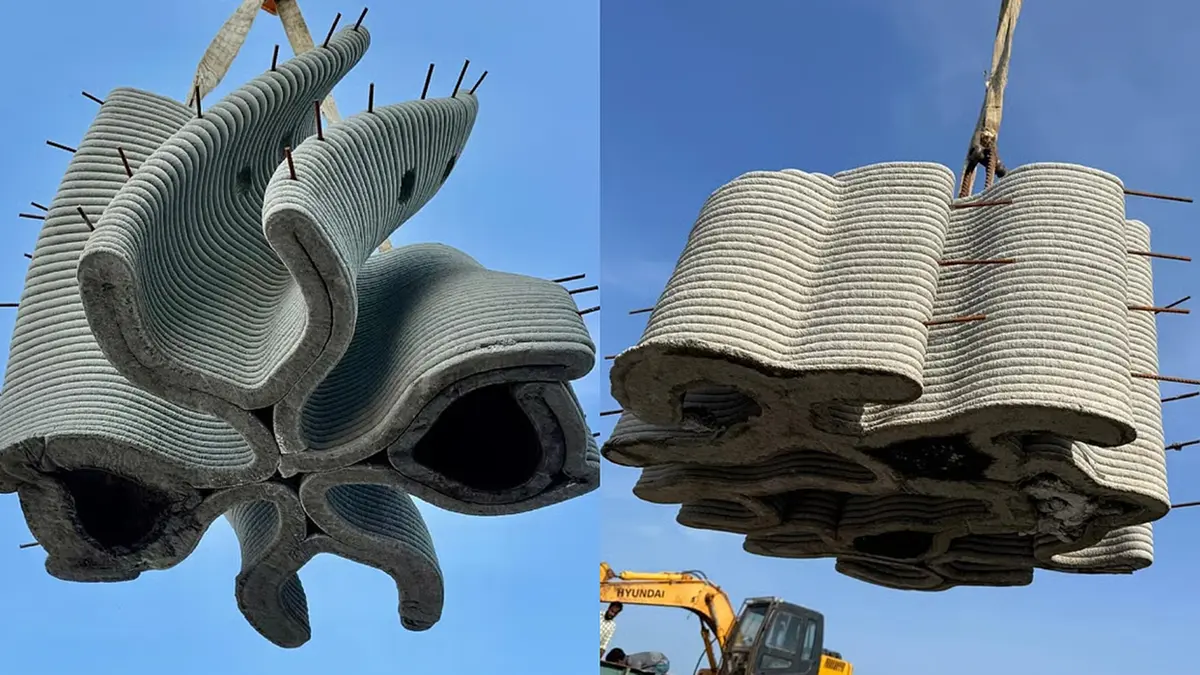
Tamil Nadu will soon deploy India’s first 3D‑printed artificial reef modules off the Ramanathapuram coast under the second phase of the Pradhan Mantri Matsya Sampada Yojana. The project aims to restore marine habitats and enhance fish populations using innovative technology.
Background
Artificial reefs provide hard surfaces for corals, fish and invertebrates to colonise. Traditional reefs are made from concrete blocks or decommissioned structures. Recent advances in 3D‑printing allow complex geometries that better mimic natural habitats. Under the Pradhan Mantri Matsya Sampada Yojana, states receive support to modernise fisheries and promote sustainable practices.
Project details
- Design and deployment: Six reef designs, each weighing about one tonne, were developed by Tvasta, an IIT Madras‑incubated startup, in collaboration with the Visakhapatnam Regional Centre of the ICAR‑Central Marine Fisheries Research Institute. Modules will be installed about two nautical miles offshore as a pilot project.
- Features: Unlike conventional reinforced concrete structures, the 3D‑printed modules have complex shapes with crevices, folds and attachment points for marine life. They use porous materials without iron reinforcement, offering greater surface area and habitat diversity while reducing corrosion.
- Advantages: 3D‑printing accelerates fabrication, reduces labour needs and allows material composition to be tailored for specific ecological conditions. By providing shelter and breeding grounds, artificial reefs can help replenish fish stocks depleted by overfishing or habitat loss.
Conclusion
The pilot deployment of 3D‑printed artificial reefs represents a promising blend of technology and conservation. If successful, similar modules could be scaled up along India’s coasts to support fisheries and restore degraded marine ecosystems.