
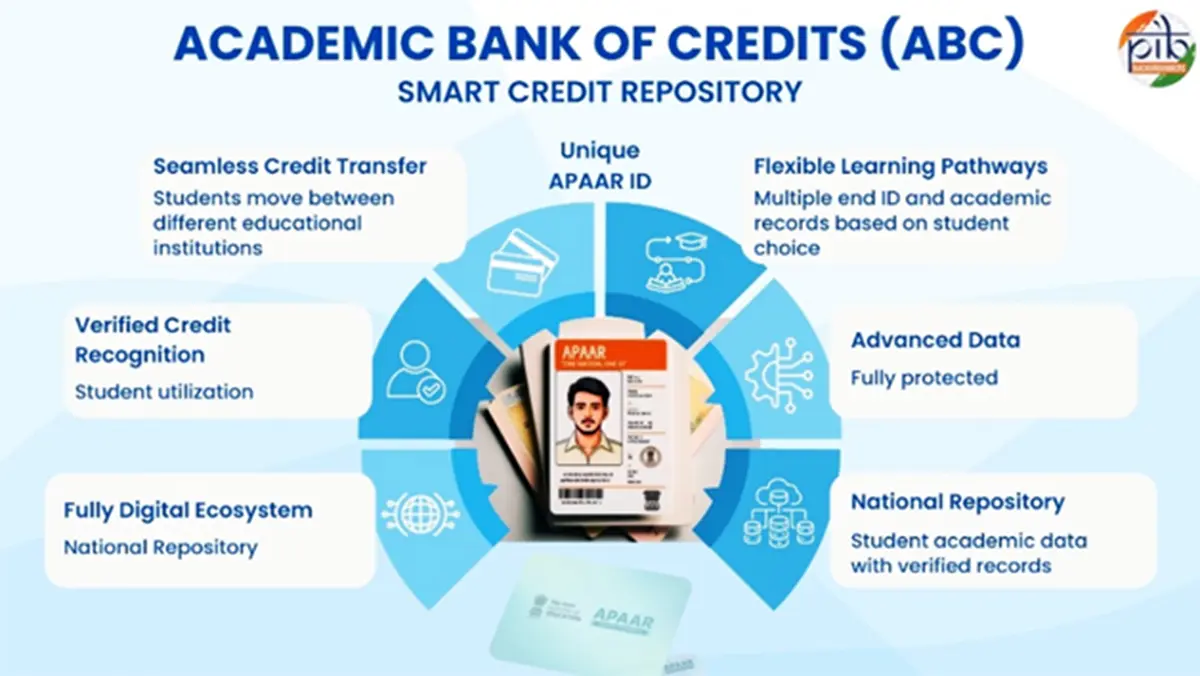
Why in news?
The Ministry of Education has been promoting the Academic Bank of Credits (ABC) platform and the APAAR (One Nation, One Student ID) to streamline higher education. The system aims to allow students to store, transfer and redeem academic credits digitally across universities. Recent initiatives encourage institutions to integrate their courses with the platform.
Background
The National Education Policy 2020 advocates flexible curricula, multiple entry and exit options and academic mobility. The UGC framed rules in 2021 to create an Academic Bank of Credits, a digital credit repository for every student. Students receive an APAAR ID linked to their Aadhaar number and DigiLocker. Credits earned from courses can be stored for at least seven years, transferred between institutions and redeemed towards degrees or diplomas. Only recognised institutions can upload credits to ensure authenticity.
How the ABC works
- Unique ID: Every student gets a 12‑digit APAAR number. This serves as a lifelong academic account linked to the student’s identity.
- Credit deposit: When a student completes a course, the institution deposits the credits into the student’s account on the ABC portal. Credits remain valid for seven years.
- Credit transfer: Students may change institutions or take courses on platforms like SWAYAM. With the ABC system they can transfer accumulated credits and avoid repetition of courses.
- Redeeming credits: Once a student earns sufficient credits to meet the requirements of a degree, diploma or certificate, they can redeem them at a participating institution.
- Transparency and mobility: The single repository reduces paperwork and speeds up recognition of credits. It encourages lifelong learning and mobility within India’s higher education system.
Conclusion
The Academic Bank of Credits and APAAR ID represent a shift toward flexible, student‑centred education. They simplify credit accumulation, support open learning and aim to break the rigidness of traditional programmes. Successful implementation depends on widespread adoption by universities and awareness among students.