

Why in news?
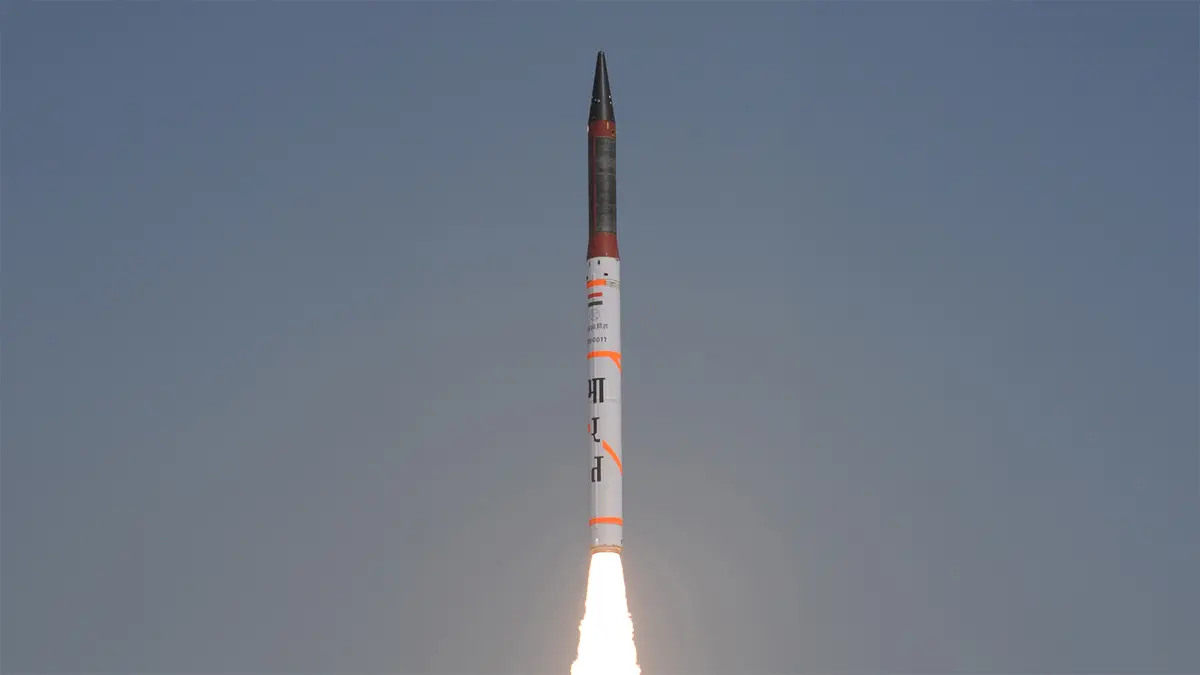
India successfully test-fired the Agni-4 ballistic missile on 6 August 2026. The launch took place at Chandipur’s Integrated Test Range in Odisha. The Ministry of Defence said all operational and technical parameters were validated; the Strategic Forces Command conducted the launch.
What Agni-4 is
Agni-4 is an indigenously developed, road-mobile ballistic missile. It travels from a surface launcher to a surface target. Official material from its November 2011 first launch describes two solid-propellant stages. It also records a re-entry heat shield.
Other features include composite rocket motors and redundant avionics. Ring-laser gyroscopes support its inertial navigation.
A micro-navigation system provides additional support; later government summaries place the missile’s reach near 4,000 kilometres.
A ballistic missile receives propulsion during early flight; it then follows a high and largely unpowered trajectory. Its re-entry vehicle descends at great speed. Solid propellant permits longer storage and reduces preparation compared with many liquid systems.
Road mobility makes launch units harder to locate; it also gives commanders more deployment choices.
Operational procedures, accuracy and warhead configurations are sensitive. Claims beyond official disclosures require caution.
Medium-range or intermediate-range?
The August 2026 release calls Agni-4 a “Medium Range Ballistic Missile”. Ministry releases in 2022 and 2024 used “Intermediate Range Ballistic Missile”. Official records still describe a reach of roughly 4,000 kilometres; the terminology therefore varies across Indian releases.
A careful account quotes the current term and records the earlier classification. It should not invent an unannounced technical change.
Why the Strategic Forces Command matters
The Strategic Forces Command operates India’s strategic nuclear delivery systems; it works within a civilian-controlled command structure. Its role signals an operational user launch. The event was not merely a laboratory experiment by the defence research organisation.
The 2022 Agni-4 test was explicitly called a routine user-training launch; that event also validated reliability.
The shorter 2026 release does not call this test “routine”; it discloses no chosen range, payload or trajectory.
Repeated testing can check both ageing and newly produced components. It also confirms that crews and range systems can execute procedures. Telemetry supports quality assurance. Testing covers the chain from launch preparation through tracking and re-entry.
The Ministry says all operational and technical parameters were validated. It supplied no public data for independent measurement.
That phrase must not become an unsupported claim of pinpoint accuracy; it also proves no new capability.
Strategic implications
Agni-4 contributes to India’s policy of credible minimum deterrence. Deterrence requires a secure retaliatory capability; an adversary must believe that capability can survive a first strike. It must also function when lawful orders arrive.
Mobility, reliable solid-fuel systems and dispersed basing strengthen credibility. Tested command procedures do the same.
The objective is to prevent coercion or nuclear attack; a missile test is not a conventional battlefield success.
Credibility also requires restraint and command safety. Political control and secure communications are as important as range. Systems must prevent unauthorised or accidental use. Public fact should remain separate from speculation.
Advance air and maritime arrangements reduce risks to civilian traffic. Limited public disclosure can support transparency without revealing secrets.
Useful releases identify the date, facility and responsible command; they can also give the broad test result.
One successful launch does not transform the regional strategic balance. It shows an established system remains in its operational test cycle. Maximum-range comparisons omit survivability, warning systems and doctrine. They also ignore force size and crisis communication.
Strategic stability needs credible capability and predictable signals. Political communication channels must remain open.
Conclusion
The 6 August test met the government’s stated objectives for Agni-4; the Strategic Forces Command carried it out. The launch helps maintain an established deterrent system and its institutions. Official records support range, propulsion and mobility claims.
They do not support dramatic claims about accuracy or payload. Technical restraint is therefore essential.