

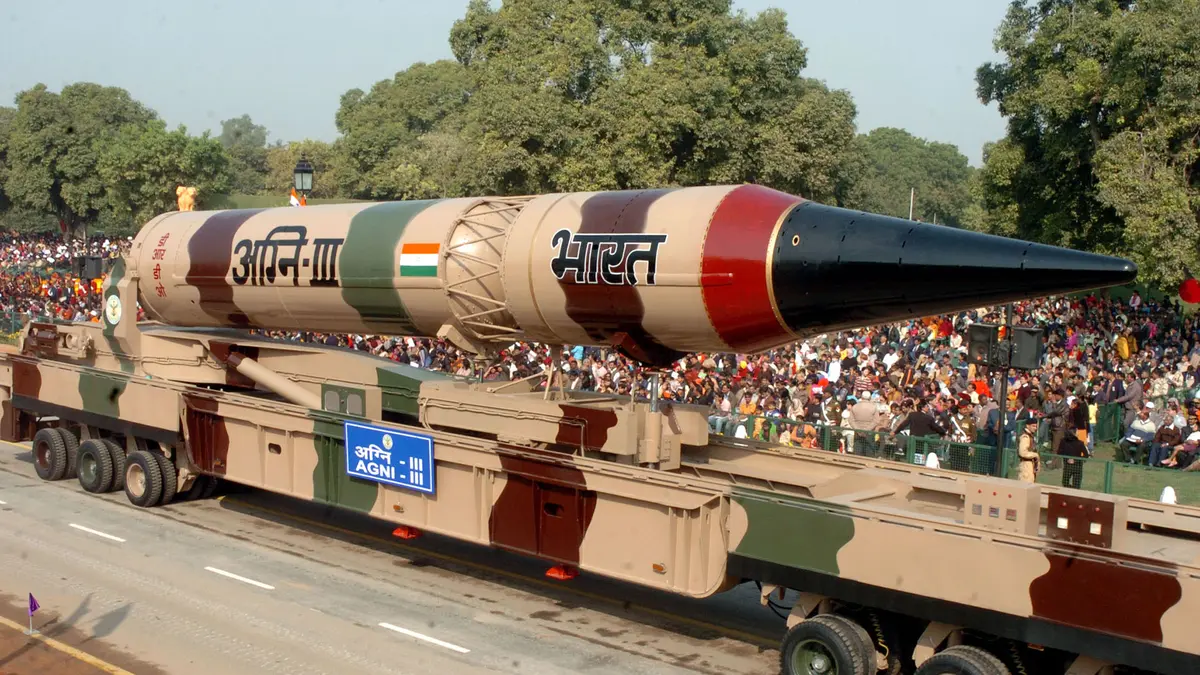
Why in news?
The Strategic Forces Command successfully test‑fired the Agni‑3 intermediate‑range ballistic missile from the Integrated Test Range at Chandipur, Odisha. The launch on 6 February 2026 validated all technical parameters and underscored India’s nuclear deterrent capability.
Background
The Agni series of missiles, developed by the Defence Research and Development Organisation (DRDO), forms the backbone of India’s land‑based nuclear deterrent. Agni‑3 was first tested in 2006 and entered service around 2011. It fills the gap between shorter‑range missiles and the longer‑range Agni‑4 and Agni‑5, providing the ability to reach targets deep inside potential adversaries’ territories.
Features of Agni‑3
- Design: A two‑stage, solid‑fuelled ballistic missile with a length of approximately 16.7 m, diameter of 2 m and launch weight around 48 tonnes.
- Range and payload: Capable of delivering a 1,500 kg payload (nuclear or conventional) over 3,000–3,500 km. The missile uses maraging steel and carbon‑fibre motor casings for lightness and strength.
- Navigation and accuracy: Equipped with a strapdown inertial navigation system supported by GPS, giving it a circular error probable of about 40 m. Thrust vector control systems improve stability and accuracy.
- Role: Designed primarily for nuclear delivery as part of India’s “credible minimum deterrence” doctrine. Its range covers strategic targets in the region, reinforcing second‑strike capability.
Significance
- Strategic deterrent: Agni‑3 strengthens India’s nuclear triad and signals technological maturity in missile development.
- Operational readiness: Repeated test‑firings ensure the missile’s reliability and readiness for deployment by the Strategic Forces Command.
- Technological advances: The integration of advanced materials and navigation systems demonstrates DRDO’s capability to produce accurate and robust delivery systems.
Source: Press Information Bureau