
Why in news?
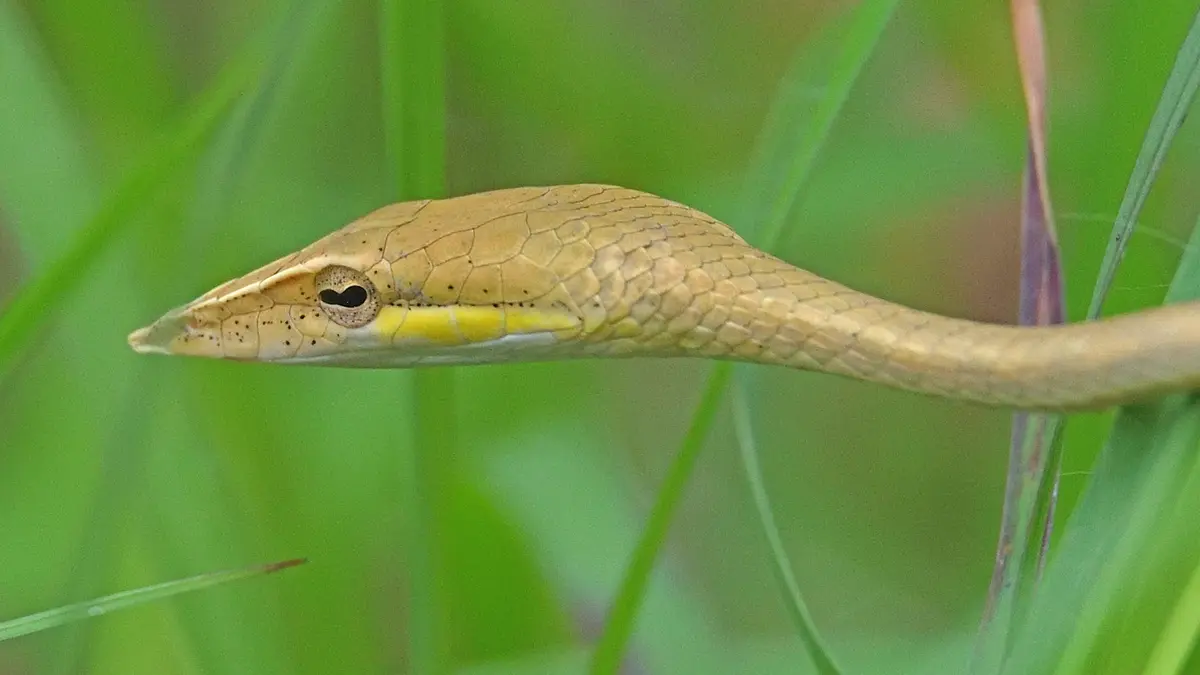
A Laudankia vine snake was photographed near Udaipur on 12 July 2026. It was found in the Ubeshwar wildlife area. This was the area’s first documented record in nearly three decades. The sighting confirms the snake’s continued local presence.
Background
The Laudankia vine snake is slender and tree-associated; its scientific name is Ahaetulla laudankia.
It belongs to the family Colubridae and subfamily Ahaetuliinae; scientists formally described the species in 2019.
The 2026 photograph was therefore a local rediscovery for Udaipur, not a new species discovery.
Do not confuse the dates: Scientists described the species in 2019; Udaipur recorded it again in July 2026.
How was the species recognised scientifically?
Researchers examined rare brown vine snakes collected from different Indian regions.
They compared external features, body scales, colour patterns and genetic evidence.
The evidence separated these specimens from previously known vine snake species.
A research team then published the formal description in 2019.
The original study recorded a range from the Eastern Ghats to eastern Rajasthan.
Only three specimens were obtained during nine years of fieldwork.
This small number showed how difficult the snake was to encounter.
Why is it called “Laudankia”?
The species name is linked with the Odia word “laudanka”.
The word refers to the dried stem of a bottle gourd plant.
The snake’s long brown body resembles a dry stem, helping it remain unnoticed among branches and vines.
How can the snake be recognised?
- Its slender, vine-like body usually has a chestnut-brown upper surface.
- Fine dark speckles occur along the body, while pale markings may appear below the head.
- A narrow, pointed snout accompanies large eyes with horizontal pupils.
Reports place adult length between about 80 centimetres and 1.5 metres.
Colour and size vary with age, locality and observation conditions; trained specialists should therefore examine photographs.
Where and how does it live?
The snake occurs in dry deciduous forest, scrub and vegetated hill country.
It is arboreal, which means it spends much of its time on vegetation.
It is also diurnal, meaning that it is mainly active during daylight.
Its slim body supports movement through vegetation, while its brown colour provides camouflage against dry twigs and stems.
The snake feeds upon lizards, geckos, small frogs and sometimes small birds.
Like other predators, it helps regulate populations of smaller animals.
What happened during the Udaipur sighting?
The snake was photographed in the Ubeshwar wildlife area on 12 July 2026.
Wildlife photographer Rohit Dwivedi documented the animal; local naturalists helped identify and verify the unusual record.
The last documented Udaipur record came from roughly three decades earlier.
The long interval may reflect low detectability rather than local disappearance.
A camouflaged tree snake can remain present without appearing in formal records.
Is the species endemic to India?
The 2019 description treated it as an Indian endemic; “endemic” means naturally restricted to a particular geographical area.
A peer-reviewed study reported the snake from Nepal in 2020, extending its known range beyond India.
Therefore, the strict “endemic to India” description is now outdated.
Updated distribution: The snake was first described from India, but a later Nepal record removed strict Indian endemism.
How has its known range expanded?
- The 2019 description covered sites from the Eastern Ghats to eastern Rajasthan.
- A 2020 publication recorded the species in Shuklaphanta National Park, Nepal.
- A 2021 paper documented it from Assam in northeastern India.
- A 2023 report extended records to Palghar district in Maharashtra.
- The July 2026 observation confirmed its continued presence near Udaipur.
New records can reflect better surveys rather than a recent biological expansion.
Is the snake dangerous to people?
The species is rear-fanged and mildly venomous; its rear fangs sit farther back in the upper jaw.
The venom mainly subdues small prey; it is not normally considered a serious danger to humans.
However, no wild snake should be handled without proper expertise.
A bite requires medical advice, especially when the species is uncertain.
Does a rare sighting mean the species is threatened?
Not necessarily; “rarely seen” and “threatened” describe different things.
A species can be hard to observe because of camouflage and secretive behaviour.
A threatened category requires evidence about population decline, range and pressures.
The Udaipur sighting provides a distribution record, not a complete population assessment.
Repeated surveys are needed before drawing broader conservation conclusions.
Why is the record useful?
- It confirms that suitable habitat remains near Udaipur.
- It improves knowledge of the species’ western distribution.
- It can guide future surveys in dry forest and scrub.
- It shows the value of careful photographic documentation.
- It reminds planners that lesser-known reptiles also need habitat protection.
Conclusion
The Udaipur record fills a long local information gap; it also shows how new evidence changes accepted species descriptions.