
Why in news?
The Algoza (also called Alghoza) gained attention recently when folk musician Taga Ram Bheel from Rajasthan’s Thar Desert received the Padma Shri award for preserving and promoting this rare woodwind instrument. The award honours his decades‑long efforts to keep the tradition alive.
Background
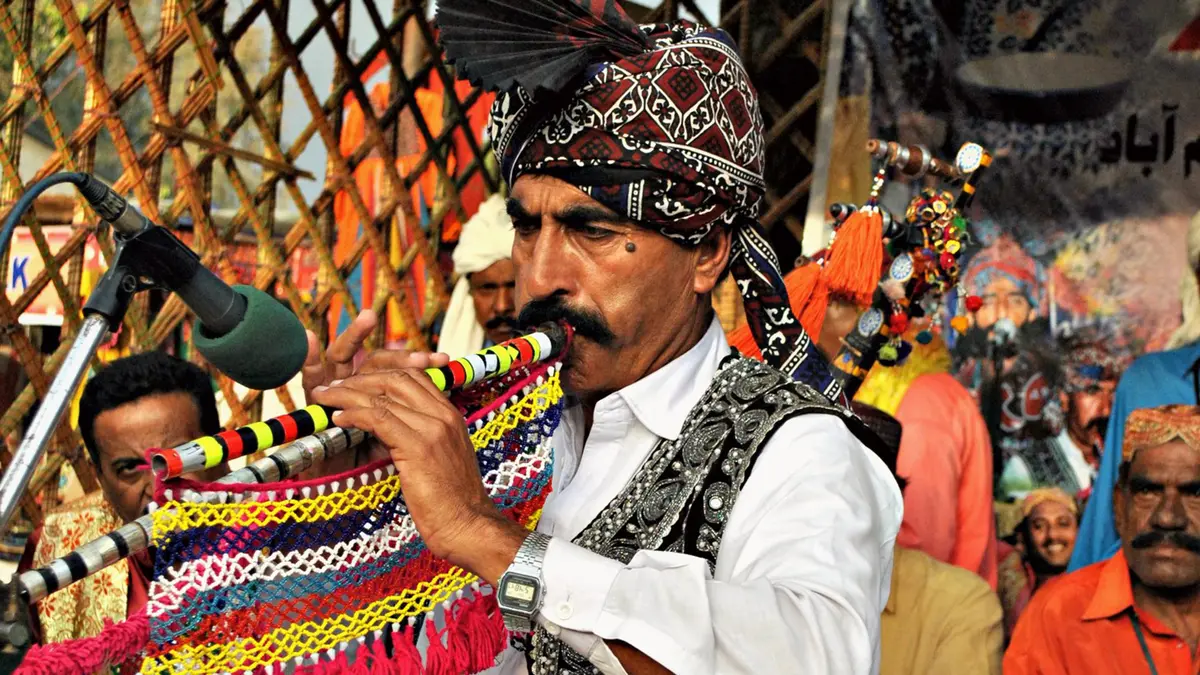
The Algoza is a pair of wooden flutes bound together and played simultaneously. One flute produces the melody while the other provides a continuous drone. Both flutes are either tied together or held loosely in the hands. To sustain sound, the player blows into both flutes at once, rapidly recapturing breath on each beat to create a bouncing rhythm. According to ethnomusicologists, similar double flutes were used in Mesopotamia as early as 7500 BC. The instrument later spread to Iran and the Indian subcontinent, where it became popular among Sindhi, Rajasthani, Punjabi, Saraiki and Baloch folk musicians.
Structure and playing style
- Two flutes: The traditional setup consists of two beak‑shaped flutes of bamboo or hardwood. Over time one flute is often made shorter than the other to create tonal contrast. The longer pipe is regarded as the “male” and the shorter as the “female” flute.
- Continuous airflow: Players must maintain a continuous stream of air into both flutes. Quick inhalation between phrases allows for uninterrupted music.
- Drone and melody: One pipe usually holds a steady drone note while the other plays melodic phrases, giving the music a hypnotic quality reminiscent of folk songs from Rajasthan and Punjab.
- Tuning with beeswax: Small plugs of beeswax can be applied to the finger holes to adjust pitch. This allows musicians to retune the instrument to different scales.
Cultural significance
- Desert folk heritage: The Algoza is integral to the musical traditions of the Thar Desert and the Indus Valley region. It accompanies ballads, devotional songs and folk dances.
- Oral transmission: Knowledge of the instrument has been passed down orally through generations. Modern education and urbanisation have reduced the number of practitioners, making preservation efforts critical.
- Taga Ram Bheel’s contribution: Hailing from a marginalised community in Jaisalmer, he learned the Algoza while herding goats and later performed at festivals across India and abroad. His Padma Shri recognition highlights the cultural value of folk music and inspires younger generations to take up traditional arts.
Conclusion
The Algoza’s haunting twin‑pipe sound is a unique part of India’s musical tapestry. Recognition of artists like Taga Ram Bheel draws attention to endangered folk instruments and encourages efforts to document, teach and revive them for future generations.