

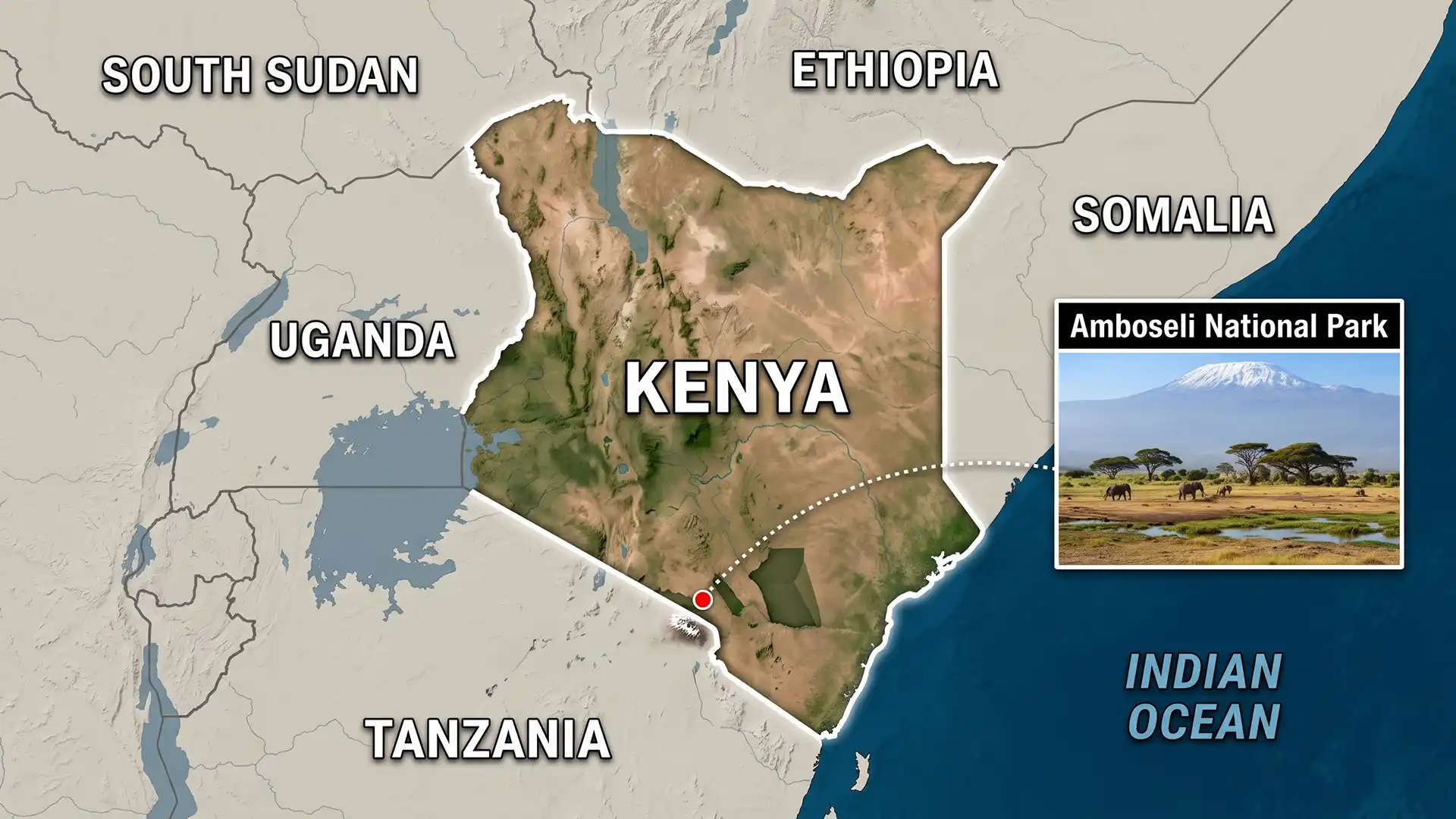
Why in news?
Kenyan authorities investigated unusual elephant deaths around Amboseli. Fifteen animals died between 24 June and 24 July 2026. Several showed weakness or paralysis before dying. The cause remained unconfirmed during the initial investigation.
Background
Amboseli lies in southern Kenya near the border with Tanzania. Mount Kilimanjaro rises across that border and dominates the wider landscape. Underground flows from its catchment help feed Amboseli's freshwater swamps.
Kenya gazetted Amboseli National Park during 1974; the park covers about 392 square kilometres. However, elephants move through a much larger ecosystem containing community lands, ranches and conservancies.
The United Nations Educational, Scientific and Cultural Organization recognised the wider Amboseli area as a biosphere reserve during 1991. That reserve covers about 798,298 hectares. It includes people, livestock, wildlife and varied land uses.
The deaths and investigation
Kenya Wildlife Service recorded fifteen deaths across the ecosystem through 24 July. Carcasses occurred inside the park, Kimana Sanctuary and Kuku Ranch. Therefore, not every animal died within the national park.
Ten elephants reportedly developed partial paralysis and could not stand; they died within one or two days. Most affected animals were adult females or calves, while only one was an adult male.
Five carcasses were too decomposed for examination; university investigators detected a possible toxic substance elsewhere. Initial government-chemist tests did not confirm the toxins examined.
Teams also collected environmental samples; Kenya Wildlife Service initially found no evidence of a transmissible public-health threat. Investigators nevertheless kept poisoning, disease and environmental exposure under review.
Why the pattern raised concern
A clustered mortality event can indicate contamination, disease or a shared food source. Neurological signs strengthen concern about toxins but cannot identify a chemical alone. Laboratory confirmation, exposure history and tissue examination must support any conclusion.
Female deaths can have long demographic effects within elephant societies. Herds depend upon experienced matriarchs for movement and resource knowledge. Calf survival may also fall when mothers or close relatives die.
Amboseli elephants cross boundaries, so investigations require cooperation among wildlife officers, landowners and pastoral communities. Restricting analysis to the park would miss important exposure routes.
Protected-area distinctions
A national park is created and managed under Kenyan law. A biosphere reserve supports conservation, research and sustainable human use across a larger landscape. These designations have different boundaries and purposes.
Amboseli National Park entered Kenya's tentative World Heritage list during 2023. A tentative listing is only a possible future nomination. It is not the same as inscription on the World Heritage List.
Elephants, water and surrounding communities
Amboseli's elephants depend upon wetlands that also support livestock and household livelihoods around the reserve. Drought concentrates animals and contaminants around limited water, while rain may move pollutants through connected channels.
Elephants leave the park for forage and water, crossing private, communal and conserved land. Fencing can obstruct these movements, so protected corridors matter as much as internal park habitat.
Communities bear costs from crop loss and dangerous encounters, requiring rapid compensation and practical prevention. Tourism income should reach people protecting migration space, while investigations should avoid premature blame.
A robust inquiry should preserve samples and combine veterinary pathology with toxicology and environmental testing. Publishing tested substances and results can guide future responses across African elephant landscapes.
Conclusion
The Amboseli deaths require cautious, transparent investigation across the entire ecosystem. Premature certainty could misdirect conservation action and weaken public trust.