
Why in news?
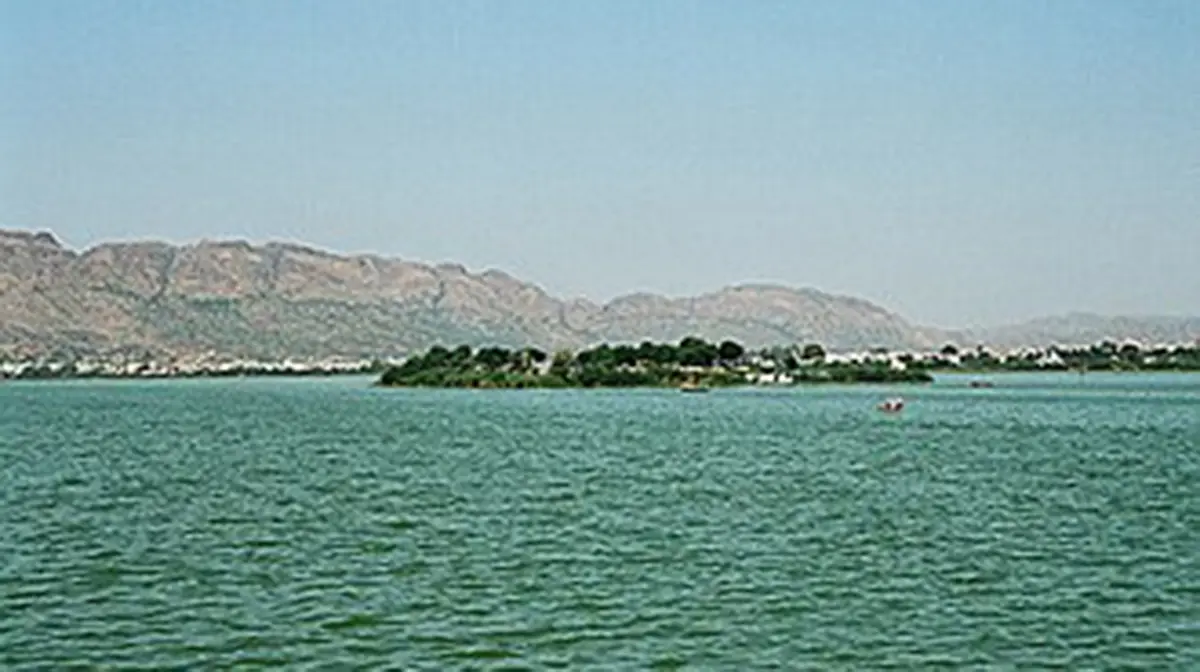
Large numbers of fish died in Ajmer’s Ana Sagar Lake. Residents also reported foul smell around the waterbody. Municipal officials began removing dead fish from the affected shoreline. The episode renewed concern about sewage, desilting and falling oxygen levels.
Background
Ana Sagar is a historic artificial lake in Ajmer, Rajasthan; artificial means people created or enlarged the waterbody through engineering.
The lake has supported water storage, recreation and Ajmer’s urban landscape.
It now receives pressure from dense construction, drains and changing water levels.
How did the lake develop?
- Chahamana ruler Arnoraj commissioned the lake during the twelfth century.
- Official tourism records place its construction between 1135 and 1150.
- Arnoraj was also known as Anaji; the lake’s name remembers him.
- Mughal emperor Jahangir later developed Daulat Bagh beside the lake.
- Emperor Shah Jahan added five marble pavilions, called Baradaris.
- Later rulers and governments maintained the lake as an urban landmark.
A Baradari is an open pavilion traditionally designed with twelve doorways.
Its open sides improve airflow and provide views across the water.
Prelims sequence: Arnoraj built the lake; Jahangir added Daulat Bagh; Shah Jahan added the Baradaris.
What happened in July 2026?
Reports described repeated fish deaths during the days before 19 July.
Municipal teams removed carcasses to control smell and secondary contamination.
Political representatives alleged that recent lake-management work worsened conditions; a court petition also questioned desilting and water-pumping decisions.
Officials had lowered water levels before the monsoon for desilting work.
Delayed rainfall reportedly left a smaller and more polluted water volume.
Drain inflows may then have placed additional pressure upon aquatic life.
Evidence caution: News reports gave varying fish counts; only scientific testing can confirm the exact cause.
Students should not present any political allegation as a proven laboratory finding.
Why can fish die together?
Fish need dissolved oxygen inside water for respiration; dissolved oxygen is shortened to DO, after explaining the term.
Sewage brings organic matter and nutrients into a lake; microorganisms consume oxygen while decomposing this organic matter.
Warm water also holds less oxygen than cooler water; shallow, stagnant water can therefore become dangerous very quickly.
- Nitrogen and phosphorus enter through sewage or runoff.
- Algae and fast-growing aquatic plants may then spread across the water.
- This excessive growth later dies and begins decomposing inside the lake.
- Microbial decomposition consumes large amounts of dissolved oxygen.
- Fish become stressed, gather near the surface and may die.
This nutrient-driven process is called eutrophication; it can continue for years when pollution remains untreated.
What is biochemical oxygen demand?
Biochemical oxygen demand measures oxygen used while microbes break down organic matter; it is shortened to BOD.
A high BOD usually indicates a heavy organic pollution load; high BOD often produces low DO for fish.
| Indicator | What it tells us | Danger signal |
|---|---|---|
| Dissolved oxygen | Oxygen available within water | Very low values can kill fish |
| Biochemical oxygen demand | Oxygen used during microbial decomposition | High values suggest strong organic pollution |
| Nutrients | Nitrogen and phosphorus supporting plant growth | Excess can cause algal blooms |
| Temperature | Water’s thermal condition | Higher temperature lowers oxygen-holding capacity |
Could desilting itself kill fish?
Desilting removes accumulated mud and can restore storage capacity; however, poorly timed work can disturb polluted bottom sediment.
Water removal can also crowd fish into a smaller volume; machines may increase turbidity and reduce suitable refuge areas.
Turbidity means cloudiness caused by suspended particles; these are possible mechanisms, not proof for this particular event.
Investigators need water samples, fish examinations and work records.
Why is lake management difficult?
- A lake receives pollution from its entire surrounding catchment.
- Cleaning only the visible water cannot stop dirty drain inflows.
- Desilting may fail when sewage adds fresh organic matter daily.
- Low water levels concentrate pollution during hot weather.
- Several agencies may control drains, land, tourism and sanitation.
A catchment is the land area draining rainfall towards a waterbody.
Effective restoration must therefore begin beyond the lake’s immediate shoreline.
What should an immediate response include?
- Dead fish should be removed safely and recorded systematically.
- Officials should test DO, BOD, nutrients, toxins and pathogens.
- Temporary aeration can raise oxygen during an emergency.
- Untreated sewage entry should be identified and stopped.
- Desilting methods should protect surviving fish and water quality.
- Results should be published for public understanding and accountability.
Aeration adds air or oxygen to water through mechanical movement.
It offers temporary relief but does not remove the pollution source.
Why does Ana Sagar matter?
- It is an important surviving example of medieval water engineering.
- Its Mughal additions show later layers of Ajmer’s history.
- The lake supports recreation, tourism and urban cooling.
- Open water can provide habitat for resident and visiting birds.
- Its condition reflects the quality of Ajmer’s wider drainage system.
Conclusion
Ana Sagar’s fish deaths show that heritage protection must include scientific water management.